


Chinese energy storage company HiTHIUM has signed a three-year, 1 GWh supply agreement with Vietnam-based DSS Solar while simultaneously unveiling what it describes as the world’s first native 8-hour long-duration energy storage system, positioning the company as a direct commercial participant in Vietnam’s rapidly expanding but severely underbuilt battery storage sector.
HiTHIUM moved on June 3, 2026, to contract 1 GWh of storage supply for Vietnam’s residential, commercial, and industrial markets over three years, pairing the deal with the public launch of its ∞Power 6.9 MWh BESS at the SNEC 2026 solar exhibition in Shanghai. Vietnam’s installed BESS capacity stood below 100 MW as of early 2025 against a revised Power Development Plan VIII target of 10,000 to 16,300 MW by 2030, making the country one of the largest storage deployment gaps in the region.
Key Facts At A Glance
- HiTHIUM’s ∞Power 6.9 MWh BESS is designed natively for 8-hour discharge, powered by a newly developed 1300Ah battery cell, and rated for a 25-year operational life
- The system delivers over 6.9 MWh from a standard 20-foot container, incorporating multi-layer protection mechanisms and low global warming potential coolants
- HiTHIUM also unveiled the ∞Cell 650Ah large-capacity battery and a ∞Power 10+ MWh product solution at SNEC 2026
- The three-year cooperation agreement with DSS Solar covers 1 GWh of storage deployment across Vietnam’s residential, commercial, and industrial segments
- Vietnam’s revised PDP8 raised the national BESS target from a prior 300 MW to 10,000–16,300 MW by 2030; installed capacity as of early 2025 was under 100 MW
- Vietnam’s Circular 62/2025/TT-BCT, effective January 26, 2026, established the country’s first standardised two-part tariff pricing framework for utility-scale BESS, applying to projects of 10 MW or more at voltages of 110 kV or above
- The Vietnam energy storage market is projected to reach approximately USD 6 billion by 2030
The Product
On June 3, 2026, HiTHIUM exhibited at SNEC 2026 in Shanghai the ∞Power 6.9 MWh BESS, which the company described as the first commercially introduced system designed natively for 8-hour long-duration energy storage. The distinction matters technically: most grid-scale BESS deployed globally today is configured for 2-to-4-hour discharge, a duration suited to managing daily solar generation peaks but insufficient for overnight balancing or multi-hour demand events. A system engineered from the cell level for 8-hour discharge represents a qualitatively different product category than a conventional 2-hour system scaled up.
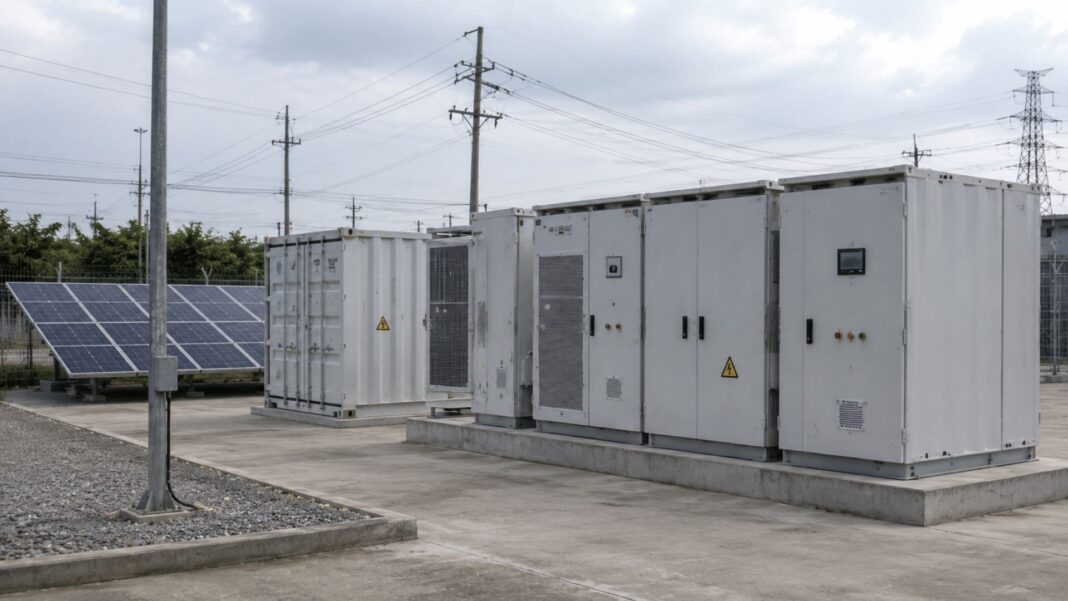
The unit runs on a newly developed 1300Ah battery cell and fits within a standard 20-foot container footprint. HiTHIUM said the design targets an operational life of 25 years, incorporates multi-layer protection systems and intelligent battery management, and uses low global warming potential coolants with recyclable structural components. At the same exhibition, the company also unveiled the ∞Cell 650Ah large-capacity battery and a companion ∞Power 10+ MWh product configuration, which extends the system’s capacity ceiling further.
HiTHIUM’s broader portfolio displayed at SNEC 2026 covers the full 1-to-8-hour range across lithium-ion and sodium-ion chemistries, including the ∞Power 6.25 MWh system for 2-to-4-hour applications, the ∞Cell N162Ah sodium-ion cell paired with a ∞Power N2.28 MWh 1-hour system, and commercial and industrial cabinet products at 261 kWh and 418 kWh. The company describes its technology strategy as a dual roadmap across lithium-ion and sodium-ion, aiming to match chemistry to application duration rather than applying a single cell architecture across all use cases.
The Vietnam Deal
On the sidelines of SNEC 2026, HiTHIUM signed a three-year, 1 GWh strategic cooperation agreement with DSS Solar, a Vietnam-based solar developer and distribution company. The agreement covers deployment across Vietnam’s residential, commercial, and industrial storage segments, combining HiTHIUM’s manufacturing and supply chain capabilities with DSS Solar’s local project development network and customer channels. No financial terms or individual project specifications were disclosed in available public reporting.
The timing is deliberate. Vietnam’s energy storage market is entering its first phase of commercially structured activity after years of policy ambiguity. The country’s Ministry of Industry and Trade issued Circular 62/2025/TT-BCT in December 2025, effective January 26, 2026, which established the first standardised pricing framework for standalone, grid-connected BESS in Vietnam. The circular applies to utility-scale projects of 10 MW or more at voltage levels of 110 kV or above, and introduces a two-part tariff that compensates BESS developers for both grid availability and actual energy delivery, as opposed to the energy-only model that had previously characterised Vietnam’s nascent storage sector. The framework also sets a 12% internal rate of return benchmark and establishes a standardised power purchase agreement structure, elements that financial institutions have indicated are necessary for BESS projects to attract project finance.
The structural context makes the revenue signal significant. Vietnam’s revised PDP8, approved by Prime Minister Decision 768/QD-TTg in April 2025, raised the national BESS target from the original 300 MW to between 10,000 and 16,300 MW by 2030. As of early 2025, installed BESS capacity across the entire country was below 100 MW. The gap between the policy target and current deployment is among the largest of any power market in Asia. Vietnam’s electricity grid operator EVN was reported as of April 2026 to have 305 MW of BESS under construction in northern Vietnam alongside a 50 MW Hanoi pilot project. The USD 136.3 billion in generation and transmission investment required under PDP8 for the 2026-to-2030 period, of which USD 18.1 billion is earmarked for transmission grid development, defines the financial scale of the buildout. The energy storage sub-sector within this program is projected to reach approximately USD 6 billion by 2030.
Market Context: Why Storage Duration Is Rising
The shift from 2-to-3-hour to 4-to-8-hour storage is not incidental. As grid penetration of variable solar and wind rises, the economic value of short-duration storage diminishes because it can only displace daytime solar surpluses, not address overnight demand or multi-hour cloudy periods. Vietnam’s solar capacity is slated to reach between 46,459 MW and 73,416 MW by 2030 under the revised PDP8, from a base that is predominantly daytime-peaking. Without storage systems capable of dispatching power for at least 4 to 8 hours, a significant share of that solar generation would either be curtailed or require continuous backup from gas or coal. Vietnam has historically experienced severe curtailment problems in its southern and central provinces due to transmission congestion. BESS at duration is one instrument for managing those constraints, alongside the Storage as a Transmission Asset framework that PDP8 also references.
The 1 GWh agreement between HiTHIUM and DSS Solar is targeted at the residential, commercial, and industrial segment rather than the utility-scale grid market governed by Circular 62. This means the projects will likely involve smaller system sizes, behind-the-meter or low-voltage applications, and commercial structures outside the formal utility PPA framework. The C&I segment in Vietnam has been growing independently of the grid-scale regulatory environment, driven by corporate procurement and industrial tariff arbitrage. The 1 GWh contracted volume over three years represents a meaningful market entry scale given that total installed BESS capacity in the country was under 100 MW as recently as early 2025.