

Envision Energy and Impact Electrons Siam have signed a strategic partnership to expand and integrate the Monsoon Wind Power Project in southern Laos beyond its operational 600 MW wind base, layering solar, energy storage, and AI-powered grid management onto what was already the first cross-border renewable energy project in Asia.
Less than ten months after Monsoon Wind achieved commercial operation on August 22, 2025, marking the first delivery of cross-border renewable power from Laos to Vietnam, Impact Electrons Siam has enlisted Envision Energy to transform the project site from a single-technology wind farm into what the parties describe as Southeast Asia’s largest integrated Future Energy System. The signing, attended by Lao Minister of Industry and Commerce Malaythong Kommasith, was announced June 1, 2026.
Key Facts At A Glance
- The Monsoon Wind Power Project reached commercial operation on August 22, 2025, making it the first cross-border renewable energy project in Asia; 600 MW of power now flows from Sekong and Attapeu provinces in southern Laos to Vietnam Electricity under a 25-year PPA
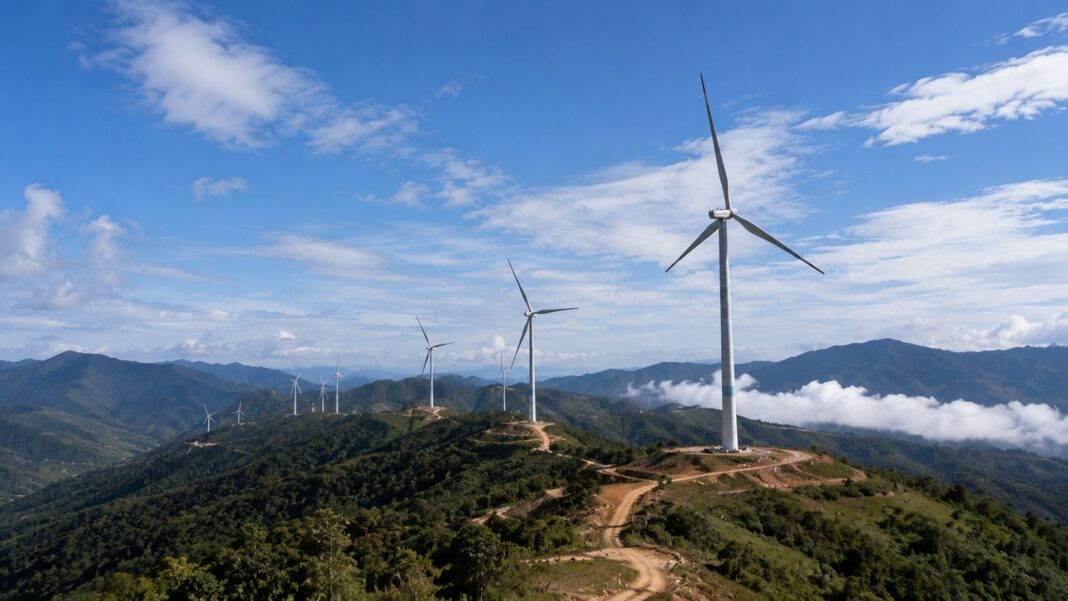
- The project features 133 Envision EN-171 wind turbines, each rated at 4.51 MW, spanning approximately 68,000 hectares at elevations of 1,100 to 1,500 metres
- Power is exported via a dedicated 500 kV transmission line: 27 km within Laos, 44 km within Vietnam, terminating at EVN’s Thanh My substation
- The project is expected to generate approximately 1,700 GWh annually and offset approximately 1.3 million tonnes of CO₂ per year
- The June 1, 2026, partnership agreement adds solar and energy storage capacity to the existing wind base and introduces Envision’s AI-powered operational management platform
- Both parties will study the potential role of green hydrogen in supporting energy stability and future industrial park development within Laos
- Laos earned over USD 2.6 billion from electricity exports in 2024, accounting for approximately 24% of total export revenue; large hydropower represented 72.7% of installed capacity in 2025
The Project That Came Before
The Monsoon Wind Power Project was conceived by Impact Electrons Siam in 2011, developed over more than a decade across multiple ownership structures, and financed with Asian Development Bank as lead arranger. The project cost exceeded USD 900 million. Construction commenced in April 2023, the 500 kV transmission line connecting Laos to Vietnam was energised in February 2025, and full commercial operation across all 133 turbines was achieved on August 22, 2025.
Monsoon Wind Power Company Limited holds a 28-year concession from the Lao government. Its shareholders include Diamond Generating Asia, a subsidiary of Mitsubishi Corporation; ACEN Renewables International, the Ayala group’s listed energy platform; Impact Electrons Siam; Thai-based BCPG; and STP&I. The project sells its full output to Vietnam Electricity under a 25-year PPA signed in 2021, which was the first cross-border wind power purchase agreement in Southeast Asia.
The physical project sits across the Dak Cheung District of Sekong Province and the Sanxay District of Attapeu Province, on a ridgeline plateau at between 1,100 and 1,500 metres above sea level. Four internal 115 kV substations collect power from the turbines and step it up to 500 kV for cross-border export. The line runs 27 km within Laos before crossing into Vietnam and continuing 44 km to EVN’s Thanh My substation. Annual generation is expected to reach approximately 1,700 GWh, displacing approximately 1.3 million tonnes of CO₂ annually over the project’s 25-year operating life.
The New Partnership
The June 1, 2026, agreement extends Envision Energy’s role from turbine supplier to integrated system operator. Under the partnership, Envision will provide its AI-powered Future Energy System platform to coordinate wind, solar, and storage operations across the Monsoon site. The scope adds solar and battery energy storage capacity to the existing wind base, though neither the scale of the additions nor their financial terms were disclosed in available public reporting.
The “Future Energy System” designation refers to Envision’s proprietary architecture for combining generation assets with an AI operations layer that manages dispatch, balancing, and grid coordination. Envision has deployed this model elsewhere in the region: a separate Envision project in Cambodia involves a 300 MWh BESS installation under Electricite du Cambodge, with the same AI platform described as a digital operational management system for the national grid. In Laos, the company’s stated objective is to use intelligent coordination to improve the reliability and cost competitiveness of the electricity generated, while extending the project’s potential end-use base from cross-border export into domestic demand support, including green data centres, green mining, and advanced manufacturing.
Both parties have also committed to studying the potential role of green hydrogen in energy stability and industrial park development within Laos. No timeline or feasibility milestones for the hydrogen component were included in available public announcements.
The signing ceremony’s attendance by Lao Minister of Industry and Commerce Malaythong Kommasith signals government endorsement of the project’s expanded scope. IES Executive Chairman Peck Khamkanist framed the partnership as a step in Laos’ transition from a traditional hydro-dominated power exporter toward a diversified clean energy economy.
Laos And The Limits Of Hydro
The strategic rationale for expanding Monsoon’s scope beyond wind is rooted in the structural fragility of Laos’ power export model. Hydropower accounted for 72.7% of installed capacity and 71.5% of annual generation in 2025. That concentration creates material dry-season exposure: when rainfall falls below seasonal norms, export commitments to Thailand and Vietnam become difficult to honour from hydro generation alone, a vulnerability that has already prompted some policy interest in coal-fired backup capacity. Laos’ installed coal capacity stood at 1.9 GW in 2025 and is projected to rise to 3.7 GW by 2035 under current plans, a trajectory that sits in tension with the country’s clean energy export positioning.
Wind power at the Monsoon site has a structural advantage in this context. The Sekong and Attapeu plateau experiences strong, seasonal monsoon winds that are partially counter-cyclical to dry-season hydro conditions. Adding solar and storage to this location would extend dispatchable hours and smooth the combined output profile, producing electricity that is more reliably available across a wider time window. For Vietnam, which imports Monsoon’s output and which faces its own grid stability challenges under rapid solar expansion, a more dispatchable Laos supply would have direct value.
Laos earned USD 2.6 billion from electricity exports in 2024, representing approximately 24% of total export revenue. Hydropower dominates those earnings, but the completion of Monsoon Wind demonstrated that wind-generated cross-border electricity is commercially viable under a bankable PPA structure. The Envision partnership is an attempt to consolidate and extend that model by adding flexibility through storage and system intelligence through AI dispatch.
Laos’ total installed power capacity grew from 9.4 GW in 2020 to 12.3 GW in 2025. The sector is projected to reach 28.7 GW by 2035, implying continued heavy capital deployment. Within that pipeline, IES also holds rights to develop the adjacent Xekong Wind Project, a separate 1,000 MW wind site in the same provinces, which Envision was already co-developing under a 2022 MOU alongside Keppel Infrastructure. The Monsoon expansion agreement announced June 1, 2026, does not directly address Xekong but reinforces the strategic alignment between the two companies on the broader southern Laos energy corridor.
What Is Not Yet Known
Available public reporting does not disclose the capacity targets for the solar and storage additions, the capital cost of the expansion, the timeline to financial close or construction, or the structure of any new offtake arrangement for additional generation beyond the existing EVN PPA. The green hydrogen study is at an exploratory stage with no defined milestones. The June 1 announcement is a partnership agreement, not a construction or financing commitment, and the depth of available independent sourcing reflects that early-stage status.