

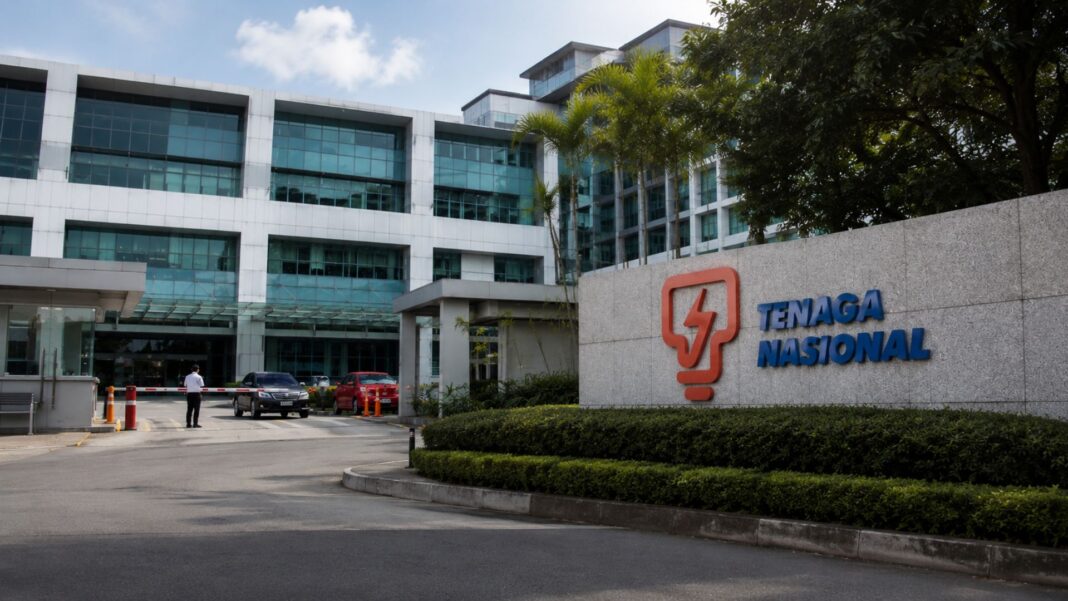

Tenaga Nasional Berhad reported cumulative earnings of RM1.1 billion for the first quarter of financial year 2026, anchored by rising commercial electricity demand and a cost-reflective tariff framework, while disclosing that the utility now supplies 36 operational data centers with a planned supply capacity of nearly 4.5 gigawatts. The results, announced on May 25, 2026, signal TNB’s deepening role as the physical backbone of Malaysia’s expanding digital economy at a moment when electricity demand is expected to grow between 4.5 and 5.5 percent across 2026.
Key Facts At A Glance
- Q1 FY2026 cumulative earnings: RM1.1 billion; core earnings rose 10.1 percent year-on-year to RM1.2 billion per HLIB Research
- Quarterly profit declined 10.2 percent sequentially due to tax normalization; effective tax rate approximately 31 percent in Q1
- Electricity sales grew 7 percent year-on-year, driven primarily by data center-related commercial demand per RHB Research
- Data center pipeline: 36 operational facilities as of March 2026; 23 additional projects under construction with a combined maximum demand of 3.8 GW; total planned supply capacity approaching 4.5 GW
- Capital expenditure in 2025: RM15.7 billion, up from RM11.2 billion in 2024; RM12.0 billion directed at grid modernization
- Q1 FY2026 regulated capital expenditure: RM2.5 billion, on track with RP4 regulatory period targets
- RP4 tariff period runs July 2025 to December 2027; base tariff for Peninsular Malaysia increased from 39.96 sen to 45.62 sen per kWh, with residential low-voltage users seeing effective reductions
- Energy Wheeling Agreement Phase 2 with Electricite du Laos and the Electricity Generating Authority of Thailand signed January 2026 under the LTMS-PIP corridor
Data Center Growth Redefines Demand Forecast
Tenaga Nasional Berhad’s Q1 FY2026 results, released on May 25, confirmed that the Malaysian state utility is navigating a structural inflection in electricity demand with its regulated asset base and capital investment program as principal levers. The quarter ended March 31, 2026 produced cumulative earnings of RM1.1 billion, with HLIB Research’s adjusted core figure of RM1.2 billion representing a 10.1 percent increase year-on-year. Quarterly performance softened sequentially by 10.2 percent, attributable to tax normalization effects that analysts expect to moderate in subsequent quarters rather than to underlying demand deterioration.
The dominant driver of revenue growth was the commercial segment, particularly the rapid buildout of data center facilities across Peninsular Malaysia. RHB Investment Bank noted that electricity sales rose 7 percent year-on-year in Q1, with data center-related demand identified as the primary contributor. As of March 2026, TNB reported supplying 36 operational data centers, with planned electricity supply capacity of approximately 4.5 gigawatts committed to future demand. A further 23 projects are currently under construction, carrying a combined maximum demand figure of 3.8 gigawatts. The scale of the pipeline means that by the time construction projects are completed and fully ramped, TNB’s committed data center supply exposure will exceed the current total installed generation capacity of several ASEAN member states.
Malaysia’s Ministry of Energy and Water Transformation has separately projected that data center electricity demand will reach 12.9 gigawatts by 2030 and 20.9 gigawatts by 2040. RAM Ratings, in a May 25 report, noted that Peninsular Malaysia’s peak demand already reached a record 21,049 megawatts in 2025, outstripping the Energy Commission’s own projection of 19,365 megawatts by more than 1,600 megawatts. That gap reflects a systematic underestimation of industrial and commercial electrification pace that makes TNB’s capital planning increasingly consequential for grid reliability.
Regulatory Framework And Tariff Architecture
The earnings performance was underpinned by the implementation of the cost-reflective RP4 tariff structure, which covers the regulatory period from July 2025 through December 2027. The base tariff for Peninsular Malaysia was raised from 39.96 sen per kilowatt-hour to 45.62 sen per kilowatt-hour for commercial and industrial users. Residential low-voltage customers, accounting for the majority of TNB’s consumer base, saw their effective tariff reduced from 55.95 sen to 45.4 sen per kilowatt-hour under the RP4 restructuring, insulating household consumers from the cost pressures faced by high-consumption segments.
Data centers, which connect at very high voltages of 500 kilovolts and 275 kilovolts, operate under a differentiated tariff architecture and are eligible to participate in the Corporate Renewable Energy Supply Scheme, or CRESS, which allows large energy users to procure electricity directly from renewable generators by paying TNB a system access charge for grid facilitation. TNB signed a 785-megawatt peak CRESS agreement in 2025, and analysts at Baringa noted that access charges under CRESS can be revised up to 15 percent per regulatory cycle, introducing a variable cost element for data center operators that has begun to factor into power purchase agreement structures across the sector.
Grid Investment And Regional Interconnection
TNB invested RM15.7 billion in capital expenditure in 2025, with RM12.0 billion of that figure directed specifically at grid modernization. In Q1 FY2026, regulated capital expenditure of RM2.5 billion remained on track against RP4 targets. TNB President and CEO Datuk Ir Ts Shamsul Ahmad indicated that the company continues to prioritize investments to future-proof the grid amid simultaneous pressures from industrial electrification, electric vehicle adoption, and the data center expansion.
On the regional front, TNB highlighted its January 2026 signing of the Energy Wheeling Agreement Phase 2 with Electricite du Laos and the Electricity Generating Authority of Thailand, an expansion of the Lao PDR-Thailand-Malaysia-Singapore Power Integration Project commercial power transfer framework. The agreement represents the most operationally advanced cross-border power trade arrangement currently in place within ASEAN, and TNB has cited it as foundational to its positioning for a broader ASEAN Power Grid role.
In March 2026, TNB signed a memorandum of understanding with Telekom Malaysia Berhad covering sustainable energy solutions, digital technologies, and artificial intelligence integration. As an initial implementation, the two companies are assessing potential solar installations at up to 150 Telekom Malaysia premises. TNB’s solar affiliate GSPARX had secured more than 530 megawatts of rooftop solar as of December 31, 2025, and the utility has deployed over 300 electric vehicle charging stations under its TNB Electron brand.
Analyst View
Multiple research houses maintained buy recommendations following the Q1 results. MBSB Research cited the stable RP4 tariff framework and projected demand growth of approximately 5.4 percent in calendar year 2026. RHB Investment Bank retained TNB as its sector top pick, setting a target price of RM16.50, and flagged that higher effective tax rates in Q1 are expected to moderate. HLIB Research pointed to disciplined operational execution as the primary earnings support factor, alongside the improving regulated asset base. Analysts noted that approval of contingency capital expenditure for additional data center, East Coast Rail Link, and government projects could drive total RP4 capex well above the approved RM26 billion base case.
The underlying question for analysts and regulators alike is whether TNB’s capital and generation planning cycle can keep pace with demand growth that has now outrun multiple successive official projections. With 23 data center projects simultaneously under construction and electricity demand growth projections rising, the utility’s grid modernization timeline is under scrutiny from investors who have priced in further contingency capex approvals over the remainder of the RP4 period.