

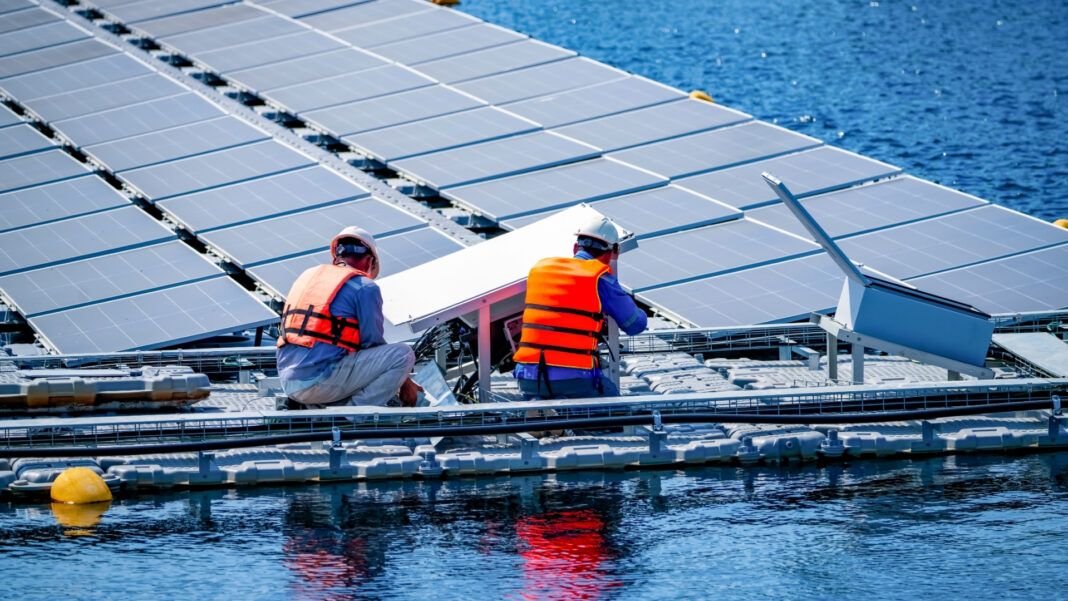

Malaysia’s Ministry of Energy Transition and Water Transformation began releasing tender documents on July 27 for the sixth round of its Large Scale Solar programme, offering 2,500 megawatts of solar capacity paired with 1,250 megawatts of battery storage. The round is Malaysia’s largest utility-scale solar tender to date and marks the first time developers will be required to pair every project with grid-connected battery storage.
Key Facts At A Glance
- LSS6 offers 2,500 MW of solar capacity, including 1,250 MW paired with Battery Energy Storage Systems
- A separate 150 MW solar-only allocation is reserved for Bumiputera companies in Peninsular Malaysia
- Package 1: open tender for 2,200 MW solar plus 1,100 MW BESS
- Package 2: Bumiputera open tender for 300 MW solar plus 150 MW BESS
- Package 3: Bumiputera solar-only programme, 150 MW, no BESS requirement
- RFP documents for Packages 1 and 2 available July 27 to August 7, 2026; Package 3 opens August 17 to August 28
- Bid sizes range from 60 MW to 500 MW under Packages 1 and 2, and 10 MW to 30 MW under Package 3
- Expected private investment of RM13 billion to RM15 billion, with commercial operations targeted no later than December 31, 2029
The Ministry of Energy Transition and Water Transformation, known as PETRA, said the tender builds on five earlier LSS rounds that have collectively approved more than 6 gigawatts of solar capacity since 2016, including nearly 2 gigawatts awarded in the most recent round last September. Unlike those prior rounds, which were awarded on price alone, every project under LSS6 must now be paired with battery storage. Deputy Prime Minister and PETRA Minister Datuk Seri Fadillah Yusof had flagged the requirement months earlier, telling reporters at the Energy Transition Conference 2026 that solar projects under LSS6 must be paired with battery storage as part of efforts to strengthen grid stability amid rising renewable penetration.
Project development will be prioritised in strategic areas with high electricity demand growth, particularly the southern region of the peninsula, according to PETRA. The government expects LSS6 to create between 15,000 and 20,000 jobs during construction and development, and to reduce carbon dioxide emissions by roughly 2.6 million tonnes annually once projects are operational. Package 3 alone is projected to generate close to RM500 million in investment opportunities for smaller Bumiputera businesses.
Grid Stability Focus
The mandatory storage requirement reflects a broader shift in Malaysia’s solar policy following a period of rapid capacity growth. Malaysia’s cumulative solar capacity closed 2025 at roughly 5.7 gigawatts, up from 4.3 gigawatts the year before. As that capacity has scaled, industry attention has moved from simple deployment volume toward how much intermittent solar the national grid can absorb and dispatch reliably, a dynamic PETRA officials have cited directly in framing the LSS6 storage mandate.
Publicly available reporting on the RFP release itself remains limited to procedural details; PETRA has not yet disclosed bid evaluation criteria or award timelines beyond the stated 2029 commercial operations deadline.