

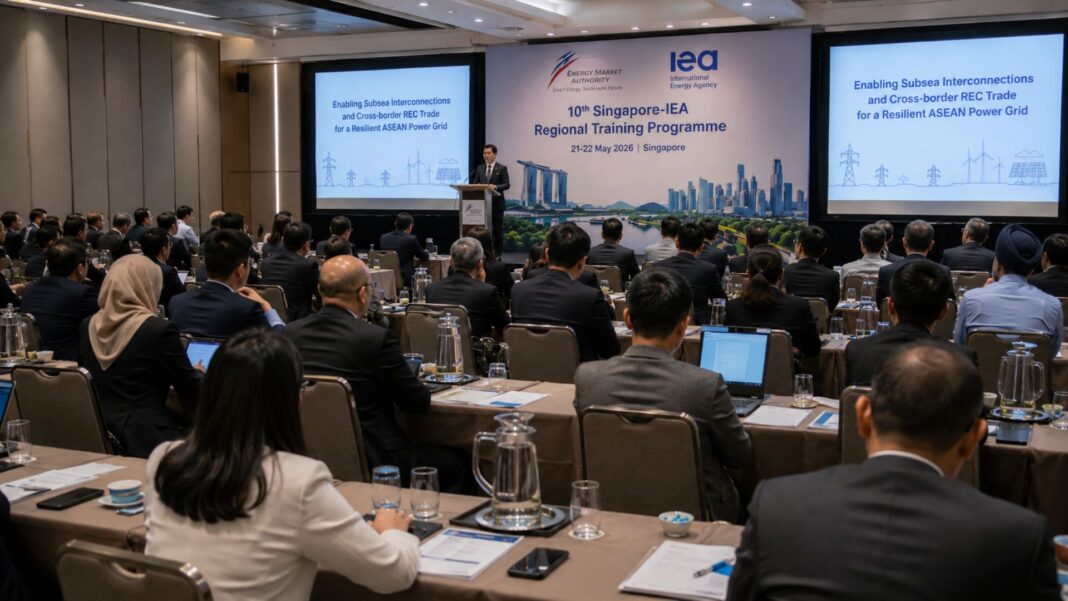

The Energy Market Authority of Singapore and the International Energy Agency convened the 10th Singapore-IEA Regional Training Programme on May 21 and 22, 2026, marking a decade of capacity-building cooperation and bringing together more than 160 energy officials from 23 countries to address the two most structurally complex obstacles to the ASEAN Power Grid: subsea interconnection governance and cross-border Renewable Energy Certificates trade.
Key Facts At A Glance
- 10th edition of the Singapore-IEA Regional Training Programme held May 21 to 22, 2026 in Singapore
- More than 160 policymakers, regulators, and industry stakeholders from 23 countries across the Asia Pacific attended
- Programme focus: enabling subsea interconnections in ASEAN and scaling cross-border Renewable Energy Certificates trade
- Cumulative participant count across ten editions exceeds 1,600 energy officials from across the region
- Key 2025 milestones referenced at the programme: Enhanced APG Memorandum of Understanding, Terms of Reference for the ASEAN Submarine Power Cable Development Framework, and the launch of the ASEAN Power Grid Financing Initiative with multilateral development bank collaboration
- Singapore has awarded Conditional Approvals to 11 electricity import projects totaling 8.35 GW from Australia, Cambodia, Indonesia, Sarawak, and Vietnam; six Indonesian projects have advanced to Conditional Licences
- Singapore’s national target: import approximately 6 GW of low-carbon electricity by 2035, representing one-third of projected demand
- Programme is part of the Singapore-IEA Regional Training Hub, co-organized with the IEA’s Regional Cooperation Centre based in Singapore
A Decade Of Capacity Building At A Critical Juncture
The 10th Singapore-IEA Regional Training Programme, held May 21 to 22 at an in-person venue in Singapore, arrived at a moment of uncommon urgency for regional energy governance. For a decade, the annual gathering has served as a technical and policy forum for ASEAN energy officials. This edition, however, convened against a backdrop in which the Hormuz disruption has shifted interconnection from a long-term transition ambition to a near-term energy security imperative for virtually every economy in Southeast Asia.
EMA Chief Executive Puah Kok Keong captured the shift in framing directly. “We are operating in an increasingly complex environment today, as countries work to strengthen energy security while keeping energy affordable and advancing their energy transitions,” he said. “Against this backdrop, our Singapore-IEA Regional Training Programme is even more important today to help countries navigate their energy pathways.” He noted that the 10th edition marks a milestone in the decade-long EMA-IEA partnership, with cumulative training output now exceeding 1,600 energy officials across the region.
Participation grew year-on-year. The 9th edition in May 2025 drew 200 participants from 20 countries; this year’s 10th edition brought 160 or more from 23 countries, reflecting the broadening geographic scope of ASEAN’s interconnection discussions as well as the programme’s established credibility as a regional capacity-building venue. Representatives from the ASEAN Centre for Energy, the Australian Energy Regulator, and private sector participants contributed sessions on technical frameworks, regulatory policies, financing models, and risk-sharing mechanisms for cross-border power trade.
Two Priority Areas: Subsea Cables And RECs
The programme structured its working sessions around two implementation-focused priorities that reflect where the ASEAN Power Grid currently faces its deepest practical constraints.
The first was subsea interconnections. ASEAN’s archipelagic geography means that most proposed power trade routes between major generation surplus zones and demand centers require laying cables across open water, exclusive economic zones, and potentially contested maritime areas. The governance complexity is substantial: any subsea cable project must address legal jurisdiction under the United Nations Convention on the Law of the Sea, national regulatory approvals across multiple sovereignties, technical compatibility standards, commercial terms for transmission services, and risk allocation between state and private capital. The 43rd ASEAN Ministers on Energy Meeting, held in Kuala Lumpur in October 2025, formally endorsed Terms of Reference for the ASEAN Submarine Power Cable Development Framework, which addresses four priority areas: legal and regulatory, technical, commercial, and governance. That framework underpinned a substantial portion of the May training programme’s technical content.
As of early 2026, as many as six subsea power cable projects across ASEAN are at advanced stages of negotiation and planning. Singapore Energy Interconnections, a government-linked company established in April 2025 specifically to invest in, develop, own, and operate cross-border interconnectors, represents Singapore’s structural commitment to this pathway. The EMA has to date awarded Conditional Approvals to 11 import projects with a combined capacity of 8.35 gigawatts, drawing from generators in Australia, Cambodia, Indonesia, Sarawak, and Vietnam. Six of the Indonesian projects have progressed to the more advanced Conditional Licence stage.
The second priority was cross-border Renewable Energy Certificates trade. As regional electricity trade expands, the question of how to attribute, track, and recognize the renewable origin of imported power across multiple jurisdictions becomes commercially and legally significant. Without a recognized REC framework, buyers in Singapore or elsewhere cannot credibly claim the low-carbon attributes of electricity that has transited Thailand and Malaysia from a hydropower source in Laos, even if the physical electrons nominally originated there. The programme explored interoperability between national REC systems, the governance requirements for cross-border recognition, and the role of standardized digital platforms in managing traceability across interconnected grid systems.
Singapore’s 6 Gw Import Target And The APG Financing Gap
Singapore’s national energy strategy positions low-carbon electricity imports as one of its four key decarbonization pathways, alongside solar deployment, low-carbon hydrogen, and natural gas with carbon capture. The city-state has committed to importing approximately 6 gigawatts of low-carbon electricity by 2035, which would meet approximately one-third of projected national demand at that point. That target is not contingent on any single source or route; it is spread across the 11 approved projects from five source geographies, giving Singapore deliberate diversification against single-corridor dependency. The 8.35 gigawatts in Conditional Approvals provides a pipeline buffer above the 6 gigawatt target to account for project attrition.
That pipeline, however, requires capital at scale. The 43rd ASEAN Ministers on Energy Meeting launched the ASEAN Power Grid Financing Initiative in collaboration with multilateral development banks, designed as a regional mechanism to mobilize public and private investment in transmission infrastructure and interconnection projects. The initiative was framed as a tool to unlock capital, de-risk investments, and strengthen the financial viability of APG project pipelines. Rystad Energy estimates that Singapore’s interconnection targets alone could unlock up to 25 gigawatts of renewable energy generation and more than forty billion dollars of investment across the region if all proposed links are realized.
The primary precedent for multilateral trade is the Lao PDR-Thailand-Malaysia-Singapore Power Integration Project, which has operated commercially since 2022 and demonstrated that physical power transfer, commercial settlement, and regulatory coordination across four ASEAN jurisdictions is achievable. The BIMP-PIP initiative, announced in 2023, aims to replicate that model across Brunei, Indonesia, Malaysia, and the Philippines, where the subsea component is unavoidable.
Energy Security Context
The Hormuz disruption that began in late February 2026 has given previously abstract arguments for grid interconnection a concrete short-term dimension. The disruption has exposed the degree to which Southeast Asian economies remain individually dependent on single-corridor fossil fuel imports. Regional interconnection offers a structural partial hedge: an economy with robust cross-border power trade links can in principle substitute imported electricity for domestically generated fuel-burning capacity, reducing net exposure to liquid fuel price volatility. That case had previously been made primarily in terms of decarbonization and cost efficiency. The events of 2026 have added a supply security rationale that is harder to defer on cost grounds alone.
For Singapore, which generates essentially all of its electricity from piped and imported LNG, the import interconnection program takes on additional urgency in a period when LNG supply from Gulf sources has been severely disrupted. For exporting countries, interconnection infrastructure represents a long-term revenue stream that can underwrite the capital costs of renewable buildout in hydropower-rich Laos, geothermal-rich Indonesia, and wind-and-solar-capable Vietnam, while reducing those countries’ own internal dependence on petroleum-linked generation fuels.