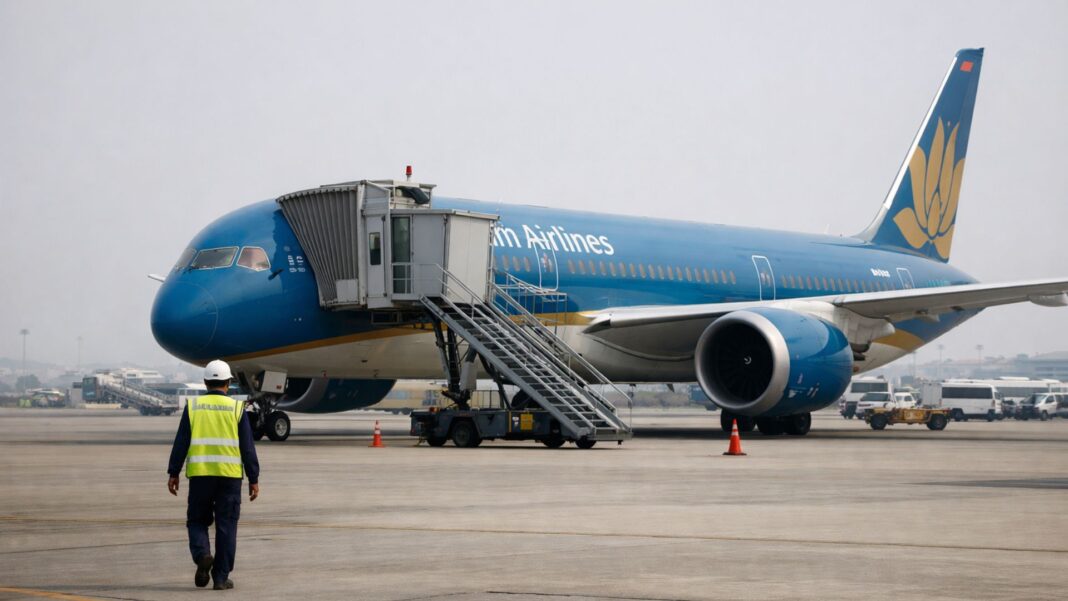

Vietnam Airlines, part of state-owned Vietnam Airlines Corp., will cancel 23 weekly domestic flights and suspend seven routes from April 1, 2026, after the Civil Aviation Authority of Vietnam confirmed that jet fuel supply can no longer be guaranteed beyond March under existing contracts. The fuel shortfall stems directly from the China and Thailand export bans on refined petroleum products, which together supplied more than 60% of Vietnam’s aviation fuel needs prior to the Middle East conflict.
Key Facts At A Glance
- Vietnam Airlines (ticker: HVN, Ho Chi Minh Stock Exchange) will suspend seven domestic routes from April 1, 2026, cancelling 23 flights per week, per a Civil Aviation Authority of Vietnam (CAAV) statement issued March 24, 2026.
- Affected routes include Hai Phong to Buon Ma Thuot, Cam Ranh, Phu Quoc, and Can Tho, and Ho Chi Minh City to Van Don, Rach Gia, and Dien Bien.
VietJet Aviation JSC is reducing flights on select routes; Bamboo Airways is maintaining its network at reduced frequencies. - Jet A-1 fuel prices in Singapore were trading at approximately USD 220–230 per barrel as of late March 2026, up from pre-conflict levels.
- Vietnam Airlines’ operating costs could increase 50–60% per month at current Jet A-1 prices; VietJet Air faces approximately VND 2 trillion (roughly USD 80 million) in additional monthly operating costs, per CAAV figures.
- Vietnam imports over 60% of its jet fuel from China and Thailand, both of which halted refined petroleum exports — China from March 11 and Thailand from March 6, 2026.
- Domestic fuel suppliers Skypec and Petrolimex Aviation have indicated they can guarantee jet fuel supplies only through the end of March 2026 under existing contracts.
- Vietnamese carriers are preparing to implement international fuel surcharges from early April; the CAAV has proposed a 100% exemption from environmental protection tax on aviation fuel through May 2026.
The cuts mark a significant operational setback for Vietnam’s aviation sector, which had just closed its strongest financial year on record. According to financial statements released January 29, 2026, Vietnam Airlines posted full-year 2025 consolidated revenue of more than VND 121.43 trillion, up approximately 10% year-on-year and the highest in the carrier’s history. Consolidated after-tax profit reached over VND 7.71 trillion, with parent-company profit more than doubling year-on-year to VND 5.51 trillion. The carrier had entered 2026 targeting more than 29 million passengers, a 13.2% increase, and a 13% rise in available seat kilometers, ambitions that are now under severe pressure.
The Supply Shock
The immediate trigger is a dual export ban. China halted refined fuel exports from March 11, 2026, following official instructions to state refiners not to agree to new export contracts, while Thailand suspended exports of refined oil products, including aviation fuel, to all countries except Myanmar and Laos from March 6. Vietnam imports more than two-thirds of its total aviation fuel demand, of which approximately 60% had been sourced from these two suppliers prior to the conflict. Domestic refineries, focused primarily on producing gasoline and diesel, cannot increase jet fuel output in the near term.
Major importers Skypec and Petrolimex Aviation have told the CAAV that deliveries beyond March can no longer be guaranteed under current contracts. Singapore-based suppliers have also reduced deliveries. The CAAV said in an internal document that partners in Singapore, Thailand, and China are delaying deliveries and may invoke force majeure clauses on existing agreements. Fuel prices in Vietnam’s consumer market reflect the severity of the disruption: 95-octane petrol prices have risen approximately 50% and diesel approximately 70% since the conflict began in late February, according to AFP reporting.
Operational Response Across The Industry
Vietnam Airlines, as the national flag carrier, is prioritising routes that the CAAV has designated as critical to national connectivity, trade, tourism, diplomacy, and domestic travel. The seven suspended routes serve secondary and tourism-dependent provincial connections, while trunk routes linking Hanoi, Ho Chi Minh City, and Da Nang remain intact.
VietJet Aviation JSC, Vietnam’s largest low-cost carrier by fleet size with 103 aircraft, has begun reducing frequencies on select domestic and international routes. The carrier has also announced fuel surcharge increases on international routes effective April 1: surcharges on South Korea services, for instance, will rise from VND 420,000–500,000 to between VND 1.33 million and VND 1.57 million per segment, an increase of roughly three times. VietJet is additionally suspending Japan routes, including the Narita-Hanoi and Kansai-Hanoi services, for the month of April.
Bamboo Airways has confirmed it will maintain the Hanoi–Ho Chi Minh City–Da Nang corridor and high-demand tourist routes including Quy Nhon and Cam Ranh, while operating at reduced frequencies. The carrier has called on the government to further reduce environmental protection taxes and aviation fuel taxes.
Financial Exposure
The CAAV has quantified the financial impact at current Jet A-1 prices of USD 200–230 per barrel. Vietnam Airlines’ monthly operating costs could increase by 50–60% against pre-conflict baselines. VietJet Air faces approximately VND 2 trillion in additional operating costs per month. Sun Phu Quoc Airways is projected to see a cost increase of approximately 30%. Fuel already accounts for 35–40% of total operating costs across the Vietnamese airline industry in normal conditions; at current prices, that share rises materially, rendering several routes economically unviable.
A CAAV survey of nearly 40 international and regional airlines operating routes to and from Vietnam found that more than 60% had either raised fares or implemented new fuel surcharges from mid-March 2026. The authority has formally proposed a 100% exemption from environmental protection tax on aviation fuel through the end of May 2026, a VAT reduction on aviation fuel from 10% to a lower rate, and a mechanism allowing domestic fuel surcharges to be applied flexibly based on Jet A-1 price fluctuations.
Government And Diplomatic Response
The fuel shortfall has prompted Vietnam’s highest levels of government to act. Prime Minister Pham Minh Chinh travelled to Moscow from March 22–25, where Vietnam and Russia signed an agreement on the construction of Vietnam’s first nuclear power plant, with Russia’s state nuclear corporation Rosatom involved. Russia’s largest LNG producer Novatek also signed a preliminary supply agreement with an unnamed Vietnamese buyer, with the company’s CEO stating it was ready to commence deliveries at the earliest opportunity. Separately, Vietnam signed agreements on oil and gas production cooperation in both countries with Russia’s Zarubezhneft, which operates joint ventures with Petrovietnam through Vietsovpetro and Rusvietpetro.
Vietnam has additionally asked for fuel support from Qatar, Kuwait, Algeria, and Japan, and is exploring alternative supply sources including South Korea and India.