

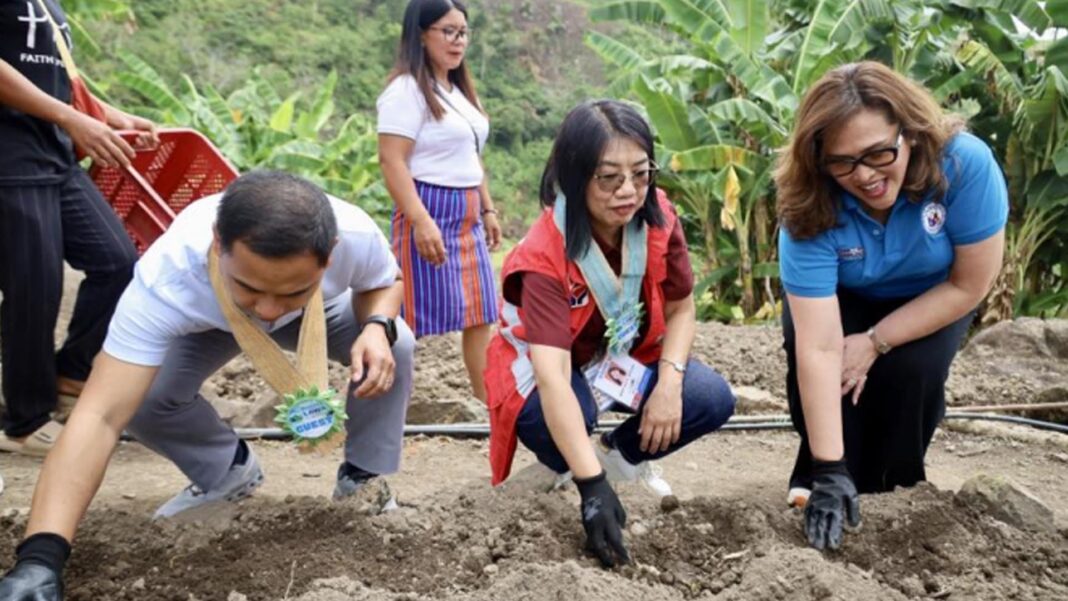

The Department of Social Welfare and Development (DSWD) highlighted its two climate-resilient projects on Monday, saying around 13,400 families involved in Project LAWA at BINHI are also expected to participate in Project Bahay Kubo, a complementary sustainable farming initiative.
Nerie Villanueva, information officer of the DSWD in Cordillera Administrative Region, said the Project LAWA at BINHI (Local Adaptation to Water Access and Breaking Insufficiency through Nutritious Harvest for the Impoverished) in the Cordillera had a total of 7,050 partner beneficiaries in 2025 and 6,400 this year.
Partner beneficiaries produced at least 900,000 kilograms of vegetables under the program, a flagship climate resilience initiative aimed at mitigating the impact of drought and flooding on vulnerable communities.
The initiative provides temporary employment through cash-for-work and cash-for-training schemes while supporting the development of infrastructure and sustainable community gardens.
“The beneficiaries eat their produce, and the extras are sold for additional income to the families,” she said in a message.
The concept of project LAWA at BINHI continues to address food insecurity, water scarcity, and climate change adaptation through sustainable livelihood and environmental initiatives, with its beneficiaries mostly belonging to the Pantawid Pamilyang Pilipino Program (4Ps).
Villanueva earlier said the project concept is planting vegetables using the side of rivers and creeks that can also serve as soil erosion control, while producing food for the table or for income.
To complement the program, the Office of the Presidential Adviser for North Luzon (OP-NL), Department of Agriculture (DA, and the DSWD launched Project Bahay Kubo to empower the partner beneficiaries to produce their own planting materials, strengthen food production, and sustain their livelihoods toward becoming climate-resilient farming communities.
“Project Bahay Kubo is targeted to be done in all municipalities to equip partner-beneficiaries with knowledge and skills in nursery production, seedling propagation, and sustainable farming practices, helping communities become more self-sufficient and less dependent on government, and will adopt the modern agriculture that aligns on the climate resilient farmer,” Villanueva said.
She said that they are forming the beneficiaries into cooperatives to be able to adopt the concept of consolidation of production of the beneficiaries and sell them in bulk.
DSWD-Cordillera acting director Enrique Gascon, meanwhile, said the combined efforts of Project LAWA at BINHI and Project Bahay Kubo provide communities with immediate support and empower them with sustainable knowledge and resources for the future.
“Through strengthened partnerships and community participation, the initiatives aim to cultivate resilient families, promote food security, and inspire self-reliant communities across the Cordillera region,” he added. (PNA)