

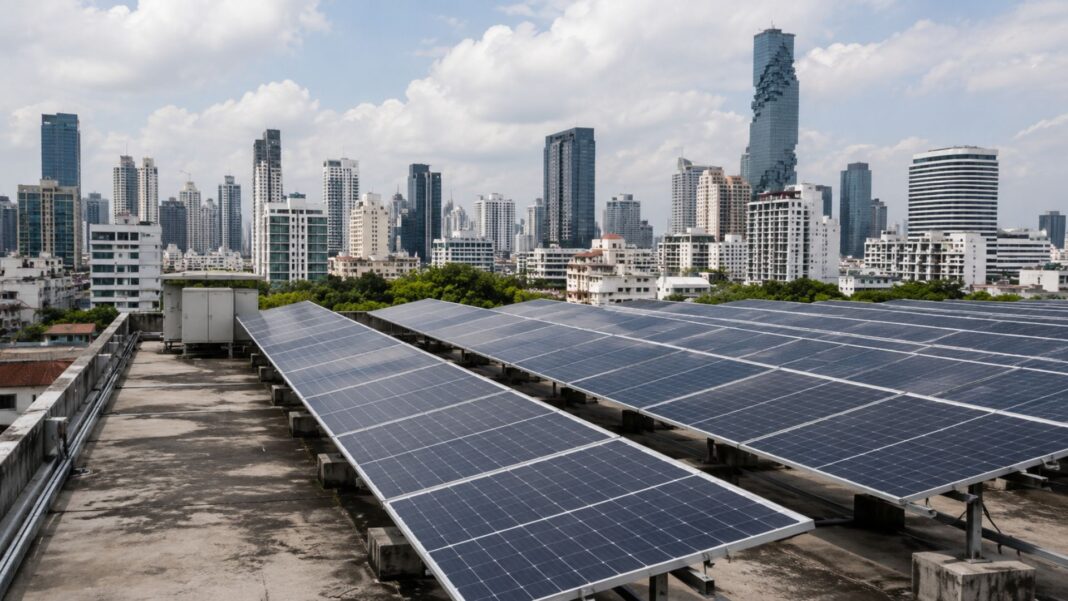

A senior official at Thailand’s Department of Alternative Energy Development and Efficiency stated on May 25 that solar power, supported by battery storage, is the most viable path for Thailand to restructure its energy system away from LNG dependence, with the country’s technical solar potential estimated at nearly 1,000 GW and a draft power development plan targeting renewable energy at more than 50 percent of total generation capacity.
Key Facts At A Glance
- Thailand’s Department of Alternative Energy Development and Efficiency estimates a national technical solar potential of nearly 1,000 GW
- Natural gas accounts for approximately 60 percent of Thailand’s current power generation mix, the majority supplied by imported LNG
- Spot LNG prices in Asia surged to USD 24 to 25 per million British thermal units in March 2026, roughly double the prior year’s average of USD 12 to 13
- Thailand’s draft 2026 Power Development Plan targets renewable energy at more than 50 percent of total generation capacity
- The National Energy Policy Council expanded the residential rooftop solar buyback program from 90 MW to 500 MW at a fixed rate of THB 2.20 per kWh under 10-year contracts
- Households installing rooftop solar systems between March 3, 2026 and December 31, 2027 are eligible for a personal income tax deduction of up to THB 200,000
- Replacing 1,000 MW of gas-fired generation with solar-plus-battery systems at an 85 percent utilization rate is estimated to cut LNG imports by approximately THB 45 billion annually
- Electricity tariffs for the May to August 2026 billing cycle were set by the Energy Regulatory Commission at THB 3.95 per unit, up from THB 3.88 in the preceding period
The Statement And Its Context
A senior official at Thailand’s Department of Alternative Energy Development and Efficiency, speaking to the Bangkok Post on May 25 without attribution, said Thailand’s clean energy development goals can be achieved if the government focuses its efforts on solar power as the central technology of the transition. The statement came during a period of acute pressure on Thailand’s electricity system driven by LNG supply disruptions linked to the conflict affecting the Strait of Hormuz corridor, which has pushed spot Asian LNG prices sharply higher since late February 2026.
The official framed solar power’s appeal in terms of scale flexibility: the technology supports investments ranging from residential micro-installations of a few kilowatts to gigawatt-scale utility projects, making it accessible to households, businesses, and institutional investors simultaneously. The government’s draft 2026 Power Development Plan, described by the official as still in preparation, calls for renewable energy to exceed half of Thailand’s total generation capacity — a target the official described as achievable through a solar-led strategy.
Energy Minister Akanat Promphan had previously framed the current energy crisis as a structural opportunity, stating the government does not want to focus only on short-term fixes but on restructuring the energy system so Thailand can rely more on itself. That framing now underpins the official policy posture on solar at both the ministry and the technical agency level.
The LNG Problem Solar Is Meant To Solve
Thailand’s electricity system is structurally exposed to global LNG price volatility. Natural gas accounts for approximately 60 percent of the country’s power generation mix, with domestic reserves depleting and import dependence rising. When LNG prices spiked during the Russia-Ukraine war in 2022, Thailand’s electricity costs surged by roughly 19 percent, adding an estimated THB 130 billion to the national energy bill. The 2026 disruption is described by analysts as more severe: spot LNG prices in Asia reached USD 24 to 25 per million British thermal units in March 2026, with infrastructure damage to Middle East oil and gas facilities expected to require at least 18 months to repair.
In response to the immediate LNG cost surge, the Energy Regulatory Commission directed the Electricity Generating Authority of Thailand to bring two retired generating units back online at the Mae Moh coal-fired power station in Lampang province in March 2026, adding 600 MW to the plant’s operating capacity of 700 MW. The move provided short-term cost relief but reinforced the government’s acknowledgment that the LNG-dependent power mix carries structural fiscal and supply-chain risk.
The official at the Department of Alternative Energy Development and Efficiency quantified one alternative path: replacing 1,000 MW of gas-fired generation with solar-plus-battery systems at an 85 percent utilization rate would cut LNG imports by approximately THB 45 billion annually. Given that solar systems carry operational lifetimes of 25 to 30 years and battery systems of approximately 10 years, the official argued the investment would generate ongoing import substitution savings over multiple decades.
Battery Storage As The Enabling Condition
The official explicitly tied the solar transition argument to the declining cost of battery energy storage systems, identifying storage as the factor that transforms solar from an intermittent daytime resource into a dispatchable generation asset. Traditional solar systems carry a capacity factor of approximately 10 percent, producing power only during daylight hours under clear skies. Solar paired with battery storage can, in the official’s framing, begin to compete directly with gas-fired plants on a dispatchability basis.
Thailand’s existing Power Development Plan already targets 10 GW of battery energy storage systems by 2030. A Bloomberg NEF net-zero scenario projects that solar and wind energy could supply 60 percent of Thailand’s electricity by 2050 if the current policy direction is maintained and extended. The draft 2026 PDP, once finalized, is expected to codify the government’s position on the storage-solar integration pathway.
Policy Instruments Already Active
Two specific instruments cited in the May 25 statement are already operational. The National Energy Policy Council’s residential rooftop solar buyback program, expanded from 90 MW to 500 MW, offers households a fixed rate of THB 2.20 per kilowatt-hour under 10-year purchase contracts, with the Provincial Electricity Authority and the Metropolitan Electricity Authority designated as one-stop service providers for applications, approvals, and installation oversight.
A parallel tax incentive introduced in March 2026 allows households installing on-grid rooftop systems of up to 10 kilowatts to deduct up to THB 200,000 from personal income tax, with eligibility running from March 3, 2026 through December 31, 2027. Finance Minister Ekniti Nitithanprapas unveiled the measure as part of a broader economic stimulus package tied to the energy crisis.
However, the Provincial Electricity Authority has flagged that current bank financing products remain a material obstacle. Existing state bank loan campaigns offer lower interest rates in early years before rates roughly double in later periods, making repayment burdensome for households. A PEA official warned that if financing conditions are not improved, the government will not reach its 500 MW buyback target within the year. The PEA is in active negotiations with state-owned and private banks to develop dedicated green loan products.
Structural Barriers Persist
Despite the policy momentum, analysts and industry observers have identified three structural constraints that the May 25 declaration does not resolve. Grid integration for intermittent generation at scale remains technically and commercially unresolved in Thailand’s vertically integrated electricity market, where the Electricity Generating Authority of Thailand operates as the single buyer. The current market architecture limits direct power purchase agreements between renewable generators and large commercial consumers, although the government is expected to allow such agreements for data centers through a third-party grid access framework in 2026.
Installation cost remains a barrier for lower-income households. A typical rooftop system capable of meeting a household’s base load requires an investment in the hundreds of thousands of baht, placing it beyond reach without subsidized financing. The tax deduction mechanism benefits only those with sufficient taxable income to utilize it, limiting its reach to middle- and upper-income households.
On the supply side, Energy Minister Akanat Promphan separately signaled that the government is reviewing the wholesale tariff rate of THB 3.78 per unit applicable to contracted solar farm operators, describing it as high and potentially subject to revision. That signal has introduced uncertainty for established solar producers, including SPCG Plc, whose legacy adder tariff contracts at THB 8 per unit have expired and whose current revenue depends on the continuation of the wholesale rate.