

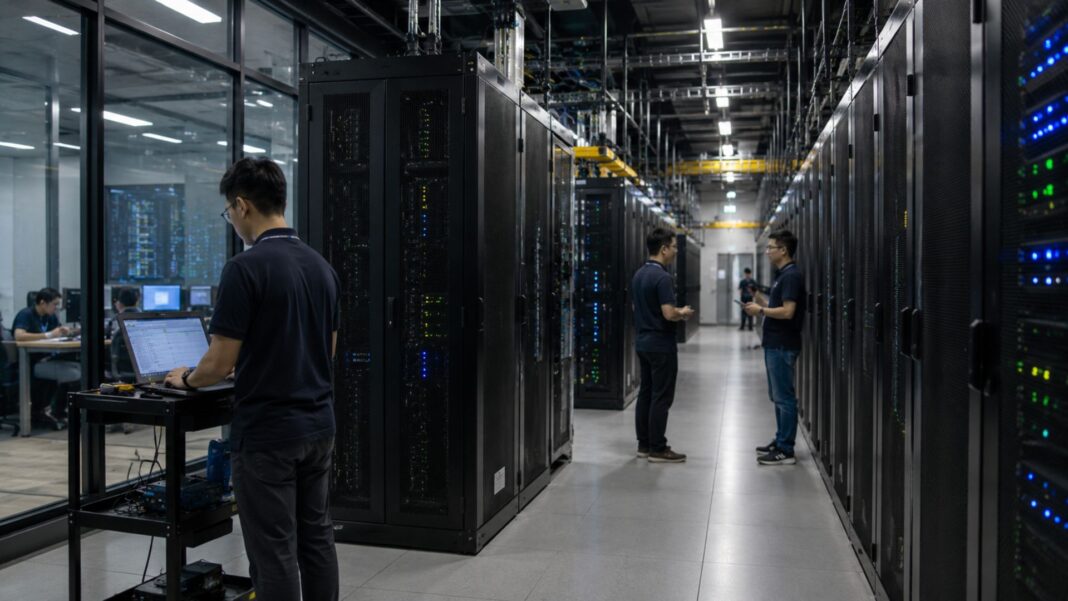

Amazon has confirmed plans to invest more than USD 33 billion in cloud computing and artificial intelligence infrastructure across Indonesia, Malaysia, Singapore, and Thailand by 2039, positioning the four-country corridor as a critical node in the company’s global expansion. The announcement, made on 21 May 2026, carries direct implications for the financial services sector across Southeast Asia, where AI-ready cloud capacity is rapidly becoming a competitive requirement for banks, payment platforms, and digital lenders.
Key Facts At A Glance
- Amazon’s planned cloud and AI infrastructure investments across Indonesia, Malaysia, Singapore, and Thailand are expected to exceed USD 33 billion by 2039.
- The investments are projected to add more than USD 64 billion to the four countries’ combined gross domestic product and support over 56,300 full-time equivalent jobs annually in the local data center supply chain.
- In 2025 alone, Amazon invested more than USD 3 billion across its businesses in Southeast Asia, including Amazon Web Services, retail, devices, and entertainment.
- Amazon has trained more than 2.7 million individuals on cloud skills across Southeast Asia since 2017.
- ASEAN, comprising 11 member states, is projected to become the world’s fourth-largest economy, with its digital economy expected to reach USD 560 billion by 2030.
- The announcement was made in Singapore on 21 May 2026 by David Zapolsky, Amazon’s Chief Global Affairs and Legal Officer.
- The investment spans a series of previously announced country-level commitments consolidated into a single regional figure.
Scale And Scope Of The Commitment
Amazon’s 21 May 2026 announcement consolidates a series of country-level investment plans made over the preceding three years into a single regional figure exceeding USD 33 billion. The commitment spans data center expansion, cloud infrastructure buildout, and AI-related operations across the four markets, with Amazon Web Services serving as the primary vehicle for deployment.
David Zapolsky, Chief Global Affairs and Legal Officer at Amazon, framed the investment in terms of regional economic leadership and workforce development. The company stated that it is building infrastructure, training local workforces, and enabling businesses across the region to compete globally.
The projected GDP contribution of more than USD 64 billion, and the figure of over 56,300 annual full-time equivalent jobs in the data center supply chain, reflect Amazon’s own economic impact assessments rather than independent projections. The company did not provide a breakdown of the investment by individual country or by year of deployment.
Implications For Financial Services And Fintech
The scale of Amazon’s commitment is structurally significant for Southeast Asia’s financial services sector. Digital banks, payment platforms, embedded finance providers, and AI-driven lending platforms across the region rely disproportionately on cloud infrastructure for core operations, fraud detection, credit underwriting, and real-time transaction processing. Expanded data center capacity across all four markets reduces latency, supports data residency compliance requirements issued by local regulators, and lowers the marginal cost of scaling AI workloads for regulated financial institutions.
Singapore and Malaysia have each established regulatory frameworks that require certain categories of financial data to be stored domestically or within approved jurisdictions. Deeper AWS infrastructure in both markets directly strengthens the ability of licensed financial institutions to meet these obligations while deploying AI-based applications at scale.
In Indonesia and Thailand, where digital banking licensing frameworks have expanded in recent years and where financial inclusion remains a policy priority, increased cloud capacity also reduces a practical barrier for fintech entrants whose growth is constrained by infrastructure availability and cost.
Workforce And Competitive Context
Amazon’s figure of 2.7 million individuals trained on cloud skills across Southeast Asia since 2017 reflects an ongoing investment in the technical labor market that underpins fintech product development across the region. The demand for cloud-fluent engineers, data scientists, and AI specialists has intensified as financial institutions accelerate their technology transformation programmes.
The announcement also arrives at a moment of intensifying competition among hyperscale cloud providers in the region. Microsoft and Google have each announced significant ASEAN infrastructure investments in recent periods, and the cumulative effect of these commitments is accelerating the availability of enterprise-grade AI compute capacity across markets that were previously constrained by limited data center footprint.