


The Department of Environment and Natural Resources (DENR) is calling on banks, businesses, and development partners to invest in community-based forest enterprises, underscoring that stronger livelihoods for upland communities are key to protecting the country’s forests.
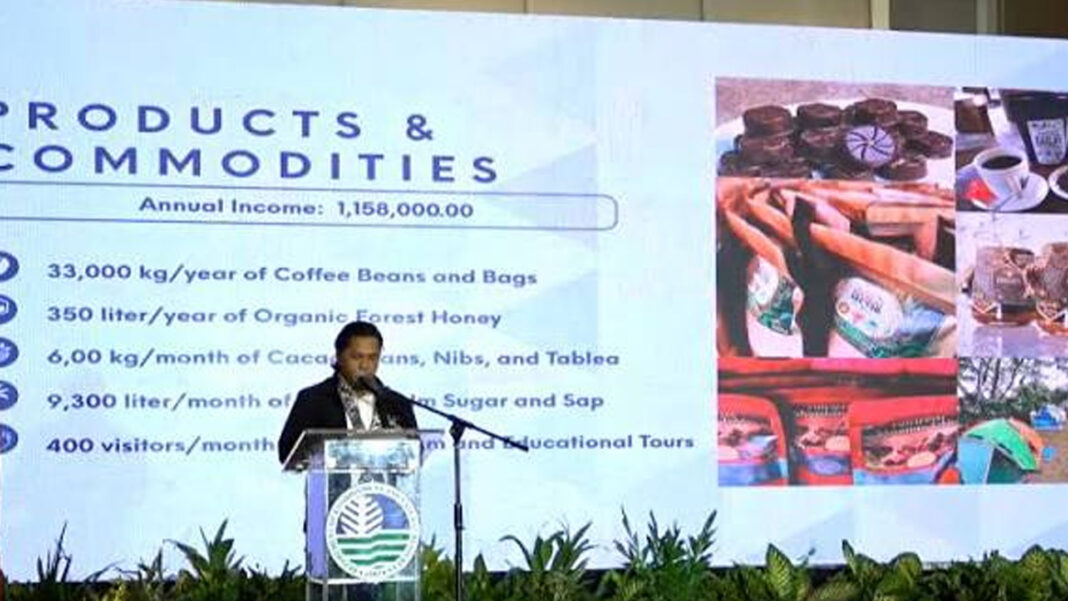
During an investment forum organized by the DENR-Forest Management Bureau (FMB) in Makati City on Thursday, the agency presented eight Community-Based Forest Management People’s Organizations (CBFM-POs), highlighting their vital role in sustainable forest management.
In his speech delivered by Undersecretary Jonas Leones, Environment Secretary Juan Miguel Cuna said these CBFM-POs have been the agency’s partner in protecting and managing the country’s forest wealth.
Forest protectors
“Only 7,226,394 hectares are what remains of our forest – 30.7 percent closed forest, 65 percent open forest, and 4.3 percent of mangrove forest. Within these forests live 20 million Filipinos. They are not merely numbers on a map, nor are they bystanders to our forest story. In many places, they are the very reason why these forests still exist,” he said.
“Today we talk about our People’s Organizations, our partners in managing the nation’s forest wealth. This has been a 30-year partnership,” he said, adding that the government could not safeguard the country’s vast forests on its own.
The DENR said the forum seeks to promote inclusive investments and partnerships, as well as sustainable financing for community forestry, while reinforcing the goals of the “Forests for Life: 5 Million Trees by 2028 Program,” which seeks to mobilize investments that empower upland communities while protecting forest ecosystems.
In sharing his previous experience as a forester when he started at the DENR, Leones noted how the community struggled in protecting the forests and sustaining their families at the same time.
He said CBFM-POs helped reduce illegal activities, but sustaining those gains requires communities to have stable sources of income.
“The question is how will this community sustain their efforts, their responsibility to protect the environment if they don’t have viable livelihood?” he said.
Leones said the forum seeks to connect community organizations with investors and markets that can help grow their enterprises, and determine what possible collaboration can be done to address forest protection.
Sustainable livelihood
In his message, Cuna said people’s organizations have already proven their ability to manage forest resources and are ready to become investment partners.
These people’s organizations, he said, have spent more than 30 years proving they are excellent environmental stewards, and that it is time they step forward as social entrepreneurs.
“Since 1995, the DENR has issued 2,000 CBFM agreements, covering 1.66 million hectares. As of April this year, 1,293 agreements remain active, covering 800,000 hectares and directly benefiting 167,543 CBFM stewards,” Cuna said.
Of the active CBFM areas, he said, over 67 percent overlap with Certificates of Ancestral Domain Titles (CADTs), ancestral land titles, and domain claims, while two out of every three hectares sit on land where indigenous and community rights are officially recognized by the state, taking care of lands their families have protected for generations.
“From 2007 to 2025, these organizations have produced more than 52.6 million seedlings, including forest trees, forest fruit trees, and high-value crops among others, while operating enterprises in agroforestry, bamboo, rattan, ecotourism and other forest-based industries,” he said.
Bridging gaps
While acknowledging that many organizations still struggle with limited financing and market access, Cuna said investments can help bridge those gaps.
“To our banking colleagues, every peso invested in closing these gaps yields sustainable production, protected watersheds, rural income, and forests that survive. The years of the PO’s work in nurseries and watersheds must translate into real local income, not just someone else’s balance sheet,” he told potential investors.
Cuna said the DENR’s long-term goal is to help communities build enterprises that can thrive independently.
“Our goal is a CBFM community that runs a self-sustaining enterprise; that is real empowerment,” he added.
Featured CBFM-POs also pitched investment-ready projects to prospective financiers.
“Our communities are the frontliners of forest protection. By investing in them, we invest in the future of our forests, and in the resilience of the families who depend on them,” Cuna said.
He also thanked the people’s organizations for helping the government protect the forestland that belongs to the Filipino people.
During the forum, the DENR also unveiled the Sustainable Forest Land Management Agreement (SFLMA) Module under the Frontline Services Transaction System (FSTS).
The new digital platform is designed to streamline the processing of forest land management agreements to improve efficiency, transparency, and accessibility for stakeholders seeking permits and approvals. (PNA)