

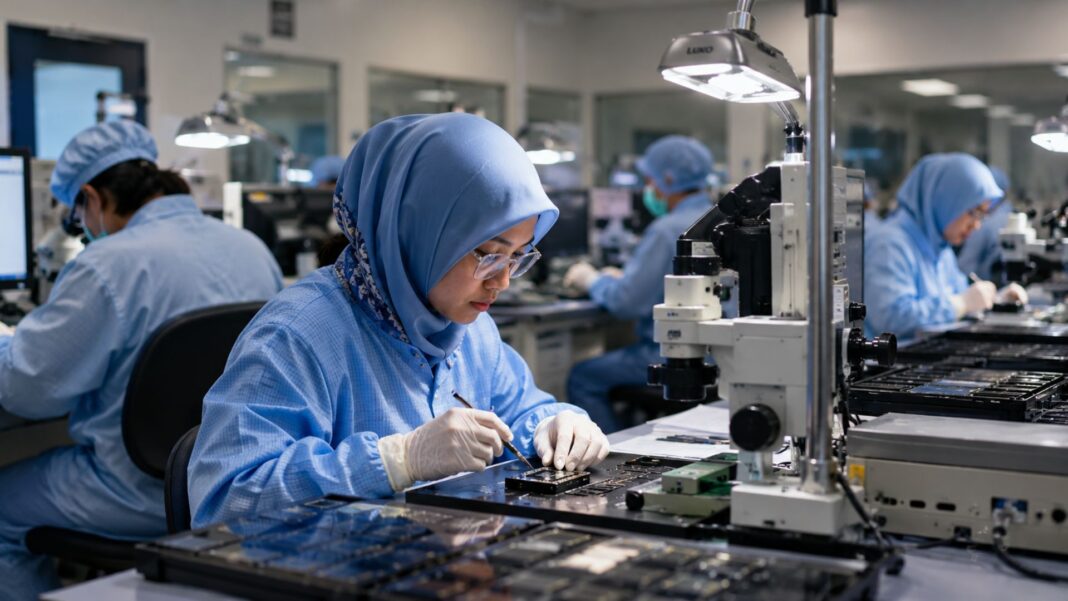

Malaysia’s Ministry of Investment, Trade and Industry officially opened SEMICON Southeast Asia 2026 in Kuala Lumpur on May 5, signaling the country’s ambition to move beyond assembly and test into higher-value semiconductor activities including advanced packaging and design. The three-day gathering, attended by more than 20,000 participants from across the global semiconductor ecosystem, coincides with a period of accelerating supply chain restructuring that is directing capital and manufacturing capacity toward Southeast Asia.
Key Facts At A Glance
- SEMICON Southeast Asia 2026 ran from May 5 to 7, 2026 at the Malaysia International Trade and Exhibition Centre in Kuala Lumpur, with participation from companies and organizations across Asia, the United States, and Europe.
- The opening ceremony was officiated by Datuk Seri Johari Abdul Ghani, Minister of Investment, Trade and Industry, and attended by SEMI leadership and the Malaysian Investment Development Authority, led by Chief Executive Officer Datuk Sikh Shamsul Ibrahim Sikh Abdul Majid.
- Malaysia’s electrical and electronics sector secured RM28.5 billion in approved investments in 2025, reaffirming its role as a cornerstone of the country’s manufacturing economy.
- The global semiconductor industry is expected to reach $1 trillion in annual sales in 2026, driven by an intensifying AI infrastructure build-out.
- MIDA and SEMI reinforced 12 years of partnership anchored on three pillars: ecosystem integration, enterprise capability, and talent advancement.
- The event focused on manufacturing scale-up, advanced packaging, intelligent manufacturing, and workforce development as companies respond to demand from artificial intelligence, high-performance computing, and advanced electronics.
Malaysia’s Strategic Repositioning
SEMICON Southeast Asia 2026 arrives at a moment when Malaysia is moving beyond its established strengths in assembly and test into higher-value activities, including design, advanced packaging, and innovation-driven manufacturing. Under the MADANI Economy Framework and the New Industrial Master Plan 2030, Malaysia’s stated direction is to move the electrical and electronics sector beyond assembly and test into design, advanced packaging, and innovation-driven manufacturing. MIDA Chief Executive Officer Datuk Sikh Shamsul Ibrahim Sikh Abdul Majid described the country as approaching its next phase of semiconductor growth as an active builder rather than a beneficiary of global trends.
The MIDA chief executive stated that the RM28.5 billion secured by the electrical and electronics sector in 2025 is proof that global confidence in Malaysia has not wavered, and that what is now being built is the ecosystem to match that confidence, through supply chain integration, local capability development, and high-value partnerships.
Supply Chain Shift And Industry Context
Market analysts note that Southeast Asia has emerged as a significant driver of global semiconductor growth, having outperformed the broader industry over the past few years, supported by sustained expansion in manufacturing capacity, assembly, testing and packaging, as well as increasing integration into global semiconductor supply chains. The region has benefited from supply chain diversification pressures tied to geopolitical competition, with Malaysia, Vietnam, and Thailand among the primary recipients of redirected manufacturing investment.
SEMI President and CEO Ajit Manocha stated that innovation is no longer confined to a single segment and requires closer alignment across design, manufacturing, materials, and supply chains, with SEMICON Southeast Asia providing a platform to bridge different parts of the ecosystem and enable stakeholders to move from discussion to execution.
MIDA-SEMI Partnership
The enduring alliance between MIDA and SEMI remains anchored on three core pillars: ecosystem integration to harmonize domestic and international supply chains, enterprise capability to empower local businesses to scale technical expertise, and talent advancement to cultivate a high-skilled workforce as the essential bedrock of Malaysia’s long-term economic resilience and competitive edge. The partnership, now in its twelfth year, has coincided with a period of sustained foreign investment inflows into Malaysia’s technology manufacturing base, with the country now serving as a critical node for semiconductor assembly, test, and packaging operations for global chipmakers.