

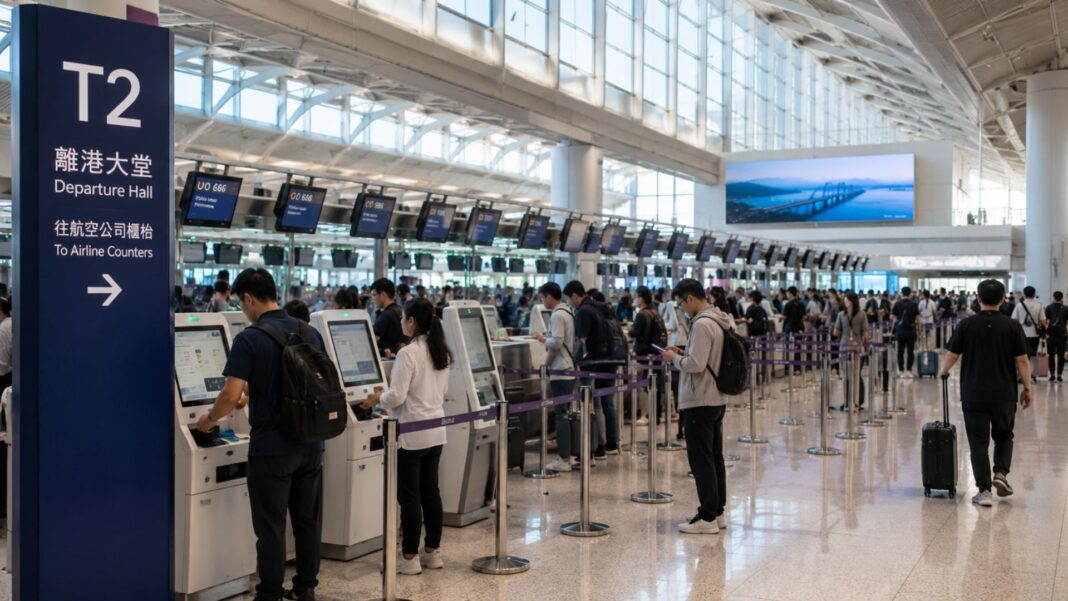

Hong Kong International Airport activated its rebuilt Terminal 2 departure facilities on May 27, 2026, the most significant expansion of the airport’s passenger processing infrastructure since the facility opened on Lantau Island in 1998. The opening, part of a HKD141 billion Three-Runway System program, positions Hong Kong directly against Singapore Changi Airport and Dubai International for transit passenger and cargo market share in the Asia-Pacific region.
Key Facts At A Glance
- T2 departure facilities opened May 27, 2026; T2 concourse with 27 boarding gates to follow in 2027
- T2 upgrade cost: approximately HKD12.9 billion (around USD1.65 billion), part of the broader HKD141 billion Three-Runway System
- Capacity: T2 designed to handle 30 million passengers annually; airport targets 100 million overall
- First departure: Hong Kong Airlines flight to Shanghai on May 27
- 15 airlines relocating check-in to T2 in phases through mid-June 2026
- T2 features 160 check-in counters, 68 automated bag-drop units, and biometric “Flight Token” processing
- HKIA ranked world’s eighth-busiest international airport in 2025, with 38.7 million seats per OAG data
- Three-runway simultaneous operations commenced late 2024
The Opening And Its Significance
Departure facilities at Hong Kong International Airport’s Terminal 2 began accepting passengers on May 27, 2026, with Hong Kong Airlines operating the new terminal’s inaugural departure, a service bound for Shanghai. The terminal opening ceremony had been held five days earlier on May 22, attended by approximately 1,500 guests including 40 business partners covering airlines, cargo terminals, and ground handlers. Airport Authority Hong Kong simultaneously ran the HKIA Expo and Career Fair on May 23 and 24, recruiting across more than 4,400 airport vacancies in ground services, aircraft maintenance, airfreight, aviation security, and catering.
The rebuilt T2 is a central element of Hong Kong’s effort to close the competitive gap with Singapore Changi Airport and Dubai International, both of which have outpaced Hong Kong in international seat capacity. OAG data for 2025 ranked HKIA as the world’s eighth-busiest international airport by seats at 38.7 million, compared with Dubai International at 62.4 million and Singapore Changi at 42.6 million. Airport Authority Hong Kong Chairman Fred Lam described the opening as “another milestone of HKIA’s development,” timing the launch to ensure the airport could meet anticipated summer peak demand.
Infrastructure And Technology
The new departure hall houses 160 check-in counters spread across eight aisles, alongside 68 automated self bag-drop counters, 58 self-service check-in kiosks, and re-engineered security screening lanes equipped with biometric e-Security Gates. HKIA has introduced a “Flight Token” system that allows eligible passengers to use facial recognition as a boarding pass at multiple checkpoints, reducing the need to repeatedly present travel documents throughout the departure process. The terminal is directly connected to the Airport Express station and to Terminal 1 via an air-conditioned footbridge, with 29 airport bus routes adding a T2 stop.
Airport Authority Hong Kong stated that T2 is expected to handle approximately eight million passenger journeys in its first year, with potential to accommodate up to 30 million passengers annually at full scale. The full T2 concourse, which will add 27 boarding gates including seven multi-aircraft ramp stands, is scheduled to open in 2027. Until the concourse opens, passengers checking in at T2 will proceed to Terminal 1 for boarding via the Automated People Mover, which operates from 05:30 to 00:30 daily.
Airline Transition Schedule
The 15 carriers relocating check-in operations to T2 cover predominantly short-haul and regional routes. Hong Kong Airlines was the first to transfer all check-in counters on May 27. Greater Bay Airlines follows on June 3, and HK Express on June 10, with the remaining carriers expected to complete their moves by mid-June. Selected Cathay Pacific flights will also transfer to T2 as part of the reallocation, freeing additional processing capacity at Terminal 1 for full-service long-haul operations. Additional carriers relocating include AirAsia, IndiGo, Bangkok Airways, Cebu Pacific, Cambodia Airways, and Hainan Airlines.
Competitive Context
The T2 launch follows the commencement of simultaneous three-runway operations at HKIA in late 2024, the first major operational capacity milestone in the airport’s Three-Runway System program. Together, the third runway and rebuilt T2 represent the two most consequential infrastructure completions in the airport’s recent history. Hong Kong is simultaneously contending with the ongoing effects of the Middle East conflict, which has disrupted Gulf hub routing and redirected some transit traffic toward East Asian gateways, creating a window of opportunity for HKIA to recapture flows that had migrated to competitors. Industry analysts have noted that Hong Kong’s infrastructure upgrades, combined with advanced biometric processing and the three-runway system, could support a meaningful recovery in international transit competitiveness, though full recovery of pre-pandemic seat volumes relative to rival hubs will take several additional years.
Publicly available information does not include confirmed airline capacity commitments or revised annual passenger forecasts specific to HKIA following the T2 opening.