

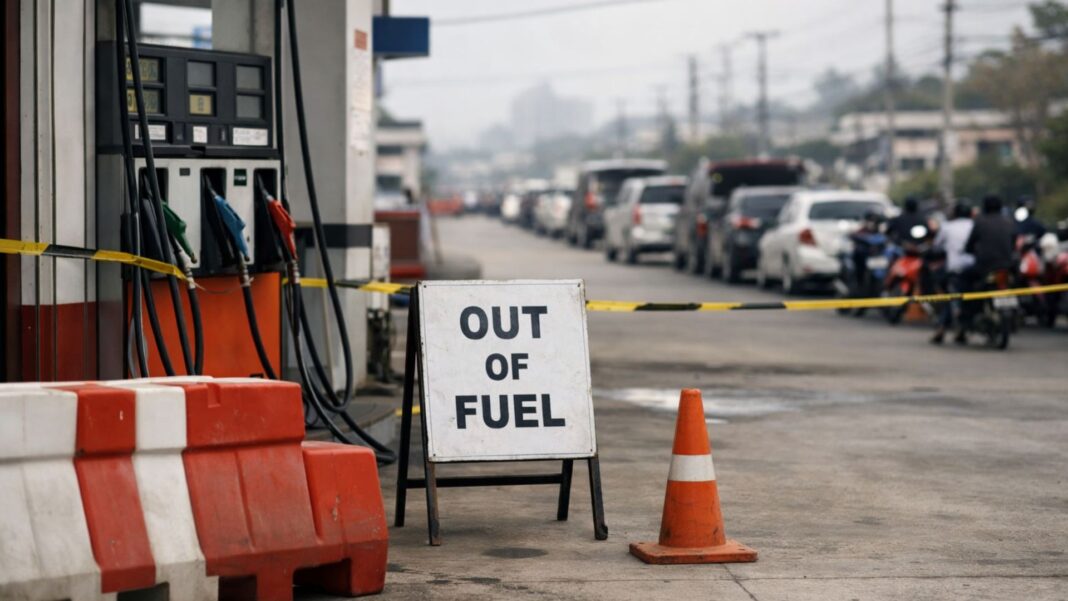

Laos enacted emergency excise tax cuts on all fuel types on March 18, eliminating the diesel excise tax entirely and halving the gasoline levy, after more than 1,000 fuel stations closed nationwide and the country recorded the world’s second-highest pump price increase in the first weeks of March 2026. The intervention came as the government acknowledged that its near-total dependence on Thai fuel imports had left it critically exposed to the cascading effects of the Strait of Hormuz disruption.
Key Facts At A Glance
- Lao Ministry of Industry and Commerce cut gasoline excise tax from 25% to 15% and diesel excise tax from 10% to 0% effective March 18, 2026
- Between March 4 and March 10, diesel prices surged approximately 50%, from LAK 21,930 to LAK 32,860 per liter; 95-octane gasoline recorded the world’s second-highest price increase in that period, per Global Petrol Prices
- 1,061 of Laos’ 2,538 registered fuel stations were reported closed as of March 11; some provinces including Xieng Khouang saw over 79% of stations shut
- Laos imports over 97% of its fuel from Thailand; Thailand’s initial export ban triggered immediate panic buying that emptied Vientiane stations within hours
- Thailand granted Laos an exemption from its fuel export ban and an emergency 12-million-liter shipment was arranged to relieve immediate pressure
- The government committed LAK 300–600 billion from its fuel support fund to stabilize retail prices
- A Prime Minister’s office directive ordered transport companies to ensure EVs account for at least 10% of their fleets by end-2026 and halted government purchases of new fuel-powered vehicles
The Immediate Shock
When Iran’s closure of the Strait of Hormuz sent regional fuel markets into distress in late February 2026, few countries in Southeast Asia were as abruptly exposed as Laos. The landlocked nation has no domestic refining capacity and imports more than 97 percent of its fuel from Thailand, according to the Lao Department of Foreign Trade. When Thailand announced an emergency export ban on refined fuels on March 1 under Prime Ministerial Order No. 2/2026, the effect in Laos was immediate: panic buying swept petrol stations across Vientiane within hours, and queues stretching two hours or longer formed at the small number of stations that remained open.
Thailand ultimately exempted Laos and Myanmar from the export ban, citing existing bilateral energy cooperation arrangements. Thailand exports approximately 7 million liters of fuel per day to Laos and in return imports a share of its electricity supply from Lao hydropower generation. Thai Prime Minister Anutin Charnvirakul confirmed on March 15 that exports to Laos would continue and that Thailand held reserves estimated at around 90 days, the highest in ASEAN. An emergency 12-million-liter shipment from Thailand helped ease the worst of the immediate pressure, but sources on the ground told AFP that when fuel arrived it was typically exhausted within a day.
The Scale Of The Disruption
By March 11, the Lao Ministry of Industry and Commerce reported that 1,061 of the country’s 2,538 registered fuel stations had closed or suspended sales, a closure rate of approximately 42 percent nationwide. The situation was more acute in outlying provinces. In Vientiane Province, 121 of 207 stations were shut; in Xieng Khouang Province, 121 of 153 stations were closed. Observers and journalists reported stations in Vientiane city with signs reading “out of fuel,” with the remainder queued by motorcycles and vehicles waiting up to two hours for partial refueling.
Pricing data tracked by Global Petrol Prices placed Laos as having the world’s second-highest premium gasoline price increase in the March 4–10 window. Diesel prices rose from LAK 21,930 per liter on March 4 to LAK 32,860 per liter by March 10, a surge of nearly 50 percent in six days. These increases unfolded against a background of pre-existing economic fragility: Laos’ inflation rate had already risen to 6.2 percent in February 2026, up from 5.1 percent the prior month, and the country entered the crisis with limited fiscal reserves and a structurally weak kip.
Government Response: Taxes, Funds, And Market Controls
The Lao government’s response unfolded in stages across March. On March 2, the Ministry of Industry and Commerce required all fuel importers and distributors to report supply and import plans daily to the Department of Internal Trade by 4:00 PM, and prohibited operators from hoarding or closing stations without valid reasons. On March 13, the ministry ordered nationwide inspections of fuel depots and stations, directing officials to review delivery records back to February 1 and take enforcement action against operators found to be manipulating supply.
On March 16, the Ministry of Industry and Commerce announced the first formal tax adjustment, cutting the 95-octane gasoline import tax from 20 percent to match the 15 percent rate applied to 91-octane regular gasoline. By March 17, the government announced broader cuts: the excise tax on gasoline dropped from 25 percent to 15 percent and diesel from 10 percent to zero. On March 18, Xinhua reported the formal issuance of the notice, with the government simultaneously committing LAK 300–600 billion from its dedicated fuel support fund to stabilize retail prices and subsidize distribution, particularly in remote areas.
A special committee was appointed to oversee crisis response and report directly to the Prime Minister. Work-from-home policies were extended to government staff, and fuel rationing was left to local authorities in worst-affected areas. A mobile fuel service was launched in Vientiane, and in Champasak province authorities introduced free bus service on main and suburban routes as a demand substitution measure.
The EV And Transport Policy Pivot
Among the more structurally significant elements of Laos’ response was a directive from the Prime Minister’s office mandating that transport companies ensure electric vehicles account for at least 10 percent of their fleets by the end of 2026. Import procedures for EVs are to be simplified and made less costly. Government agencies were ordered to halt purchases of new fuel-powered vehicles for administrative use. Authorities in Vientiane were also directed to extend the existing Bus Rapid Transit network to the capital’s railway station and airport.
Laos had previously pursued modest EV adoption through existing incentives: zero import tariffs on EVs, a preferential excise tax of approximately 3 percent, and roughly a 30 percent reduction in annual road tax compared to petrol vehicles of comparable size. The country recorded more than 4,600 EV sales in 2023. The March directives represent a formal escalation from incentive-based promotion to mandatory fleet transition targets, though analysts note that charging infrastructure remains limited and upfront EV costs remain prohibitive for much of the population.
The Structural Exposure
The 2026 crisis crystallized a supply chain vulnerability that predates it. Laos’ near-total dependence on Thai refined petroleum products means that any Thai domestic supply decision, export restriction, or bilateral diplomatic development cascades directly and immediately into Lao fuel availability. The Economic Research Institute for ASEAN and East Asia noted that Laos, along with Cambodia and Myanmar, lacks meaningful domestic refining capacity, leaving all three countries wholly dependent on refined product exports from neighboring states.
The episode also exposed the limits of the Lao fuel support fund as a price stabilization mechanism. While the fund provided a buffer during prior periods of volatility, the scale and speed of the March 2026 price increase rapidly depleted its capacity to moderate retail prices without external tax adjustments. Government officials said the fund’s allocations were focused on distribution support and preventing sudden spikes rather than absorbing the full magnitude of price increases.
Publicly available details on the precise disbursement terms of the LAK 300–600 billion fuel support fund allocation and the enforcement outcomes of the March 13 market inspection orders remain limited as of the publication date of this report.