

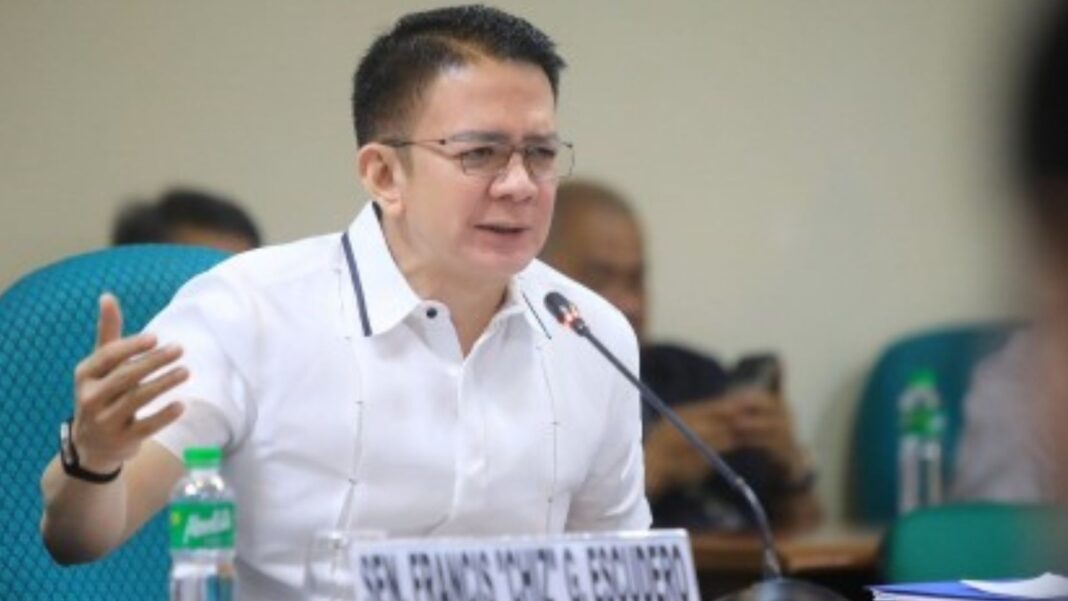

The proposal to give barangay and Sangguniang Kabataan (SK) officials a five-year term is designed to establish a definite electoral cycle rather than continue the practice of repeatedly postponing village elections.
“My bill does not extend. My bill fixes,” Senator Francis Escudero said Monday during a public hearing of the Committee on Local Government.
“The natural effect will be, of course, to postpone the upcoming elections, but the subject matter of this bill is fixing the term.”
Escudero was referring to Senate Bill (SB) No. 2387, which would amend Republic Act (RA) No. 12232 by setting the term of barangay and SK officials at five years, instead of the current four.
The distinction was reflected in the committee agenda, which separately listed Escudero’s term-setting measure and SB 2067 of Senator Imee Marcos, whose stated purpose is to postpone the Nov. 2 Barangay and SK Elections (BSKE).
Under RA 12232, signed into law in August 2025, barangay and SK officials currently have four-year terms, with the next regular elections scheduled on the first Monday of November 2026 and every four years thereafter.
Barangay officials may serve no more than three consecutive terms in the same position, while SK officials are limited to one term.
Escudero said fixing a permanent five-year term into law would provide barangays with a more predictable governance cycle and reduce the need for Congress to repeatedly revisit election dates.
The proposal would also give local officials more time to carry out community development projects, disaster preparedness programs, and peace and order initiatives without being interrupted by frequent electoral exercises.
Under the bill’s transition mechanism, the additional period served by incumbent officials would be counted as part of their term for purposes of term limits.
This means barangay officials already on their third consecutive term would remain barred from seeking the same post in the next election, while the existing one-term limit for SK officials would remain.
If enacted, the next regular BSKE would be held in November 2028, followed by elections every five years.
Escudero’s distinction between fixing a term and merely postponing an election also mirrors the Supreme Court’s treatment of RA 12232 last year.
In an 8-5-2 decision in November 2025, the high court upheld the law and ruled that it was “fundamentally a term-setting law,” with the change in the BSKE schedule considered incidental to Congress’ authority to determine the term of barangay officials.
BSKE Preparations Ongoing
The Commission on Elections (Comelec), meanwhile, told the hearing that preparations for the November polls are underway.
Comelec Chairperson George Garcia said about PHP8 billion of the PHP19.57-billion funding for the 2026 BSKE has been spent, obligated or earmarked.
The poll body estimated around PHP3 billion as costs already incurred, although printed ballots, ballot boxes and other election materials may still be preserved and used if the polls are reset.
Garcia also said around PHP10.944 billion could remain unobligated should the November election no longer proceed, with Comelec exploring how the amount could eventually support preparations for the 2028 national and local elections. (PNA)