

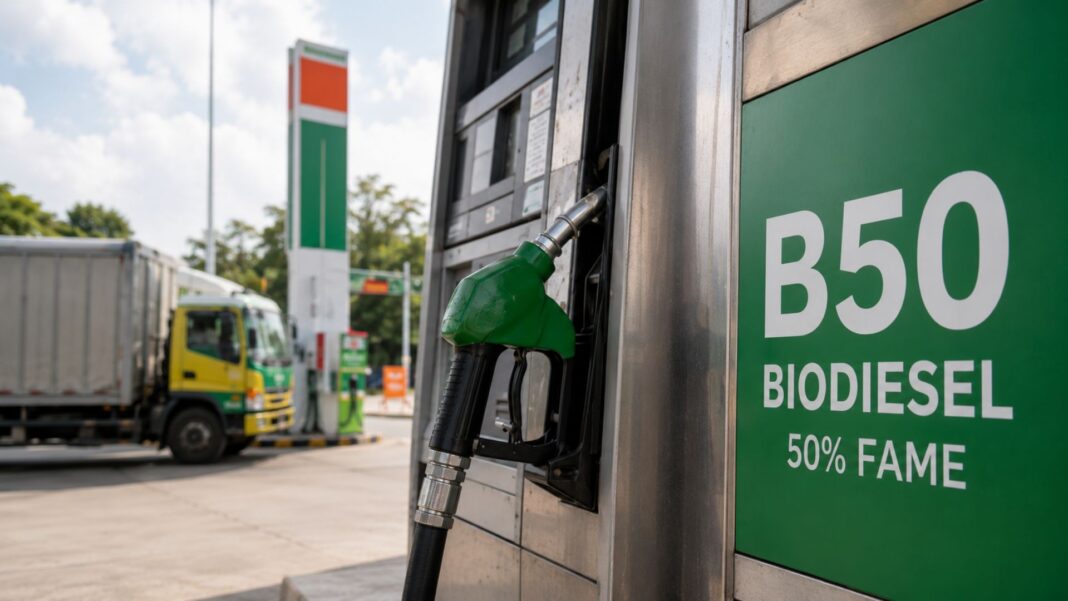

Indonesia’s Energy and Mineral Resources Minister Bahlil Lahadalia confirmed on June 18, 2026 that the country will implement a mandatory B50 biodiesel blend starting July 1, 2026, following positive results from technical trials across multiple transport and industrial sectors. The mandate, which raises the palm oil-based biodiesel share in diesel fuel from 40% to 50%, is projected to eliminate C48 diesel imports and save approximately IDR 157.28 trillion in foreign exchange this year.
Key Facts At A Glance
- B50 is a mandatory fuel blend of 50% Fatty Acid Methyl Ester derived from crude palm oil and 50% conventional fossil diesel, up from the current 40% blend under the B40 mandate.
- Energy Minister Bahlil Lahadalia confirmed the July 1, 2026 implementation date to reporters in Jakarta on June 18, 2026.
- The mandate is projected to save IDR 157.28 trillion (approximately USD 8.84 billion) in foreign exchange in 2026, an increase of approximately 17.9% over the IDR 133.3 trillion saved under the B40 program in 2025.
- The BPDPKS (Palm Oil Plantation Fund Management Agency) collected IDR 17.4 trillion in palm oil export levies from January to May 2026, approximately 64% of the IDR 26.84 trillion annual target used to fund biodiesel subsidies.
- Expected B50 demand in the second half of 2026 is approximately 17.6 million kiloliters of FAME, exceeding the 15.65 million kiloliters previously allocated for the full year.
- State-owned railway operator PT Kereta Api Indonesia has been conducting B50 locomotive and generator trials since April 2026; railway and power generation sector testing will continue into the second half of 2026.
- The program is projected to generate IDR 24.68 trillion in crude palm oil added value, absorb 2.21 million workers, and reduce greenhouse gas emissions by 46.72 million tons.
July 1 Confirmation And Trial Outcomes
Energy and Mineral Resources Minister Bahlil Lahadalia confirmed on June 18, 2026 that Indonesia will implement the B50 biodiesel mandate on July 1, stating the blend had undergone rigorous trials and produced positive results (en.antaranews.com). The B50 blend consists of 50% Fatty Acid Methyl Ester (FAME) derived from crude palm oil and 50% conventional fossil diesel. Testing covered heavy equipment, ships, trains, mining vehicles, excavators, and agricultural machinery. The ministry noted that the B50 blend features lower water content than the current B40 mixture (en.antaranews.com).
Technical testing for the automotive sector commenced December 2, 2025, and was targeted for completion in June 2026. Testing for agricultural machinery, mining equipment, and the railway and power generation sectors remains ongoing and will continue into the second half of 2026. Ministry spokesperson Dwi Anggia stated that full simultaneous implementation across all sectors would proceed on July 1 regardless of remaining testing milestones.
State-owned railway operator PT Kereta Api Indonesia (KAI) has been conducting B50 trials on locomotives and generators in cooperation with the Energy Ministry since April 2026. KAI President Director Bobby Rasyidin confirmed the company is finalizing operational adjustments to transition its full fleet to B50 ahead of the July 1 rollout. KAI’s biodiesel history runs from B0 in 2017 through sequential blend increases to B40 in 2025-2026, with B50 representing the most recent increment in a structured decade-long energy transition roadmap.
Policy History And The March Reversal
The July 1 mandate represents a policy reversal from January 2026, when Deputy Energy Minister Yuliot Tanjung announced that Indonesia would remain at B40 for the year, citing technical concerns and insufficient FAME supply infrastructure. That decision sent Malaysian crude palm oil benchmark prices down 0.52% on the day of announcement, reversing earlier gains of up to 1.33%, as markets had anticipated additional CPO absorption from a higher blend mandate.
The government revived B50 planning in March 2026 following the Strait of Hormuz disruption and the resulting surge in global diesel prices. Higher fossil fuel prices narrowed the traditional price premium of palm oil-based biodiesel over conventional diesel, improving the subsidy economics of the program and reducing fiscal pressure on the BPDPKS funding mechanism. Energy Minister Lahadalia stated that the Middle East supply disruption directly highlighted the risks of fossil fuel import dependence and reinforced the strategic case for B50.
Subsidy Mechanics And Fiscal Structure
The biodiesel mandate is financed through the BPDPKS, which collects export levies on CPO and its derivative products and uses the proceeds to subsidize the price gap between FAME and conventional diesel at the consumer level. Under Finance Ministerial Regulation PMK 9/2026, the export levy on CPO and its derivatives is capped at 12.5% of the Trade Ministry’s reference price. The BPDPKS manages the full pass-through mechanism under which biodiesel producers receive guaranteed margin certainty, with any production cost increases compensated directly by the state.
From January to May 2026, the BPDPKS collected IDR 17.4 trillion in levies, approximately 64% of the IDR 26.84 trillion annual target. With the shift to B50 in the second half of the year, expected FAME demand rises to approximately 17.6 million kiloliters, exceeding the 15.65 million kiloliters initially allocated for 2026 in full. The Energy Ministry is preparing the regulatory acts needed to authorize the additional biodiesel quota to fulfill the B50 mandate.
CPO Supply And Export Implications
Indonesia’s annual CPO production has remained between 48 and 51 million tons in recent years, with 2026 output projected at approximately 50 million tons (indonesia-investments.com). Domestic CPO consumption for biodiesel under B50 is projected at approximately 16 to 18.5 million tons, leaving an estimated 22 million tons available for export, a modest reduction from pre-B50 levels. The Indonesian Palm Oil Association (GAPKI) has warned that if CPO production remains stagnant, increased domestic biodiesel absorption will compress export volumes and reduce the export levy revenues that fund BPDPKS subsidies, creating a potential circular fiscal constraint.