

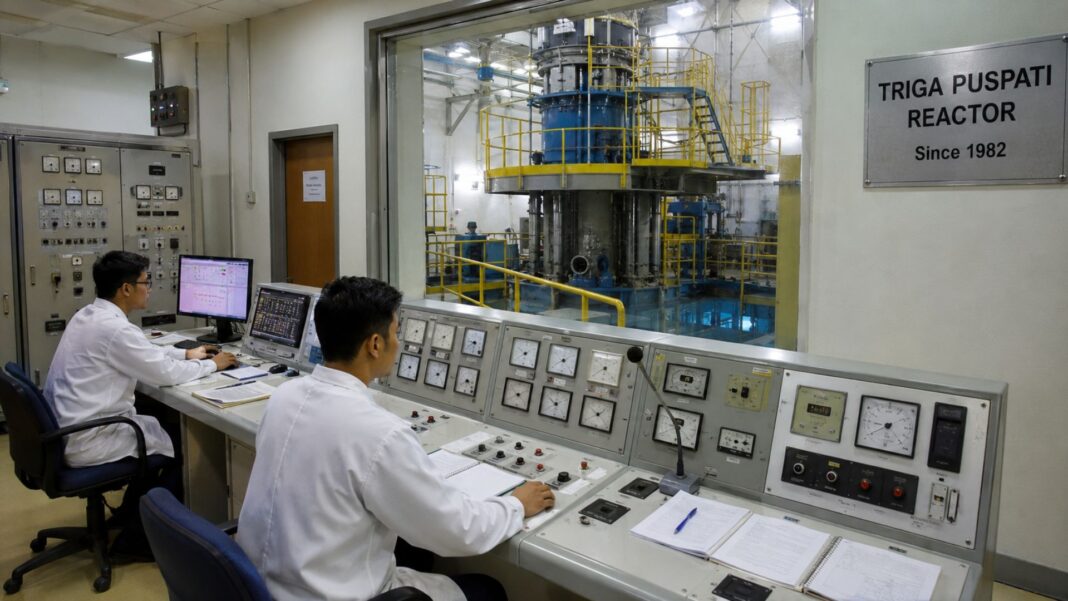

International Atomic Energy Agency Director General Rafael Mariano Grossi stated on June 14, 2026 that Malaysia is well-positioned to pursue a nuclear power programme, citing the country’s decades of experience operating a research reactor as a concrete technical foundation. The endorsement adds multilateral institutional weight to Malaysia’s nuclear ambitions as formalised in the 13th Malaysia Plan and accelerated by energy security pressures arising from the ongoing Strait of Hormuz disruption.
Key Facts At A Glance
- IAEA Director General Grossi made the statement on June 14, 2026 at the IAEA Journalists Seminar in Vienna.
- Malaysia operates the TRIGA Puspati Reactor at the Malaysian Nuclear Agency in Bangi, in operation since 1982.
- Nuclear power is embedded in the 13th Malaysia Plan (RMK13) for 2026-2030, tabled on July 31, 2025, with implementation targeted to begin from 2031.
- MyPOWER Corporation has been designated as Malaysia’s Nuclear Energy Programme Implementing Organisation (NEPIO) under the Ministry of Energy Transition and Water Transformation (PETRA).
- Malaysia and the United States signed a Strategic Civil Nuclear Memorandum of Understanding in July 2025, initiating negotiations toward a full 123 Agreement; MyPOWER also signed a non-disclosure agreement with Rosatom in June 2025.
- Tenaga Nasional Berhad has received data center power supply applications exceeding 11 GW, representing more than 40% of Peninsular Malaysia’s existing installed capacity.
- Malaysia is among 28 countries in the IAEA’s nuclear decision-making phase out of approximately 70 newcomer countries globally pursuing or exploring nuclear energy as of January 2026.
IAEA Director General Rafael Mariano Grossi publicly affirmed on June 14, 2026 that Malaysia is well-positioned to pursue a nuclear power programme. Speaking to journalists at the IAEA Journalists Seminar in Vienna, Grossi cited Malaysia’s operation of the TRIGA Puspati research reactor at the Malaysian Nuclear Agency in Bangi since 1982 as a concrete technical foundation. Having a research reactor was described as “certainly a very good, solid basis” for advancing the programme, as it meant the country already had people familiar with nuclear technology and reactor operations. Grossi also noted that the IAEA had been actively working with Malaysia and that the government had expressed strong interest in exploring nuclear energy more systematically.
The Director General described nuclear power as a long-term national commitment spanning multiple generations, noting that plants operate for close to one hundred years. He added that the IAEA provides no one-size-fits-all approach, instead assisting governments in evaluating reactor technologies and vendor proposals for compatibility with national grid capacity, supply chain capabilities, and long-term development objectives. Malaysia is among 28 countries currently in the IAEA’s decision-making phase, out of approximately 70 newcomer countries across Africa, Latin America, and Asia pursuing or exploring nuclear energy as of January 2026.
Programme Institutional Architecture
Malaysia’s nuclear ambitions are formally embedded in the 13th Malaysia Plan (RMK13) for 2026-2030, tabled by Prime Minister Datuk Seri Anwar Ibrahim on July 31, 2025, which identifies nuclear energy as a clean, competitive, and safe electricity source with implementation targeted to begin from 2031. PETRA, led by Deputy Prime Minister Datuk Seri Fadillah Yusof, holds the primary policy mandate.
MyPOWER Corporation has been formally designated as Malaysia’s NEPIO, responsible for coordinating phased nuclear programme preparation in accordance with the IAEA’s Milestones Approach. MyPOWER conducted a nuclear pre-feasibility study between June and December 2024, producing 24 key findings and 22 strategic recommendations in support of nuclear readiness. The IAEA Milestones Approach is a three-phase framework established in 2007 guiding newcomer countries in developing the legal, regulatory, and institutional infrastructure required for safe and sustainable nuclear power deployment.
On the partnerships front, Malaysia and the United States signed a Strategic Civil Nuclear Memorandum of Understanding in July 2025, launching formal negotiations toward a full civil nuclear cooperation agreement under Section 123 of the US Atomic Energy Act. A full 123 Agreement is required before any transfer of nuclear materials, equipment, or technology originating from the United States can take place, and would also provide Malaysia access to technology and plant designs from countries including Japan, France, and South Korea, which rely substantially on US-derived intellectual property. In June 2025, MyPOWER also signed a non-disclosure agreement with Rosatom covering cooperation on legal frameworks, technology transfer, and workforce training.
Demand Drivers And Vendor Landscape
Two concurrent pressures are shaping the pace of Malaysia’s nuclear programme. The first is electricity demand from the data center sector: Tenaga Nasional Berhad has received power supply applications from data center operators exceeding 11 GW, a figure representing more than 40% of Peninsular Malaysia’s existing installed capacity. This load concentration has pressed the government to identify firm, low-carbon baseload options that cannot be met by variable renewables alone.
The second pressure is the energy security shock from the Strait of Hormuz disruption. Fadillah stated in March 2026 that the disruption to key energy routes has directly intensified the urgency of assessing nuclear power’s feasibility. Fossil fuels account for over 70% of Malaysia’s energy mix, and the country faces the prospect of becoming a net gas importer within 10 to 20 years despite domestic oil and gas production.
Small modular reactors have emerged as the leading technology consideration, given their smaller footprint and modular deployability. GE Vernova and Hitachi signed a memorandum of understanding in March 2026 to pursue commercial deployment of their BWRX-300 SMR in Southeast Asia, while Rosatom has maintained engagement with MyPOWER since June 2025. No final decision on reactor technology, plant location, or construction contract has been announced. Site assessment criteria include proximity to water for cooling, grid connection, port logistics, and geological and seismic conditions.