

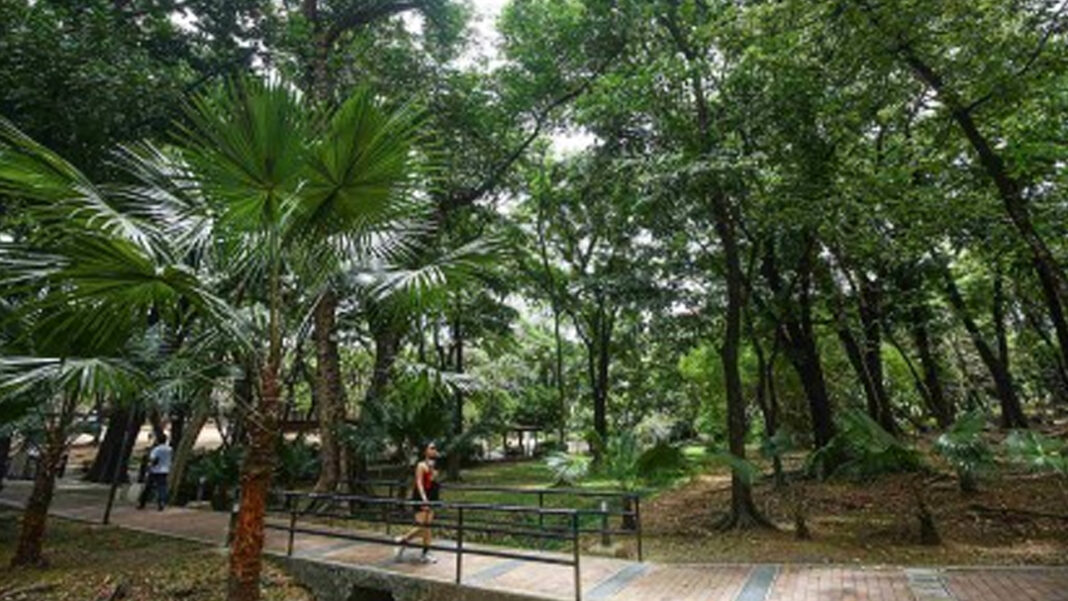

Metro Manila, being the country’s bustling, energetic, and highly populated capital region, is dominated by closely-knit houses, high-rise towers, highways, and malls, but a detailed mapping by the Department of Environment and Natural Resources (DENR) instills hope that green spaces will persist to provide fresh air to its residents and visitors.
The National Capital Region (NCR) is often described as a concrete jungle, where nature is rare yet highly prized. The DENR-NCR in 2025 and early 2026 documented pockets of green, totaling about 11,000 hectares, that provide vital breathing room for its residents, the DENR-NCR said in its social media post on Tuesday.
“Metro Manila is more than just a highly urbanized region; it is an urban forest striving to become greener, more sustainable, and more resilient for future generations,” the post added.
Green inventory
The DENR-NCR has expanded its validation of urban green spaces across multiple local government units, documenting parks, tree-lined roads, gardens, coastal vegetation, and other ecological assets that collectively form Metro Manila’s urban environmental backbone.
“The initiative forms part of the implementation of the Philippine Biodiversity Strategic Action Plan, particularly Target No. 12, which aims to increase the extent and accessibility of urban green and blue spaces for the public by 2040,” it said.
In 2025, validations covered six cities and one municipality.
This includes Muntinlupa City with 1,680.70 hectares, Parañaque with 789.83 hectares, Taguig with 670.38 hectares, Marikina City with 428.57 hectares, Las Piñas with 408.73 hectares, and Pateros, the sole municipality, with 62.61 hectares.
For the first half of this year, the mapping expanded further to include Quezon City (5,616.68 hectares), Pasay City (250.24 hectares), and San Juan (88.33 hectares).
The DENR-NCR said these validated areas cover a wide spectrum of urban ecological features, including public parks, school gardens, landscaped compounds, roadside greenery, center islands, pocket gardens, plant boxes, and coastal vegetation.
Urban nature
Since 2024, the DENR-NCR has validated a total of 11,233.37 hectares of green spaces across 15 cities and one municipality in Metro Manila.
It said that the growing dataset is being used as a reference point for environmental planning and urban design, helping local governments better understand how green spaces are distributed and where gaps in coverage remain, to guide future greening initiatives.
“These validations provide critical data for environmental planning, land-use planning, urban greening initiatives, and biodiversity conservation efforts,” it said.
Why urban green spaces matter?
In a region facing persistent challenges such as flooding, heat stress, and air pollution, urban green spaces serve as more than a visual relief.
These pocket green spaces function as natural infrastructure, helping regulate temperature, absorb rainfall, improve air quality, and provide limited but important habitats for the remaining urban biodiversity.
The DENR said the ongoing validation effort is expected to support more targeted urban greening programs and strengthen climate resilience planning across Metro Manila’s local governments.
Despite the continued urbanization, these green spaces should remind us that nature is not absent from the city but is embedded within it.
Residents can help by protecting the existing greenery by disposing of waste properly, avoiding litter, and illegal dumping.
“Sa pamamagitan ng sama-samang pagkilos ng pamahalaan, pribadong sektor, at komunidad, layunin ng DENR-NCR na makamit ang isang mas luntian, mas maaliwalas, at mas sustainable na Metro Manila para sa susunod na henerasyon (Through the collective action of the government, private sector, and community, the DENR-NCR aims to achieve a greener, more spacious, and more sustainable Metro Manila for the next generation),” the agency said. (PNA)