
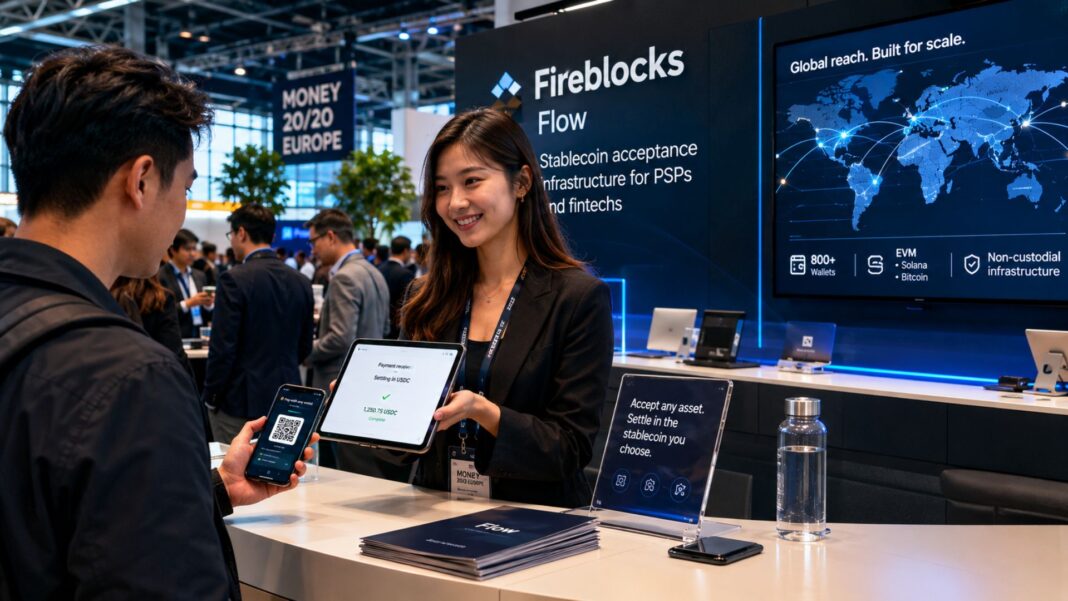

Fireblocks has launched Fireblocks Flow, a stablecoin acceptance product built for payment service providers and fintechs, enabling merchants to receive digital asset payments from any wallet and settle in a stablecoin of their choice without rebuilding existing checkout or deposit infrastructure. Unveiled at Money20/20 Europe in Amsterdam on June 2, 2026, Flow arrives as Fireblocks also co-founded the Open Transaction Layer, an open industry protocol standard for compliant on-chain transactions, signaling a broader push to set the rails on which institutional stablecoin commerce will run.
Key Facts At A Glance
- Fireblocks launched Flow on June 2, 2026 at Money20/20 Europe in Amsterdam; the product is available immediately
- Flow supports over 800 external wallets across EVM networks, Solana, and Bitcoin, plus exchange deposits from Coinbase, Kraken, and Crypto.com
- Merchants can accept any digital asset from consumers and settle in their preferred stablecoin; Fireblocks does not take custody at any point
- Flow includes built-in wallet ownership verification, sanctions screening, geographic controls, automated asset conversion, and transaction reconciliation
- Flutterwave, Africa’s largest payment company, is among the launch customers integrating Flow into its stablecoin infrastructure
- Flow is compatible with the Open Transaction Layer, an open industry standard for compliant on-chain transactions that launched May 28, 2026, co-founded by Fireblocks alongside Robinhood, MetaMask, Checkout.com, and over 30 other institutions
- Fireblocks secures more than USD14 trillion in digital asset transactions and counts Worldpay, BNY, Galaxy, and Revolut among its institutional clients
- According to Fireblocks’ own research, 56% of institutions in Asia are already live with stablecoin initiatives, the highest adoption rate globally; 69% of private banks and wealth managers globally are running stablecoin programs
The Product
Fireblocks Flow is designed to eliminate the engineering burden that has historically prevented payment service providers and fintechs from accepting stablecoin and digital asset payments at scale. Before Flow, a PSP seeking to accept stablecoins was required to assemble separate components for wallet connectivity, asset routing, compliance tooling, conversion infrastructure, and reconciliation, typically across multiple vendors and months of integration work.
Flow plugs into a payment company’s existing checkout and deposit flows. Once integrated, all merchants on that PSP’s platform can immediately accept payments from any of 800-plus supported external wallets across EVM chains, Solana, and Bitcoin, as well as from exchange accounts held at Coinbase, Kraken, and Crypto.com. Consumers pay from whichever wallet or digital asset they hold; the merchant receives settlement in the stablecoin they configure. Fireblocks sits in the infrastructure layer and does not take custody of funds at any point, including during conversion.
Compliance functions are embedded in the product stack. Flow performs wallet ownership verification, sanctions screening, geographic controls, and automated reconciliation against existing transaction ledgers, removing the need for a dedicated in-house crypto compliance team to operate the product.
The OTL Connection
Flow’s launch is part of a broader infrastructure move by Fireblocks. On May 28, 2026, Fireblocks co-founded the Open Transaction Layer alongside Robinhood, MetaMask, Checkout.com, Cross River Bank, SoFi, WalletConnect, FalconX, Wintermute, eToro, MoonPay, and more than 30 other financial institutions, blockchain networks, and infrastructure providers.
OTL defines shared protocols for identity, messaging, and transaction coordination across institutions, unhosted wallets, and AI-driven agents. Its technical architecture draws on existing standards including W3C DIDs, IVMS101, ISO 20022, and CAIP-19, organized into four layers covering identity, session, transport, and messaging, with an application layer above for business logic. The founding blockchain participants include the Solana Foundation, Stellar Development Foundation, Polygon, TON Foundation, Monad Foundation, and Sui Foundation.
Fireblocks co-founder and chief product officer Idan Ofrat described the problem OTL addresses: regulated institutions have been building bespoke connections for each digital asset counterparty, creating integration sprawl and parallel systems that do not reconcile. OTL is designed so that an institution integrates the standard once and can reach all other OTL participants without bilateral rebuilds.
Flow is built to be compatible with OTL, meaning that as new providers join the standard, Flow’s coverage expands automatically without additional integration work on the payment company’s side.
Southeast Asia Relevance
Fireblocks’ launch statement directly named Manila as a market where PSPs are already handling stablecoin-denominated consumer payments on infrastructure the PSPs did not build for. Ran Goldi, SVP Payments and Network at Fireblocks, cited Lagos, São Paulo, and Manila in the same context: markets where consumer stablecoin use has outpaced the merchant and PSP infrastructure available to capture it.
The Philippines is one of Southeast Asia’s most active stablecoin and digital asset markets. The Bangko Sentral ng Pilipinas has one of the region’s most developed virtual asset service provider frameworks, and remittance-linked stablecoin use has grown alongside the country’s large overseas worker population. Indonesia and Vietnam represent high-volume informal markets where stablecoin transfers are widely used for cross-border payments but where compliant institutional infrastructure remains limited.
Fireblocks has existing institutional clients in Southeast Asia. Singapore-based QCP, an institutional liquidity and structured products provider, is a live participant on the Fireblocks Network for Payments. The company also participated in a Fintech News Singapore webinar in April 2026 where its head of business solutions for APAC discussed stablecoin adoption across the region alongside representatives from Coinbase, Amazon Web Services, and FOMO Pay.
According to Fireblocks’ own research published in 2025, 56% of institutions in Asia were already live with stablecoin initiatives, the highest adoption rate of any region globally. A separate Fireblocks survey found that 69% of private banks and wealth managers globally are running stablecoin programs. Publicly available information does not specify which Southeast Asian PSPs are in active discussions to adopt Flow.
Competitive Context
Flow positions Fireblocks more directly against a group of companies also building stablecoin acceptance infrastructure for PSPs, including Stripe, Coinbase Commerce, and Checkout.com, the last of which is also an OTL founding partner. The distinction Fireblocks is emphasizing is non-custodial settlement, where funds flow directly to the merchant’s configured destination with Fireblocks never holding the assets, and the breadth of supported wallets and chains at launch.
Fireblocks’ existing infrastructure relationships with major global payment processors, including Worldpay and BNY, give it a channel into large-scale PSP deployments that newer entrants to the stablecoin acceptance market do not yet have.