

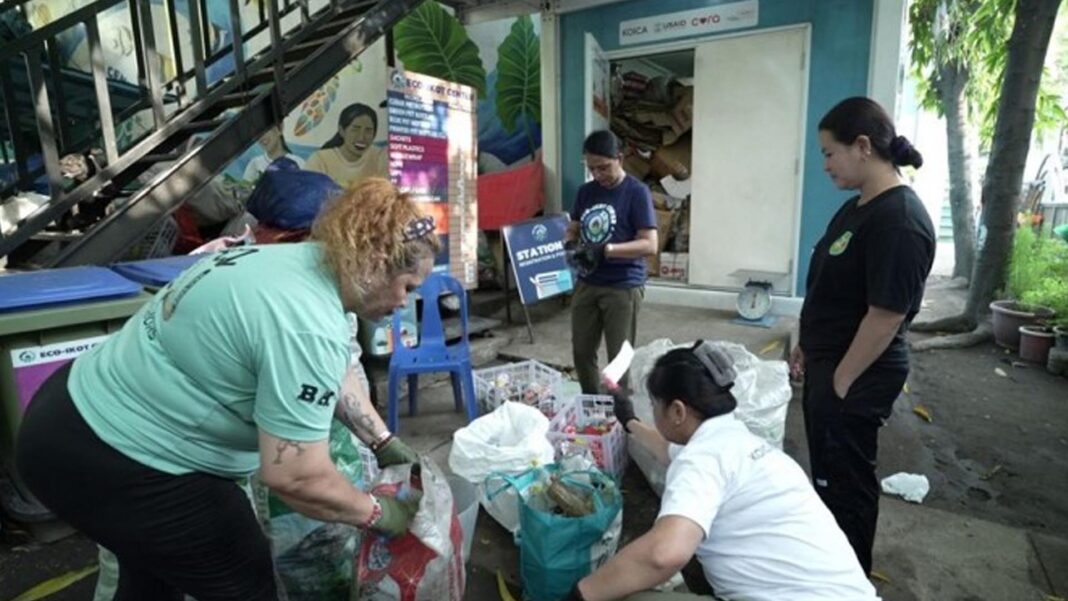

For decades, residents of Barangay 128 in Tondo, Manila, endured flooding and foul odor even after a brief rain, as garbage clogged streets and canals, affecting not only their daily lives but their livelihoods as well.
In this village near Smokey Mountain and Manila Bay, a short downpour was enough to turn the community into a maze of rising water and floating waste.
“Ang aming barangay kasi ay katabi lang ng (Our barangay is right next to) Smokey Mountain,” Barangay Kagawad Wendy Cañeda said.
“Sobra-sobrang polusyon ang natatanggap namin. Mabahong simoy ng basura, gabundok na basura kahit saan ka pumunta, at kaunting ulan lang, mabilis nang umabot hanggang bewang ang baha (We receive an overwhelming amount of pollution. The stench of garbage, mountains of trash wherever you go, and with just a little rain, the flood quickly reaches waist-deep).”
Today, however, residents say these wastes are increasingly being pulled out of circulation and turned into a source of livelihood, through the Eco-Ikot Center, a community facility established in October 2024 under the Enhancement of Marine Litter Management in Manila Bay Project.
The project, a partnership among the Department of Environment and Natural Resources (DENR), Barangay 128, the non-profit organization Communities Organized for Resource Allocation, the Korea International Cooperation Agency (KOICA), and the United States Agency for International Development (USAID), has helped residents slowly regain their dignity while helping them support their daily lives.
Each day, residents bring to the center collected recyclables from homes, schools, and nearby establishments.
These materials are then sorted, weighed, and converted into points that can be exchanged for rice, vegetables, eco-bags, bamboo products, shirts, and other essentials.
Cañeda said that for some households, the system has become a practical source of added income.
Carolina Davan, 54, who has lived in the barangay for two decades, now helps sort recyclables to support her family’s daily needs.
“Tinutulungan ko silang mangalakal at hinihiwalay ko nang maayos ang mga recyclable (I help them with their scavenging and I properly separate the recyclables),” Davan said.
“Malaking tulong po iyon kasi hindi na lahat ibabawas sa araw-araw na kinikita ng asawa ko (It’s a big help because not everything will now be deducted from my husband’s daily earnings).”
The Eco-Ikot Center is practically being run by residents, including seven women who manage the daily operations.
Among them is 47-year-old Rhea Villamor, who said participation from the community remains steady.
“Around lima hanggang sampung tao po ang pumupunta rito araw-araw para magdala ng recyclable waste. Umaabot po minsan ng lima hanggang sampung kilo bawat tao (About five to 10 people come here every day to bring recyclable waste. Sometimes, it reaches 5 kg. to 10 kg. per person),” Villamor said.
But beyond livelihood, barangay officials say the project is slowly changing the residents’ long-standing waste habits.
“Mas naging disiplinado ang mga tao sa segregation at waste management. Unti-unti siyang naging bahagi ng araw-araw naming buhay (People became more disciplined in segregation and waste management. Little by little, it became a part of our daily lives),” Cañeda said.
“Nagkaroon din ng dagdag kabuhayan para sa mga kababaihan, at mas marami nang espasyong puwedeng pagtamnan (It also serves as an additional source of livelihood for women, and now, there are more spaces where people could plant).”
Environment Secretary Juan Miguel Cuna explained that the initiative is part of broader efforts to reduce pollution and rehabilitate Manila Bay’s heavily affected coastline.
“The government strategy is to shift toward science-based policies, strict local government unit enforcement, and modernized clean-up operations,” Cuna said in a news release on Saturday.
For residents, the impact is most visible during rainfall, as streets no longer fill as quickly with trash-laden water as they once did.
“The transformation is measured less in statistics than in what no longer overwhelms their community: fewer piles of unmanaged waste, cleaner surroundings, and floodwaters that no longer rise as quickly as they once did,” Cuna said.
Barangay 128 residents say waste is no longer just a burden carried by floods, but has increasingly become part of how they earn, manage, and at the same time, protect their community. (PNA)