

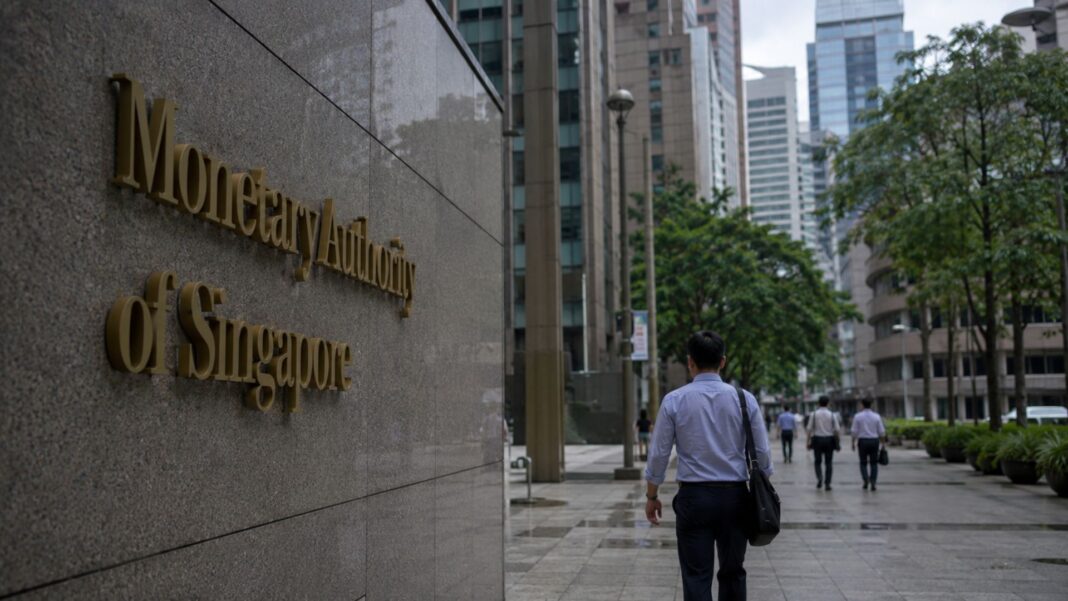

The Monetary Authority of Singapore revoked the Major Payment Institution Licence of Bsquared Technology Pte Ltd on May 20, 2026, citing serious regulatory breaches uncovered during a 2025 onsite inspection, including repeated submission of false or misleading information from the licence application stage through the inspection itself. The enforcement action, effective May 14, 2026, marks one of Singapore’s most consequential crypto payment licence revocations since the Payment Services Act 2019 came into force.
Key Facts At A Glance
- Bsquared Technology Pte Ltd, also known as BSQ, operated as a crypto liquidity provider under a Major Payment Institution Licence granted on January 1, 2025.
- The revocation took effect on May 14, 2026, approximately 16 months after the licence was originally issued.
- MAS announced the action publicly on May 20, 2026.
- An onsite inspection conducted in 2025 found significant weaknesses in BSQ’s risk management practices and conflict of interest policies.
- BSQ failed to comply with MAS Guidelines on Outsourcing in its arrangements with related entities.
- BSQ provided false or misleading information to MAS on multiple occasions, spanning from its licence application to the inspection period.
- BSQ self-declared to MAS that it held no outstanding customer assets at the time of revocation.
- MAS has required BSQ to submit a closure certificate from independent auditors confirming all customer funds have been returned.
- BSQ is no longer permitted to provide digital payment token services in Singapore under the Payment Services Act 2019.
Licence Revoked After 16 Months
The Monetary Authority of Singapore has cancelled the Major Payment Institution Licence of Bsquared Technology Pte Ltd, removing the firm’s authority to offer digital payment token services in Singapore under the Payment Services Act 2019. The revocation, effective May 14, 2026, came approximately 16 months after MAS originally licensed Bsquared on January 1, 2025 to carry on digital payment token services in the city-state.
The announcement, published on May 20, 2026, identified three distinct categories of failure that led to the cancellation: weaknesses in BSQ’s risk management practices, weaknesses in conflict of interest policies, and non-compliance with MAS Guidelines on Outsourcing in the company’s arrangements with related entities. The combination of operational failures and governance gaps across multiple compliance categories is notable in that each category on its own could attract regulatory action under Singapore’s licensing framework for digital payment token service providers.
False Information Across Inspection And Licensing Stages
The most serious finding disclosed by MAS was that Bsquared had provided information to the regulator that was false or misleading in material particulars on multiple occasions. The regulator specified that the false submissions began at the time of the company’s licence application and continued through the 2025 onsite inspection.
That disclosure raises substantive questions about the firm’s conduct across the entire lifecycle of its licensed operations. Where a firm’s compliance failures are limited to operational weaknesses, remediation pathways are more common. A concurrent finding of material misrepresentation across both the licensing process and the supervisory inspection significantly narrows such pathways and typically points toward the kind of firm enforcement action MAS took here.
MAS stated that entities that breach regulatory requirements or provide inaccurate information will face consequences, a formulation that reads as a direct signal to other licensed digital payment token service providers regarding the regulator’s approach to integrity failures.
Customer Asset Status And Closure Requirements
Bsquared informed MAS that it had no outstanding customer assets at the time of the revocation. Notwithstanding that self-declaration, MAS has directed BSQ to provide a closure certificate from independent auditors formally confirming that all customer funds have been returned to their rightful recipients. The independent audit requirement adds an institutional verification layer that goes beyond relying on the firm’s own assurances, a procedural discipline consistent with MAS’s post-FTX approach to consumer protection in digital asset enforcement.
The closure certificate requirement applies even where a firm declares zero client assets, a point that distinguishes Singapore’s revocation process from more minimal winding-up procedures in other jurisdictions. Once that certificate is submitted and accepted, the regulatory matter in relation to customer funds would be formally closed.
Regulatory Context
Singapore has among the most structured licensing regimes for digital payment token service providers in Asia, with the Payment Services Act 2019 establishing distinct licence tiers including the Major Payment Institution Licence category that Bsquared held. MAS has escalated enforcement scrutiny across the digital asset sector following high-profile global failures, and the Bsquared revocation is consistent with that pattern. The MAS Guidelines on Outsourcing, which BSQ was found to have violated in its arrangements with related entities, are a long-standing pillar of Singapore’s financial institution governance framework and are designed to ensure that operational dependencies on affiliated parties do not create unmanaged risk concentrations.
Publicly available information does not identify the specific nature of BSQ’s business operations or its client base beyond its designation as a crypto liquidity provider.