

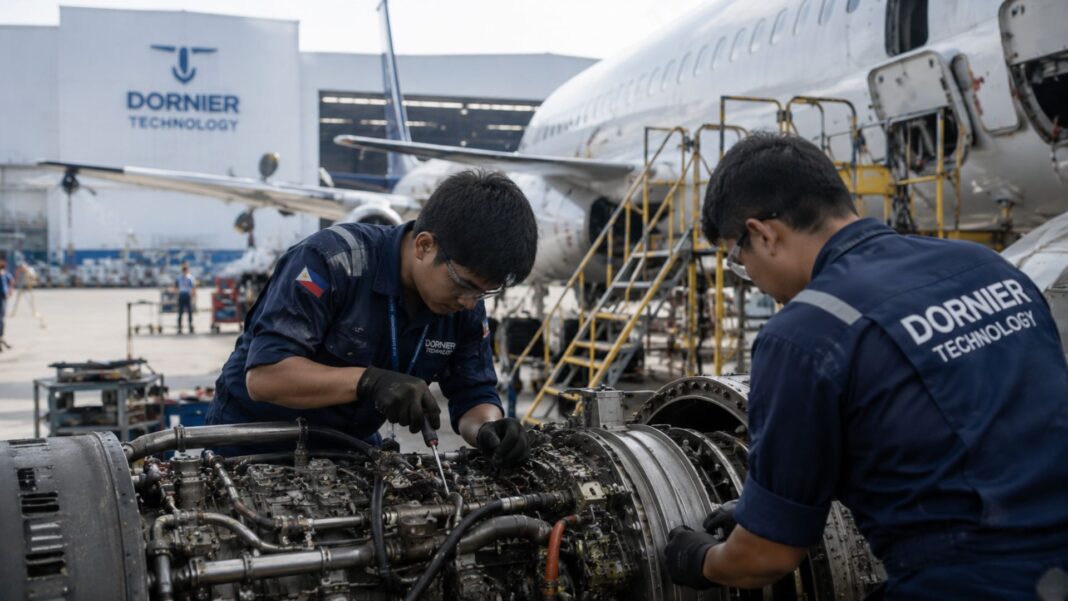

Philippine-based independent MRO provider Dornier Technology has activated a second hangar at Clark International Airport and confirmed a third facility targeting completion by the end of the third quarter of 2026, as fleet growth across Asia-Pacific continues to outpace available maintenance infrastructure. The expansion grows the company’s operational footprint to four hangars covering more than one hectare of base maintenance space, and adds full aircraft painting capability that positions Clark as a single-location solution for narrowbody heavy checks and repainting.
Key Facts At A Glance
- Hangar 1: 4,705 sqm, configured for one narrowbody aircraft or two turboprop aircraft simultaneously
- Hangar 2: 4,401 sqm, newly operational, capacity for four turboprop aircraft simultaneously
- Hangar 3: 4,705 sqm, scheduled for completion by end of Q3 2026, capacity for two narrowbody aircraft simultaneously
- Fourth hangar: 2,250 sqm, configured for two turboprop aircraft
- Full aircraft painting now available for narrowbody and ATR aircraft types
- Additional certifications in progress: CAAV, CAAC, and EASA (EASA targeted for 2027)
- Target LCC partners: carriers in Cambodia, Myanmar, Japan, and South Korea
A Measured Expansion Against A Tightening Supply Backdrop
Dornier Technology has been operating at Clark International Airport since 1995, building its base maintenance business alongside growing demand from Philippine carriers and regional operators. The company currently holds civil aviation authority certifications from the Philippines, Indonesia, South Korea, and the United States Federal Aviation Administration, the latter covering heavy maintenance on Airbus A320 family aircraft including both A320ceo and A320neo variants.
The expansion comes as MRO slot availability across Asia-Pacific reaches a structural constraint. Airlines and aircraft lessors are increasingly locking in long-term maintenance partnerships as fleet orders across the region accelerate and existing maintenance capacity fails to keep pace. For independent providers such as Dornier Technology, this imbalance represents a material commercial opportunity distinct from the captive maintenance capacity operated by major airline groups.
The newly operational Hangar 2, spanning 4,401 square metres, adds dedicated space for up to four turboprop aircraft simultaneously, complementing Hangar 1, a 4,705-square-metre facility capable of accommodating one narrowbody or two turboprop aircraft at the same time. The planned Hangar 3, targeted for the end of Q3 2026 at 4,705 square metres and configured for two narrowbody aircraft simultaneously, is designed to absorb rising demand from Airbus A320 family operators, the dominant fleet type across Southeast Asia’s low-cost carrier sector.
A One-Stop Maintenance And Painting Package
One of the most commercially significant additions accompanying the hangar expansion is the introduction of full aircraft painting capability for narrowbody and ATR aircraft. Chief Executive Officer Nick Gitsis identified this as a gap in the regional market that Dornier Technology is now positioned to close. Aircraft lessors repositioning planes between operators routinely require both a heavy airframe maintenance check and a complete repaint, and locating a single provider capable of delivering both in the same facility has been a persistent challenge across Asia.
The combined heavy maintenance and painting service reduces ferry flights, shortens turnaround time, and lowers logistics overhead for lessors managing fleet transitions across the region. In the context of Asia-Pacific’s large and expanding operating lessor market, this capability carries practical commercial weight beyond its technical function.
Southeast And Northeast Asia As Dual Growth Markets
Gitsis said the two primary demand sources driving the Clark expansion are low-cost carriers in Southeast Asia and operators in Northeast Asia, where labour shortages have created acute pressure on MRO capacity. The company is actively pursuing new partnerships with carriers based in Cambodia, Myanmar, Japan, and South Korea. Dornier Technology’s geographic positioning at Clark International Airport, located north of Manila and within convenient range of multiple Southeast Asian aviation markets, is central to its competitive strategy.
The Philippines’ aviation context amplifies this positioning. Philippine Airlines and Cebu Pacific are both expanding their fleets, and the anticipated opening of the New Manila International Airport in Bulacan within the coming years is expected to deepen the country’s role as a regional aviation hub. Dornier Technology noted that Clark Airport’s proximity to both Manila and the Bulacan development, combined with established customs processes and airport management support, makes it a strategic anchor for regional MRO growth.
Separately, the company participated in MRO Southeast Asia 2026, held in Singapore on May 13 and 14, 2026, using the platform to advance new customer discussions with low-fare airline operators across the region.