

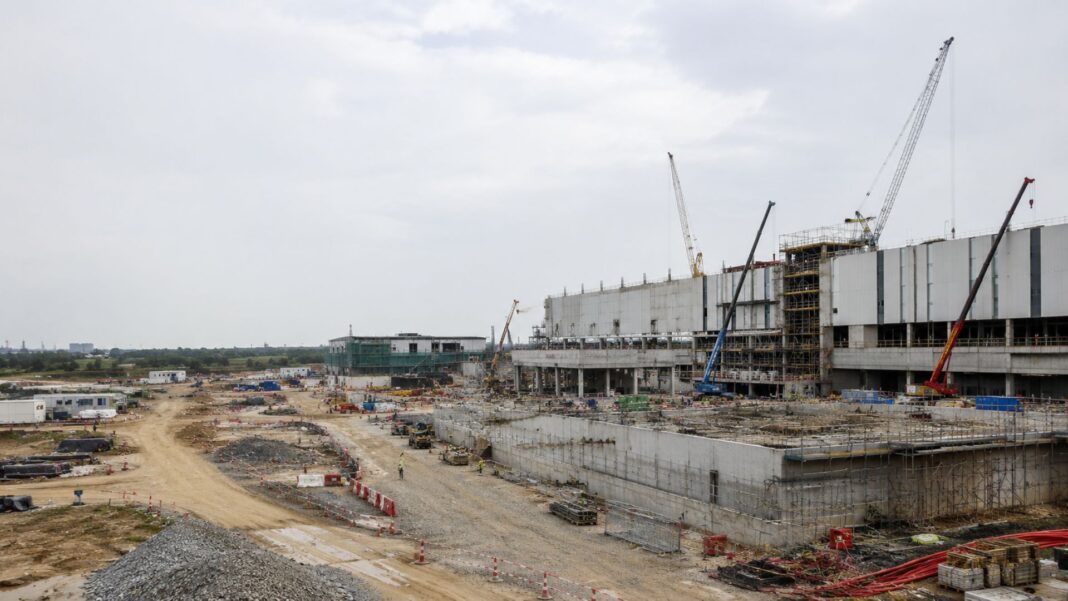

Vietnam’s foreign direct investment surged 42.9 percent year-on-year to USD15.2 billion in the first quarter of 2026, driven by a USD4 billion semiconductor packaging project by Samsung Electronics and an LNG power plant investment of USD2.2 billion, both licensed in March. The Q1 result marks the strongest registered FDI quarter in recent years and positions Singapore as Vietnam’s single largest investor, accounting for over USD5.3 billion or 52 percent of all newly registered and adjusted capital.
Key Facts At A Glance
- Total registered FDI in Vietnam for Q1 2026: USD15.2 billion, up 42.9 percent year-on-year
- FDI disbursement for Q1 2026: USD5.41 billion, up 9.1 percent year-on-year, the highest first-quarter figure in five years
- Samsung Electronics’ planned chip packaging and testing facility in Thai Nguyen province: up to USD4 billion total, with an initial phase of USD2 billion
- Samsung’s cumulative investment in Vietnam to date: more than USD23.2 billion, supporting approximately 90,000 jobs
- Singapore ranked as top investing economy in Q1 2026 with USD5.32 billion; South Korea second with USD3.68 billion
- Thai Nguyen province led all Vietnamese localities with USD5.72 billion in newly registered and adjusted FDI
- Manufacturing and processing accounted for 69 percent of newly registered FDI capital; power generation ranked second at 22.3 percent
- As of March 31, 2026, Vietnam held 46,198 valid FDI projects with total registered capital exceeding USD542 billion
A Quarter Defined By Two Mega-Projects
Vietnam’s Q1 2026 FDI figures underwent a sharp reversal from consecutive monthly declines in January and February, when total registered capital fell 40.6 percent and 12.6 percent respectively. The turnaround came in March, driven by two projects with combined registered capital exceeding USD6.2 billion. The dominant transaction was a semiconductor packaging and testing facility by Samsung Semiconductor Asia Holdings, a Singapore-registered entity, in Thai Nguyen province, with total registered capital exceeding USD4 billion. The second significant project was the Quynh Lap LNG power plant in Nghe An province, invested by a consortium comprising PV Power, Nghe An Sugar, and South Korea’s SK Innovation, with registered capital of more than USD2.2 billion.
Samsung’s Strategic Escalation In Vietnam
The semiconductor plant represents a notable strategic shift for Samsung Electronics in Vietnam. The company entered Vietnam in 2008 with a mobile handset facility in Bac Ninh province and subsequently built what became its largest global smartphone production hub, a major complex in Thai Nguyen commissioned in 2013. Total Samsung investment in Vietnam has since exceeded USD23.2 billion. The new chip packaging and testing project extends Samsung’s footprint into higher-value back-end semiconductor manufacturing, a segment of the supply chain that is gaining strategic importance as demand from AI applications and data centers accelerates. The investment is structured in phases, with an initial commitment of approximately USD2 billion. Vietnam’s Ministry of Finance confirmed it is coordinating with other ministries to finalize and submit to the Prime Minister a memorandum of understanding between the government and Samsung Group covering the semiconductor project. No final agreement had been publicly signed as of the time of reporting.
Earlier in Q1, Samsung Electro-Mechanics Vietnam licensed a separate USD1.2 billion project in Thai Nguyen focused on high-end electronic circuit board production. Together, the two projects made Thai Nguyen Vietnam’s top FDI-receiving locality for the quarter, at USD5.72 billion in total newly registered and adjusted capital.
Sectoral And Geographic Concentration
Manufacturing and processing dominated Q1 FDI at 69 percent of newly registered capital, with the sector attracting USD7.07 billion across 904 new projects. Power generation and utilities ranked second at 22.3 percent, largely driven by the Quynh Lap LNG plant. Disbursement within manufacturing reached USD4.48 billion, representing 82.8 percent of total disbursed FDI for the quarter. Geographic concentration was pronounced. Thai Nguyen received USD5.72 billion in total registered capital, or 37.6 percent of the national total. Ho Chi Minh City ranked second with USD2.9 billion, benefiting from its dominance in new project origination, with 52.5 percent of all newly licensed FDI projects and 70.4 percent of all capital contribution and share purchase transactions during the quarter.
Singapore Overtakes South Korea As Top Investor
For newly registered and adjusted capital combined, Singapore overtook South Korea as Vietnam’s largest foreign investor in Q1 2026, with USD5.32 billion compared to South Korea’s USD3.68 billion. The two countries together accounted for approximately two-thirds of total registered capital for the quarter. Indonesia was the third-largest source at USD1.7 billion, followed by China at USD828.3 million. The concentration of capital from a small number of source economies is consistent with a broader trend noted by Vietnam’s Foreign Investment Agency: while 68 countries and territories participated in Q1 FDI, a handful of large, technology-oriented projects are driving headline figures, with broad-based capital expansion among existing investors remaining more cautious.
Context: Trade Risks And The Investment Quality Question
The strong Q1 data arrived against a backdrop of elevated external risk. Vietnam’s export-dependent manufacturing sector, which accounted for approximately 80 percent of total export turnover in Q1, faces a compounding set of trade enforcement pressures from the United States. The U.S. Trade Representative initiated a Section 301 investigation into manufacturing overcapacity in March 2026, naming Vietnam among 16 economies, while a separate USTR Special 301 Report published in late April designated Vietnam a Priority Foreign Country on intellectual property enforcement grounds, the first such designation in 13 years. A potential secondary tariff regime could weigh on export margins for FDI-backed manufacturers, particularly in electronics, should Section 301 findings result in additional duties before or after the July 24, 2026 expiry of existing Section 122 tariffs.
At the same time, Vietnam’s forthcoming reclassification by FTSE Russell to Secondary Emerging Market status on September 21, 2026, confirmed in an interim review on April 7, is widely expected to unlock passive capital inflows of approximately USD6 billion from global index-tracking funds. That structural tailwind may offset some near-term uncertainty around trade policy, though analysts have noted the inflows are already being partly front-loaded by active investors ahead of the reclassification date.