

Coordinating Minister for Economic Affairs Airlangga Hartarto announced on April 28, 2026, that Indonesia will eliminate import duties on liquefied petroleum gas and key plastic packaging resins for six months beginning in May, after a Strait of Hormuz-linked naphtha shortage drove domestic plastic prices up by 50 to 100 percent. The measure directly targets upstream feedstock costs in the petrochemical sector and signals how the Middle East energy crisis is now cascading beyond fuel markets into Indonesia’s industrial input supply chains.
Key Facts At A Glance
- Coordinating Minister Airlangga Hartarto announced the duty cuts on April 28, 2026, at a press conference in Jakarta
- LPG import duty for the petrochemical industry reduced from 5 percent to 0 percent
- Import duties on polypropylene, LLDPE, and HDPE reduced from a range of 5–15 percent to 0 percent
- Domestic plastic prices had risen 50–100 percent due to naphtha supply disruptions linked to the Strait of Hormuz conflict
- Approximately 90 percent of Indonesia’s petrochemical raw material distribution routes transit the Strait of Hormuz
- The duty waiver applies for six months; government will reassess extension based on market conditions
- President Prabowo Subianto separately instructed Energy and Mineral Resources Minister Bahlil Lahadalia to identify alternative naphtha supply sources
- The measure was the result of a cross-ministerial coordination meeting reported to the President
The Naphtha Problem And The LPG Pivot
Naphtha is the dominant feedstock for Indonesia’s petrochemical industry, used to crack and produce base resins including polyethylene and polypropylene — the materials underpinning plastic packaging for food, beverages, and consumer goods. Under normal supply conditions, naphtha arrives through supply chains that move predominantly through the Strait of Hormuz. With approximately 90 percent of petrochemical raw material distribution routes running through the strait, according to the Directorate General of Agro Industry, Chemical and Pharmaceutical Industry of the Indonesian Ministry of Industry, the closure of that corridor beginning in late February 2026 triggered rapid feedstock shortages that have no short-term domestic substitute.
The government’s response is to facilitate a partial pivot from naphtha to LPG — specifically propane and butane — as alternative cracker feedstocks. LPG can substitute for naphtha in producing certain olefins, and Indonesian petrochemical plants that have dual-feed capability are being encouraged to make the shift. By cutting the LPG import duty from 5 percent to zero, the government is reducing the cost differential between the disrupted primary feedstock and the available alternative. Airlangga framed the measure explicitly as enabling this feedstock switch, describing the incentive as aimed particularly at the petrochemical industry, which is facing difficulties procuring naphtha due to the conflict in the Strait of Hormuz.
Plastic Price Pass-Through And Consumer Exposure
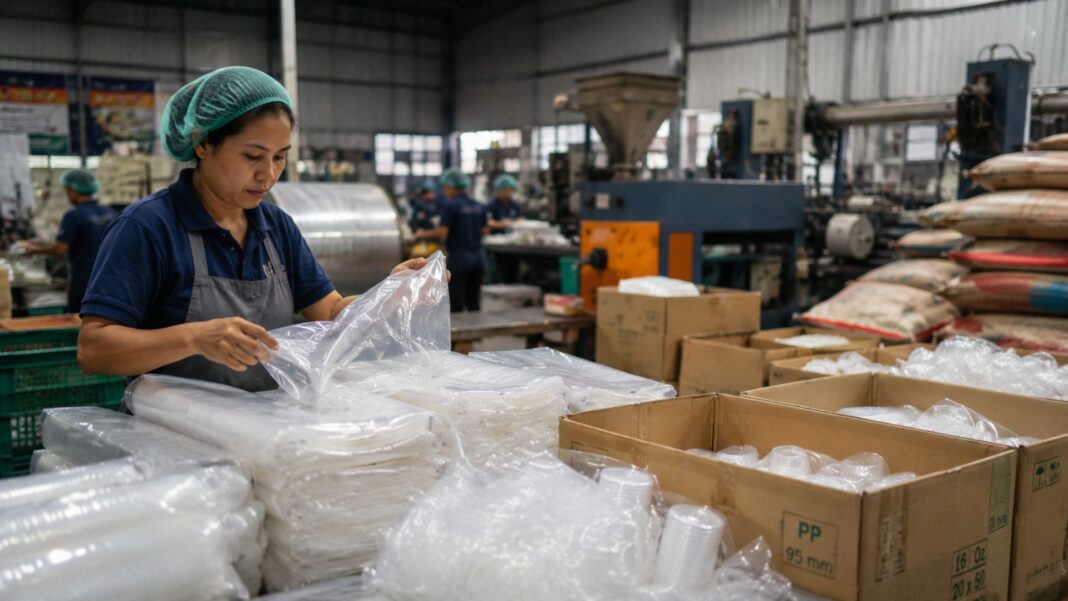
The upstream feedstock squeeze is already reaching downstream. Indonesian domestic plastic prices have risen between 50 and 100 percent since the disruption began, according to Airlangga’s April 28 statement. The tariff reductions on polypropylene, linear low-density polyethylene, and high-density polyethylene — the resins most commonly used in food and consumer goods packaging — are intended to dampen further price increases before they fully pass through to the retail chain.
Industry associations have welcomed the upstream relief while flagging balance-of-supply concerns. The Director of Upstream Chemical Industry at the Ministry of Industry, Wiwik Pudjiastuti, noted that maintaining competitive parity between upstream resin producers and downstream packaging manufacturers will require ongoing coordination, particularly if the duty waiver creates an arbitrage situation where imported resins undercut domestically produced stock. The Indonesian Olefin, Aromatic and Plastics Industry Association described the LPG duty cut as good news for upstream production while stressing the need to preserve equilibrium across the value chain.
The downstream stakes are substantial. Indonesia’s rapidly growing packaged food and beverage sector depends heavily on polyolefin packaging, and any sustained rise in resin input costs translates directly into higher shelf prices for consumer staples. Airlangga acknowledged this pass-through risk, noting that the measures are designed to prevent plastic price increases from feeding into wider consumer goods inflation.
Policy Design: Emergency Cushion, Not Structural Liberalization
The six-month duration of the measure is deliberate. Officials have characterized it as an emergency cushion rather than a permanent trade liberalization, preserving the government’s ability to restore normal tariff structures once supply chains stabilize. The policy is also time-bounded to the point at which operators can seek alternative supply arrangements for both naphtha and resins from non-Hormuz-dependent sources.
The measure was authorized at cross-ministerial level and reported directly to President Prabowo Subianto, indicating that the government treats the petrochemical feedstock disruption as a matter of strategic economic management rather than a purely sectoral issue. Separately, President Prabowo tasked Energy Minister Bahlil Lahadalia with identifying alternative naphtha sources from outside the Middle East supply chain — a parallel supply diversification effort that may involve suppliers in North America, Southeast Asia’s own upstream sector, or other non-Hormuz-routing sources.
The combination of tariff relief and sourcing diversification reflects the broader pattern across Indonesia’s crisis response: use immediate fiscal tools to absorb price shocks while attempting to restructure supply dependency over a six-to-twelve month horizon. Whether that horizon is sufficient depends on the duration of Hormuz disruption, which the IMF has characterized as potentially the worst global energy supply shock in recorded history.