

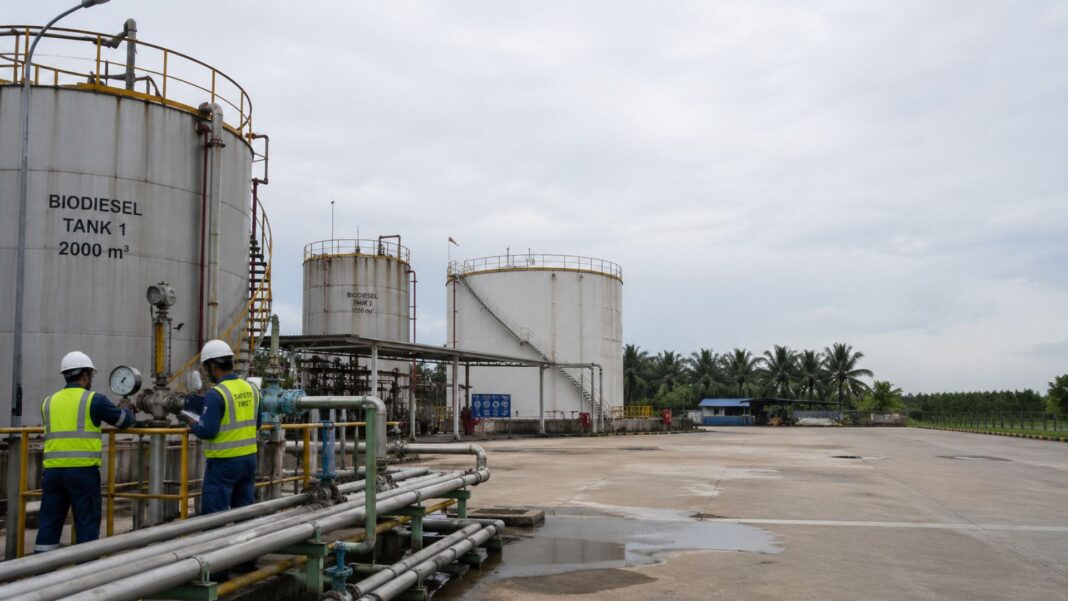

Malaysia’s Economy Minister Akmal Nasrullah Mohd Nasir announced the formation of a dedicated national biofuel committee on April 28, 2026, elevating biodiesel policy to a cabinet-level coordination function as the country absorbs a tenfold surge in monthly fuel subsidy costs driven by the Strait of Hormuz crisis. The committee formalizes a biofuel escalation pathway already set in motion with the April 14 decision to raise the national biodiesel blend mandate from B10 to B15.
Key Facts At A Glance
- Committee name: Jawatankuasa Peringkat Tertinggi Biobahan Api, chaired by Deputy Prime Minister Datuk Seri Dr Ahmad Zahid Hamidi; secretariat function held by the Ministry of Plantation and Commodities
- Announcement date: April 28, 2026, at a Global Supply Crisis Briefing; committee established under a Cabinet decision
- Mandate upgrade: B10 to B15, beginning with interim B12 rollout, announced April 14 following a National Economic Action Council meeting
- Malaysia’s 2025 biodiesel production: 975,207 metric tonnes against installed capacity of 2.36 million metric tonnes, leaving substantial idle capacity available for immediate ramp-up
- Demand addition estimates from the Malaysian Palm Oil Board: B10 to B12 adds approximately 130,000 metric tonnes per year; B12 to B15 adds approximately 204,000 metric tonnes per year; B15 total CPO absorption estimated at approximately 1.8 million metric tonnes annually
- Diesel price trajectory in Peninsular Malaysia: RM3.12 per liter in early March 2026 to a high of RM6.72 per liter in early April; eased to RM5.12 per liter as of April 23
- Monthly fuel subsidy bill: RM700 million pre-crisis; climbed to RM6 billion in March and RM7 billion in April; Nurhisham Hussein, economic adviser to the Prime Minister’s Office, described the rate as approximately RM2,300 per second
- Longer-term mandates under the 13th Malaysia Plan: phased depot upgrades for B20 and B30 blends; B30 mandate in preparation specifically for the commercial and public transport sectors
- Nearly half of Malaysia’s crude oil imports pass through the Strait of Hormuz
Fiscal Pressure Behind The Policy
When the Strait of Hormuz was effectively closed in late February 2026 following conflict involving Iran, Malaysia faced a fuel pricing dynamic that its subsidy architecture was not designed to absorb. Diesel subsidies had been removed from Peninsular Malaysia in June 2024 as part of subsidy rationalization, leaving commercial diesel fully exposed to market pricing. Within weeks of the Hormuz closure, diesel prices in Peninsular Malaysia climbed from RM3.12 per liter to a peak of RM6.72 per liter by early April, representing a more than twofold increase. Bus operators, logistics companies, and tour operators outside existing subsidy eligibility categories faced immediate cost pressure. Industry associations warned that without relief, a portion of commercial transport operators could be forced to suspend services during Visit Malaysia Year 2026.
The government’s monthly fuel subsidy liability, covering RON95 petrol under the BUDI95 scheme and targeted diesel assistance programmes, surged from approximately RM700 million pre-crisis to RM7 billion in April, a tenfold increase. The Ministry of Finance separately reduced the monthly RON95 BUDI95 quota from 300 liters to 200 liters per eligible person from April 1, while maintaining the RM1.99 per liter subsidized price for those who qualify. Economic adviser Nurhisham Hussein described the subsidy outlay as approximately RM8.28 million per hour and acknowledged publicly that spending at this rate was not sustainable over the long term.
The B10-To-B15 Escalation
Against this backdrop, Economy Minister Akmal Nasrullah Mohd Nasir announced on April 14 that the National Economic Action Council had endorsed raising the national biodiesel blend from B10 to B15, beginning with a phased introduction of B12. The minister stated that the transition would carry no additional upfront costs because Malaysia’s existing blending infrastructure, built during earlier B10 implementation, could support the higher blend immediately. “The ongoing B10 implementation proves that the foundation for this already exists. Therefore, the government has agreed to increase the biodiesel blend rate to B15, beginning with B12,” he said at a nationally televised briefing, as reported by The Star.
Malaysia is the world’s second-largest producer and exporter of palm oil, and palm oil-based methyl ester is the primary feedstock for its biodiesel industry. The Malaysian Palm Oil Board estimates that the move from B10 to B12 would add approximately 130,000 metric tonnes of annual biodiesel demand, with the subsequent move to B15 adding a further 204,000 metric tonnes. Combined, B15 adoption is estimated to absorb approximately 1.8 million metric tonnes of crude palm oil annually, representing roughly 9 percent of Malaysia’s annual palm oil output.
Malaysia’s biodiesel industry produced 975,207 metric tonnes in 2025, well below its installed capacity of 2.36 million metric tonnes per year. The Malaysian Biodiesel Association noted that higher blend mandates would directly utilize idle production capacity, and that every metric tonne of palm oil used in blending displaces an equivalent tonne of imported petrodiesel. However, the association’s president Tee Lip Teng also cautioned against assuming biodiesel would always be cheaper than fossil diesel, noting that production costs are tied to crude palm oil prices, which can at times trade at a premium over gasoil.
The High-Level Committee: Scope And Structure
The April 28 announcement of the Jawatankuasa Peringkat Tertinggi Biobahan Api added a formal governance layer above the April 14 mandate decision. Deputy Prime Minister Datuk Seri Dr Ahmad Zahid Hamidi chairs the committee, which was established under a Cabinet decision and positions the Ministry of Plantation and Commodities as secretariat. Ahmad Zahid described the committee as an immediate government response to strengthen national preparedness for global energy supply uncertainty, framing its establishment as a proactive response to the supply crisis triggered by Middle Eastern geopolitical tensions.
Economy Minister Akmal stated the committee would serve as a high-level cross-ministry coordination platform to streamline decision-making as the government evaluates how biofuel can complement existing energy sources within Malaysia’s broader energy transition agenda. Beyond the B12-to-B15 blend mandate, the government has also outlined longer-term infrastructure plans under the 13th Malaysia Plan, including phased upgrades of fuel depots to support B20 and B30 blends, with a B30 mandate in preparation specifically for the commercial and public transport sectors. Depot upgrade locations under review include facilities in Sandakan, Tawau, Sepanggar, and Bintulu.
Industry And Analyst Assessment
Reception from the two principal industry bodies diverged on sector impact. The Malaysian Biodiesel Association welcomed the mandate increase as directly supportive of producers and as a means of bringing idle production capacity into use. The Federation of Malaysian Manufacturers, by contrast, described the biodiesel blend change as having only a marginal impact on industrial fuel costs, with Federation president Jacob Lee stating that global crude oil prices remain the dominant variable for manufacturers who have historically operated under market-based fuel pricing without access to subsidized diesel.
S&P Global Commodity Insights noted that the B12 rollout does not require additional blending infrastructure costs and assessed the existing blending system as capable of absorbing the near-term increase immediately. CIMB Securities, in an April 2026 ESG monitor report, assessed biodiesel as a supplementary energy security buffer rather than a permanent hedge, noting that wider adoption of B20 and B30 blends would require significant upgrades to storage, logistics, and distribution infrastructure, and that compatibility across all diesel engine types remains uneven. Analysis in The Edge Malaysia characterized the mandate increase as a measured strategic nudge rather than a comprehensive structural solution, noting that biodiesel economics remain sensitive to the price spread between crude palm oil and gasoil.