

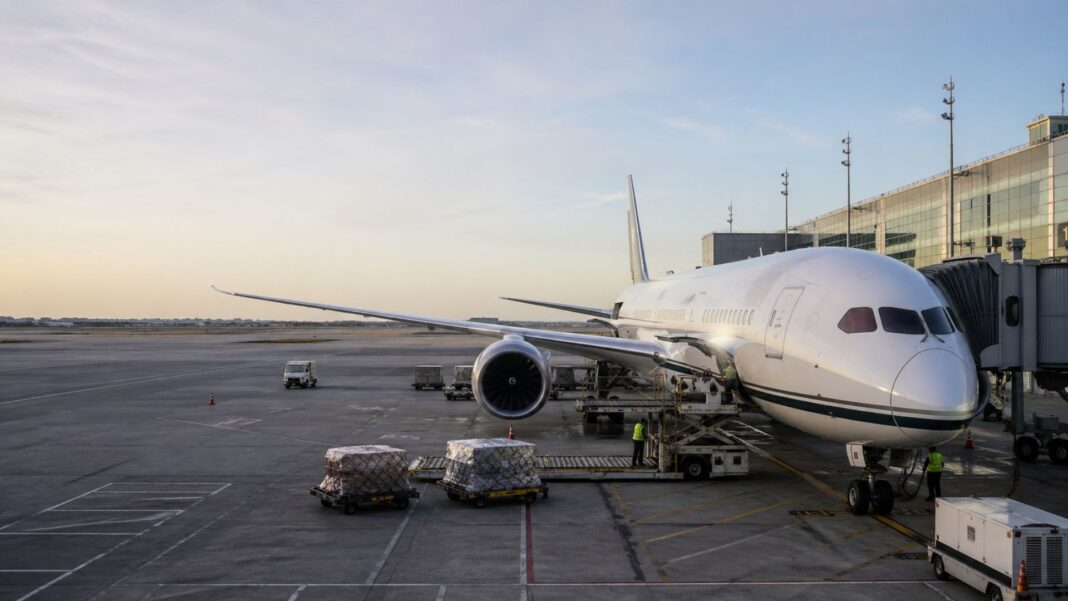

Alaska Airlines on 28 April 2026 operated its inaugural nonstop flight from Seattle-Tacoma International Airport to Rome Fiumicino Airport, marking the carrier’s first-ever scheduled service to Europe in its 90-year history. The launch simultaneously debuted the airline’s new International Business Class Suites product and signals a broader strategic push by Alaska Air Group to position Seattle as a long-haul global hub.
Key Facts At A Glance
- Route: Seattle-Tacoma International Airport (SEA) to Rome Fiumicino Airport (FCO), daily seasonal service operating 28 April to 23 October 2026
- Aircraft: Boeing 787-9 Dreamliner, configured with 34 Business Class Suites and 266 Economy seats; no Premium Economy cabin
- Business Class Suites: Fully enclosed lie-flat suites with direct aisle access, privacy doors, 18-inch HD entertainment screens, wireless charging, and multi-course dining
- Bedding developed in partnership with Seattle outerwear brand Filson; amenity kits include Salt & Stone skincare products
- Alaska is the first US passenger airline to offer daily nonstop cargo service between Seattle and Rome, expanding its cargo network to 109 destinations
- Subsequent European launches: London Heathrow on 21 May 2026 (daily, year-round); Reykjavik, Iceland, on 28 May 2026 (seasonal, on Boeing 737 MAX 8)
- Alaska’s current transpacific Dreamliner network includes Seoul Incheon (five times weekly, year-round) and Tokyo Narita (daily, year-round)
- Alaska Air Group has ordered a total of 17 Boeing 787 widebody aircraft, targeting at least 12 intercontinental destinations from Seattle by 2030
Alaska Airlines crossed the Atlantic commercially for the first time on 28 April 2026, when flight AS-180 departed Seattle-Tacoma International Airport at 5:30 p.m. bound for Rome’s Leonardo da Vinci Fiumicino Airport. The route, operated daily on a Boeing 787-9 Dreamliner, runs as a seasonal service through 23 October 2026 and was upgraded from its originally planned four-times-weekly frequency to daily operations following strong advance demand.
A Structural Shift For Alaska Air Group
The Rome launch is the product of Alaska Air Group’s 2023 acquisition of Hawaiian Airlines, which gave the carrier access to widebody long-haul aircraft and the operational foundation to compete on intercontinental routes. Prior to that acquisition, Alaska operated almost exclusively on narrowbody aircraft across North America. The Boeing 787-9 Dreamliners now in service were originally delivered to Hawaiian Airlines and have since been repainted in Alaska’s new global livery inspired by the Aurora Borealis.
Alaska Air Group’s Chief Executive Officer Ben Minicucci described the Rome launch as a step in the execution of a long-term growth strategy. In January 2026, the company announced its largest-ever fleet order: 105 Boeing 737-10 aircraft and five additional 787 widebody aircraft, extending deliveries through 2035 and bringing Alaska’s firm future 787 fleet to 17 aircraft.
The International Business Class Suites Product
The Rome launch also served as the commercial debut of Alaska’s International Business Class Suites, a product the airline has positioned as its primary competitive tool in long-haul premium markets. The suites feature fully enclosed lie-flat seats with direct aisle access and privacy doors, a configuration that places Alaska in the same product tier as legacy international carriers operating similar aircraft. The 34-suite configuration across the 787-9 is intentionally leisure-oriented, with no Premium Economy cabin, reflecting the West Coast demographic the airline is targeting.
Dining in the Business Class cabin includes multi-course service with up to six entrée choices per route. On Rome flights, options include roasted chicken with pasta carbonara; on Seoul Incheon services, Korean-inspired selections such as chicken bulgogi and jajangmyeon are available. Meals can be pre-ordered through the airline’s app. A dessert cart featuring Salt & Straw ice cream sundaes is served after the main course. Premium bedding developed exclusively with Filson, and amenity kits with Salt & Stone skincare products, are provided to all Business Class passengers.
Starlink satellite internet is planned for installation across Alaska’s 787-9 fleet by autumn 2026, with complimentary access for Atmos loyalty programme members. The full widebody fleet rollout is targeted for completion by 2027.
Asia-Pacific And The Broader Network
While the Rome launch marks Alaska’s European entry, the carrier already operates transpacific long-haul services of direct relevance to Asia-Pacific travel flows. Seattle-Seoul Incheon service, launched in September 2025, operates five times weekly year-round on the 787-9. Seattle-Tokyo Narita service is daily and year-round. Both routes feature the same International Business Class Suites product and form part of Alaska’s strategy to build Seattle into a hub connecting the US West Coast with Asia and Europe through the oneworld alliance, of which Alaska has been a member since 2021.
Alliance connectivity is a stated competitive advantage. oneworld membership gives Alaska passengers access to partner lounges and onward connections on carriers including American Airlines, British Airways, Japan Airlines, and Cathay Pacific. The Rome route allows onward connections to Amsterdam, Athens, Barcelona, Paris, and Venice via London Heathrow with oneworld partners.
Cargo And Infrastructure
Alaska becomes the first US passenger airline to operate daily nonstop cargo service between Seattle and Rome, expanding its cargo network to 109 destinations. The airline is also establishing a dedicated 787 operational hub in Seattle, supported by a new pilot base for widebody operations opened in 2026 alongside the existing 737 pilot base. Premium check-in lanes for Business Class Suites and Atmos Titanium loyalty members have been introduced at Seattle-Tacoma International Airport.