

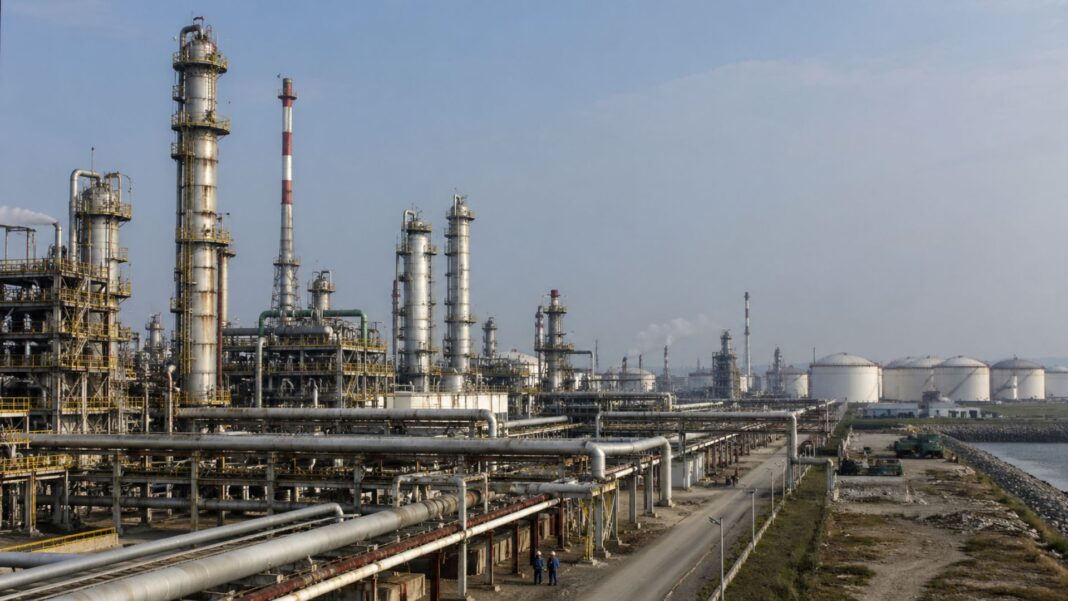

President Prabowo Subianto launched 13 second-phase national downstreaming projects on April 29, 2026, in Cilacap, Central Java, committing IDR 116 trillion in state-enterprise investment to refinery expansion, fuel storage, and coal-to-DME production. The program targets a reduction of up to 2 million kiloliters in annual gasoline imports and positions Indonesia’s domestic coal reserves as a structural substitute for imported LPG.
Key Facts At A Glance
- Total investment: IDR 116 trillion (approximately USD 7.2 billion) across 13 simultaneous projects in energy, minerals, and agriculture
- Energy projects: five of the 13, including gasoline refinery expansions at Pertamina’s Refinery Units in Cilacap (RU IV) and Dumai (RU II), combined capacity of 62,000 barrels per day
- Gasoline refinery target commissioning: Q4 2030; projected annual import substitution of up to 2 million kiloliters, saving an estimated USD 1.25 billion per year in import costs
- Fuel storage additions: three terminals in Palaran (East Kalimantan), Biak (Papua), and Maumere (East Nusa Tenggara), adding 153,000 kiloliters of combined capacity; Maumere targets onstream 2027, Palaran and Biak in 2028
- Coal-to-DME plant at Tanjung Enim: 1.4 million tonnes per year production capacity, equivalent to approximately 1 million tonnes of LPG; 7 million tonnes of low-rank coal feedstock per year; operated by MIND ID and PT Bukit Asam Tbk, with PT Pertamina Patra Niaga as off-taker
- DME plant site: 585 hectares within the Bukit Asam Coal Based Industrial Estate, Tanjung Enim, South Sumatra; operational target 2028
- Indonesia currently imports approximately 7 million metric tonnes of LPG annually; domestic supply covers only 12-15% of national demand
- Projects are designated as National Strategic Projects overseen by sovereign wealth manager Badan Pengelola Investasi Daya Anagata Nusantara
- Projected employment: approximately 600,000 jobs across all 13 projects; the DME facility alone is expected to absorb 5,380 workers
Indonesia’s Fuel Import Exposure
Indonesia currently consumes approximately 1.6 million barrels of fuel per day while domestic production stands at roughly 600,000 barrels, leaving a structural gap long managed through imports. Roughly 20 to 25 percent of its crude oil imports passed through the Strait of Hormuz before the waterway’s effective closure in late February 2026. The resulting supply disruption, compounded by a currency-weakened import bill, has added estimated pressure of more than IDR 200 trillion above the original 2026 subsidy budget. Finance Minister Purbaya Yudhi Sadewa acknowledged that if oil averages USD 92 per barrel for the year, the national budget deficit could approach 3.6 percent of GDP, above Indonesia’s legal ceiling of 3.0 percent.
The government has committed to maintaining subsidized Pertalite fuel at IDR 10,000 per liter despite market pressure and is seeking up to IDR 100 trillion in additional budget savings to sustain that commitment. State energy firm PT Pertamina has raised prices for non-subsidized fuel lines. Against that backdrop, the April 29 groundbreaking is the most concrete infrastructure response Indonesia has mounted to the ongoing energy shock.
The Refinery Expansion: Cilacap And Dumai
The Cilacap refinery, designated Refinery Unit IV, has operated since 1974 and is Indonesia’s largest, with existing capacity of approximately 348,000 barrels per day, representing 33.2 percent of total national refinery capacity. The expansion at Cilacap, together with a parallel expansion at Refinery Unit II in Dumai, Riau, will add a combined 62,000 barrels per day of gasoline processing capacity under PT Kilang Pertamina Internasional. Both facilities are targeted for commissioning in Q4 2030. Upon completion, the two units are projected to substitute up to 2 million kiloliters of gasoline imports annually and to reduce byproduct imports including propylene and LPG. Investment and Downstreaming Minister Rosan Roeslani said the refinery projects alone could cut fuel imports by approximately USD 1.25 billion per year.
The groundbreaking ceremony was held at the Cilacap complex and attended by President Prabowo Subianto and Central Java Governor Ahmad Luthfi. Prabowo called on Danantara and the downstream task force to continually reassess project plans and adopt more efficient technologies as they become available. “If better and cheaper technology emerges, we must be willing to adjust. Focus on the numbers. The most efficient solution that delivers the greatest benefit to the public is what should be pursued,” he said, as quoted by The Jakarta Post.
Fuel Storage For Eastern Indonesia
Three new operational fuel terminals form a separate energy tranche: a 37,000-kiloliter facility in Palaran, East Kalimantan; a 46,000-kiloliter facility in Biak, Papua; and a 70,000-kiloliter facility in Maumere, East Nusa Tenggara. Operated by PT Pertamina Patra Niaga, these terminals will add a combined 153,000 kiloliters of storage capacity, representing a 3.1 percent increase in national petroleum storage. The facilities are explicitly designed to strengthen energy distribution reliability in eastern Indonesia, a region that has chronically experienced higher fuel prices and supply vulnerability than western Java. Maumere is targeted to come onstream in 2027, with Palaran and Biak following in 2028.
The Coal-To-Dme Facility: Reviving A Stalled Project
The Tanjung Enim coal-to-dimethyl ether facility carries the longest development history of any project in the April 29 package. A first groundbreaking ceremony was held at the same site in January 2022 under former President Joko Widodo, at that time involving a three-way partnership between PT Bukit Asam Tbk, PT Pertamina, and US chemical company Air Products and Chemicals, Inc., with Air Products pledging approximately USD 2 billion. Air Products withdrew from the project in 2023, citing a strategic refocus on hydrogen investments outside Indonesia, effectively freezing construction.
The project has now been reconstituted under Danantara with a revised consortium of MIND ID, PT Bukit Asam Tbk, and PT Pertamina. PT Bukit Asam’s Director of Downstream and Product Diversification, Turino Yulianto, confirmed the plant will process 7 million tonnes of low-rank coal per year to produce 1.4 million tonnes of DME, equivalent to approximately 1 million tonnes of LPG annually. Turino stated the facility will use clean coal technology capable of reducing emissions by 30 to 40 percent compared to direct coal combustion. Produced DME will be absorbed by PT Pertamina Patra Niaga as off-taker.
Pertamina Director of Strategy, Portfolio, and Business Development Emma Sri Martini stated that Indonesia’s LPG supply security is currently achievable domestically at only 12 to 15 percent of national demand, with the remainder relying on imports averaging 7 million metric tonnes per year. The DME facility, if operational on its 2028 target, would substitute approximately one-seventh of that annual import volume. PT Bukit Asam management committed to prioritizing local employment from South Sumatra, specifically the Muara Enim and Lahat areas, for both the construction and operational workforce.
Danantara’s Coordinating Role And Wider Program
Danantara is acting as the initiating and coordinating institution for the full downstreaming program, with its chief Rosan Roeslani present at the Cilacap ceremony. Danantara’s involvement marks a departure from prior arrangements in which individual state enterprises managed their own investment and project development independently. President Prabowo has described downstreaming as integral to the Asta Cita, his administration’s eight-goal development agenda targeting 8 percent annual economic growth. The 13 April 29 projects span not only energy but also mineral processing, including copper and gold processing in Gresik, East Java, and stainless steel production in Morowali, Central Sulawesi, and agricultural processing, including palm oil to oleofood and biodiesel in Sei Mangkei, North Sumatra, and coconut processing facilities.
Prabowo indicated the program will not stop at this second phase, stating that the government intends to launch an additional six downstream projects later in 2026 and describing further phases as planned for subsequent years.
Financial Viability Questions
Independent analysis has flagged cost concerns around the DME project specifically. Reported DME production cost estimates significantly exceed the average cost of LPG imports to Indonesia, which stood at approximately USD 435 per tonne in 2024, creating a price gap that would require ongoing government subsidy or policy mandates to close. Separately, PT Bukit Asam CEO Arsal Ismail had previously indicated physical construction could begin as late as Q1 2028, implying that the April 29 ceremony marks the commencement of a pre-construction phase rather than a full construction start. Neither the government nor Danantara have publicly addressed the price gap question or detailed the subsidy or pricing framework under which produced DME would be sold into the domestic market.