
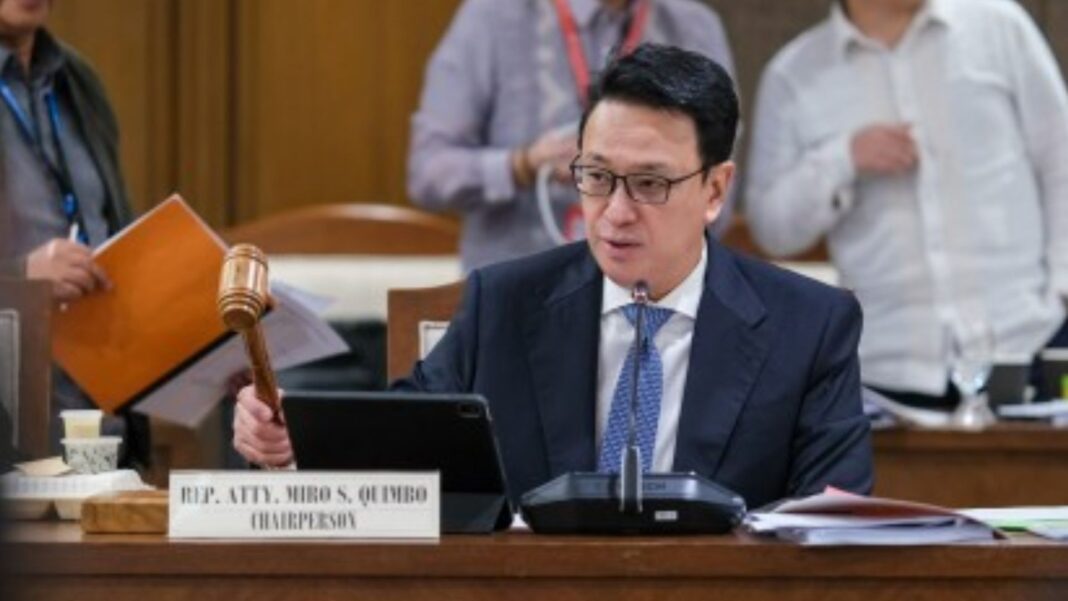

The House of Representatives’ 13-panel Legislative Energy Action and Development (LEAD) committee hearings are now moving to turn testimony, sectoral complaints, and agency recommendations into what Marikina 2nd District Rep. Miro Quimbo described as a consolidated Kalinga bill.
“Ang next task na po is magbe-break up ang 13 committees para gawin nila ang kanya-kanyang subject matter expertise para kunin at i-collate ang lahat ng mga recommendations ng departments (Our next task is for the 13 committees to break up according to their own areas of expertise and begin collating the recommendations of the departments needed to shape the final measure),” Quimbo, the overall chair of the LEAD hearings and chair of the House Committee on Ways and Means, said in a press conference Friday.
He said the process will not stop at sector-by-sector collection, because the entire point now is to bring the scattered pieces together into a single legislative framework.
“And then we will consolidate so we can firm up and submit to the Joint Committee formally on the first week of May the consolidated Kalinga Bill filed by Speaker Bojie Dy,” he said.
Quimbo, however, clarified that the formal presentation still depends on plenary action constituting the committee in the proper legislative sense.
“I say formally because right now, the committee has not been formed by plenary action. So as soon as that is done, the consolidated bill will now be presented formally to the Joint Committee,” he pointed out.
The 13-panel LEAD structure was assembled by the House under Dy and House Majority Leader Ferdinand Alexander “Sandro” Marcos to give the chamber a wider, whole-of-House response to the oil price increases.
This consists of the committees on energy, agriculture, aquaculture and fisheries, foreign affairs, ways and means, labor, transportation, information and communications technology, economic affairs, social services, trade and industry, overseas workers affairs, and appropriations.
Dy and Marcos have filed House Bill (HB) 8834, or the Kalinga Act, a measure designed to guarantee fast, targeted, and automatic government response when fuel price shocks begin driving up the cost of living.
The proposed measure establishes a national protection framework that allows the government to act early, decisively, and in a coordinated manner before rising fuel costs spiral into widespread increases in fares, food prices, electricity, and other daily expenses.
Meanwhile, Quimbo said the hearings were never meant to function as an exercise in criticism for its own sake, but as an attempt to improve the government’s response while there is still time to shape the outcome.
“We all mean well here. I think what’s important is, like I always say, I hope the Executive understands that we are not here to criticize. We are here to make the necessary suggestions so that the executive and the President (Ferdinand R. Marcos Jr.) can make accurate and correct decisions, best decisions for our people,” he said.
He also clarified the legislative identity of what is now being assembled, saying that while the framework may once have resembled the idea of a Bayanihan 3, the House has now settled on a broader and more defined Kalinga bill.
Quimbo also signaled that the House intends to use the proposed measure to address complaints that the middle class has been squeezed by the oil shock, but too often left outside the first layer of government help.
“They (middle class) also deserve some help. So, one of that is to realign, reprogram, and amend funds, enter supply agreements or emergency supply agreements, and suspend or reduce fuel taxes,” he said.
For Quimbo, that also means the House cannot pretend that a crisis of this scale can be managed with ordinary tools alone, especially when agencies need room to move faster than they would in normal times.
“We need emergency powers to be able to address urgent needs,” he said.
He said the House also wants closer coordination with the Executive branch, particularly the Department of Finance, because the final quality of the Kalinga bill will depend not just on intention but on whether the government is working off the fullest and most accurate data available.
“We want to help the Executive, we want to help the President find the best solution. And you can only find the best solution if you have the best data,” Quimbo added. (PNA)