

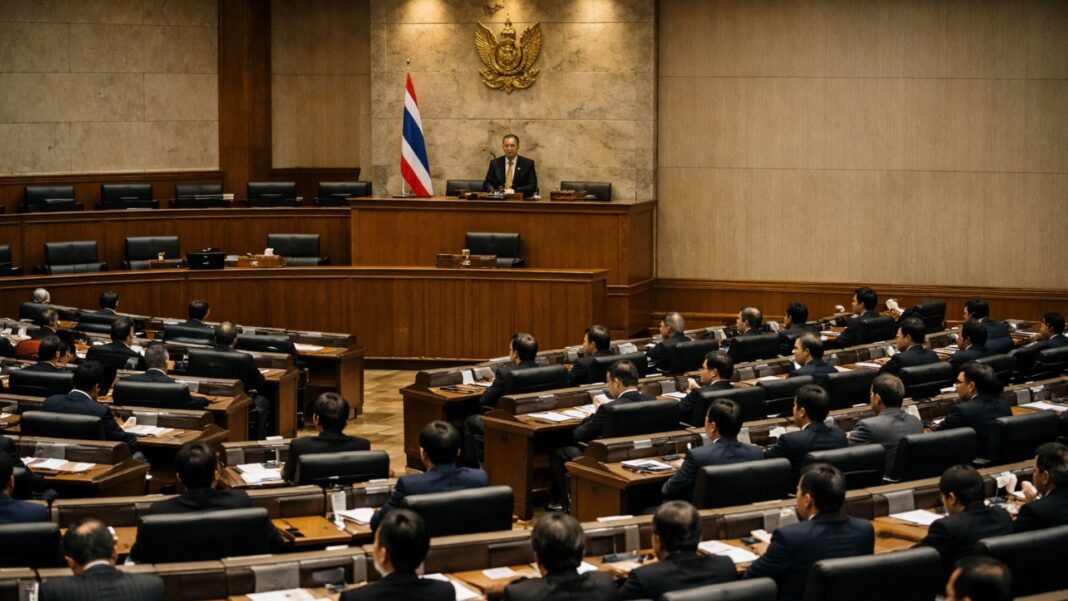

Thailand’s newly elected parliament convened on March 14, 2026, with the Bhumjaithai Party-led coalition expected to form a government and unlock a backlog of stalled energy policies, including a pilot direct power purchase agreement scheme and a long-delayed national Power Development Plan. Both initiatives require approval from the National Energy Policy Council, which is chaired by the prime minister, and cannot advance until a functioning cabinet is in place.
Key Facts At A Glance
- Thailand held a general election on February 8, 2026; the Bhumjaithai Party won 191 seats, the People’s Party placed second with approximately 120 seats, and Pheu Thai placed third
- The Bhumjaithai and Pheu Thai coalition, together with smaller parties, commands approximately 291 to 298 seats in the 500-seat House of Representatives
- Parliament opened on March 14; Bhumjaithai veteran Sophon Saram was elected Speaker on March 15 with 289 votes
- A prime ministerial vote is expected imminently, with Anutin Charnvirakul widely expected to retain the premiership
- The pilot DPPA scheme has a 2 GW cap and targets data center operators as primary offtakers; it was approved by the National Energy Policy Council in 2024 but suspended pending the new government
- Thailand has been operating under the 2018 Power Development Plan for nearly seven years; a new PDP drafting panel was established in late 2025 with a four-month completion target
- Energy Minister Auttapol Rerkpiboon is expected to continue in his role; he was appointed by Anutin in September 2025 and is a former chief executive of PTT Public Company Limited
Thailand’s new House of Representatives convened for the first time on March 14, 2026, opening the procedural path to government formation and clearing the way for energy policy decisions that have been on hold since Anutin Charnvirakul dissolved parliament in December 2025. The King and Queen of Thailand presided over the opening of parliament. On March 15, lawmakers elected Sophon Saram of Bhumjaithai as Speaker of the House of Representatives, receiving 289 votes against 123 for People’s Party candidate Parit Watcharasindhu. The vote foreshadowed the composition of the incoming government and set the stage for the prime ministerial vote expected in the days following.
The Bhumjaithai and Pheu Thai coalition, joined by a group of smaller parties, controls approximately 291 to 298 of the 500 parliamentary seats. Anutin Charnvirakul, who has served as caretaker prime minister since the election, stated publicly that the prime ministerial vote must not be unnecessarily delayed, describing fast government formation as necessary for political stability.
The Energy Policy Backlog
Two energy initiatives of direct relevance to Thailand’s power sector remain suspended pending the formation of the new government. Both require sign-off by the National Energy Policy Council, a body chaired by the prime minister and therefore unable to act during a caretaker period.
The first is a pilot direct power purchase agreement scheme with a 2 GW ceiling, designed to allow renewable energy producers to sell electricity directly to large industrial and commercial consumers, primarily data center operators, bypassing the state utility as sole buyer. The National Energy Policy Council approved the scheme’s framework in 2024, but the Energy Permanent Secretary confirmed that implementation could only proceed once the new government was formally constituted. The scheme would give eligible corporate buyers direct access to renewable generation under Thailand’s forthcoming Third-Party Access framework, which governs grid access fees, balancing obligations, and compliance standards for both generator and offtaker parties.
The second is a solar-powered water pump program targeting approximately 700,000 rai of agricultural land nationally, which was one of the outgoing Anutin government’s flagship quick-impact rural energy projects. Like the DPPA scheme, it requires NEPC endorsement before procurement can begin.
The Power Development Plan Delay
Thailand has been operating under the 2018 Power Development Plan for close to seven years, a situation widely cited by business and energy sector stakeholders as a structural obstacle to investment planning. A revised PDP drafted during the pre-election period set a 51% non-fossil energy target by 2037, but that document was set aside following the change in government in 2023 and the subsequent political volatility. A new PDP drafting panel, chaired by Thosaporn Sirisamphan, a former board chairman of the Bank of Thailand and PTT Public Company Limited, was established in late 2025 with a target of submitting a completed plan to the NEPC within four months. That timeline depends on the NEPC reconvening under a sitting prime minister.
Vietnam, Thailand’s main competitor for regional foreign direct investment in manufacturing and data infrastructure, approved its revised Power Development Plan VIII in April 2025, outlining renewable capacity targets through 2030. Several industry observers noted in the lead-up to Thailand’s election that the absence of an updated Thai PDP was creating commercial uncertainty for investors in the data center and clean energy sectors who require long-term generation planning visibility before committing capital.
Energy And The New Parliament
The People’s Party, which placed second in the election with approximately 120 seats and will sit in opposition under the Bhumjaithai-led coalition, had included reducing electricity prices and strengthening environmental protections among its nine declared legislative priorities. Those commitments are now outside government, though the party retains a platform for scrutiny of energy policy from the opposition benches.
Energy Minister Auttapol Rerkpiboon, a former PTT chief executive appointed by Anutin in September 2025, is expected to continue in the energy portfolio. His ministry is simultaneously managing the immediate pressure of the Strait of Hormuz supply disruption, which has pushed LNG spot prices sharply higher and prompted the Energy Regulatory Commission to approve emergency spot LNG procurement for March and April 2026. The interaction between the short-term fuel crisis and the unresolved structural questions of PDP drafting and DPPA implementation will define the incoming government’s first months on energy file.