

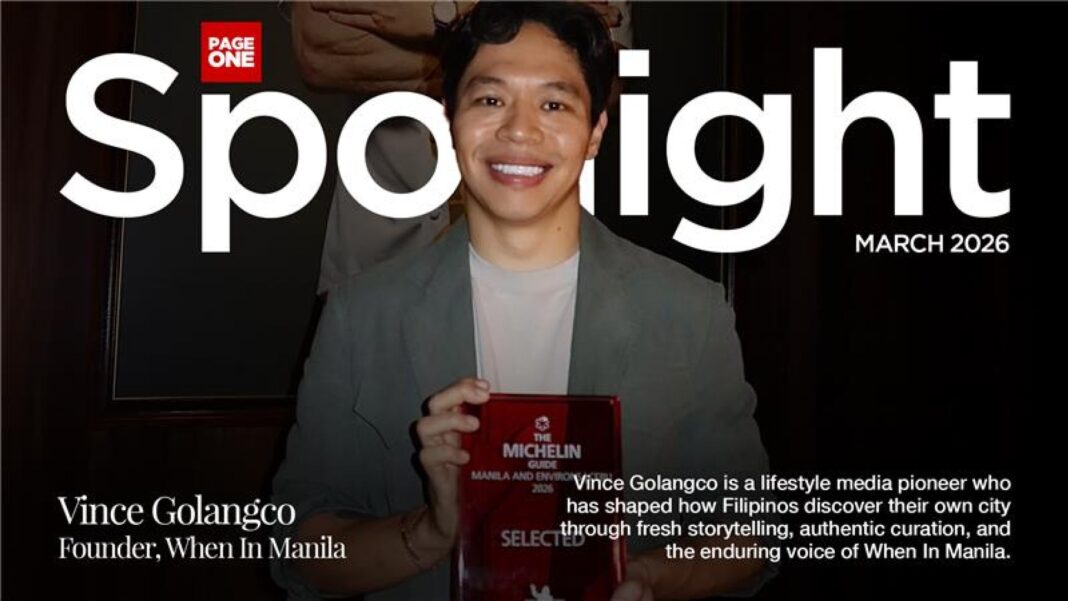

There is a moment every platform eventually reaches, when what once felt casual begins to carry weight.
For Vince Golangco, that moment came not through numbers, but through consequence.
It started quietly. A feature goes up. A restaurant gets mentioned. Then, almost immediately, something shifts offline. Tables fill. Reservations spike. The effect is visible, measurable, and real.
“When restaurants started telling me they were fully booked after a wheninmanila.com feature, that was a wake-up call,” Golangco recalls.
What had once been a space for sharing personal discoveries no longer existed in isolation. The platform had begun influencing decisions, shaping foot traffic, and affecting livelihoods. It was no longer just about highlighting what was interesting. It was about understanding that what gets published can directly impact businesses and communities.
“That’s not a small thing,” he says. “And I haven’t taken it lightly since.”
With influence comes pressure, and not all of it is visible to the audience.
Golangco acknowledges that there have been moments when brands, partners, or public figures have attempted to shape what appears on the platform. Some push for coverage. Others push for silence. He does not dwell on specifics, but the outcome is clear.
“We’ve ended partnerships over it,” he says.
The decision is rarely easy. Walking away from a deal often means giving up immediate opportunities. But for Golangco, the trade-off is not worth it. Relationships in the industry can be rebuilt over time. Audience trust, once broken, is far more difficult to restore.
“It’s not always comfortable,” he admits. “But the alternative is worse.”
To many readers, When In Manila still appears effortless. The content feels light, accessible, and easy to consume. Food features, travel guides, event coverage. It reads like a curated collection of experiences, stitched together seamlessly.
What often goes unseen is everything behind it.
“That it’s easy,” Golangco says, when asked what people misunderstand most. “People see the fun content and assume it’s all brunches and events.”
The reality is more complex. Each post sits on top of a structure that includes editorial decisions, team coordination, advertiser discussions, technical challenges, and late-night deadlines. Publishing does not always happen at convenient hours. Content does not always come easily. What looks like a lifestyle platform is, in practice, a full media operation.
“It’s a real media operation,” Golangco explains, “just dressed in a fun lifestyle costume.”
That balance between tone and responsibility is what defines the platform’s position. It may present itself through approachable, everyday content, but the decisions behind it carry the same weight as any structured media outlet.
At the center of those decisions is a line Golangco refuses to cross.
“Anything that exploits, demeans, or misleads our readers,” he says. “Full stop.”
The rule is simple, but it holds firm regardless of circumstance. No disinformation for profit. No shaming for engagement. No content that trades integrity for traffic. These are not flexible guidelines. They are boundaries.
“We’re not going to run disinformation for a check,” he adds. “We’re not going to shame people for clicks.”
In an industry where attention is currency, that kind of restraint is not always common. But for Golangco, it is necessary. Influence, once recognized, demands a different kind of discipline. It requires knowing not just what to publish, but what to walk away from.
When In Manila may still feel like a guide to the city, a place to discover where to eat, where to go, and what to try next. But behind that familiar surface is something heavier. A platform aware of its reach. A system built on choices that are not always visible.
And at the center of it, a founder who understands that being the go-to is not just about being trusted to recommend. It is about being trusted to decide.