

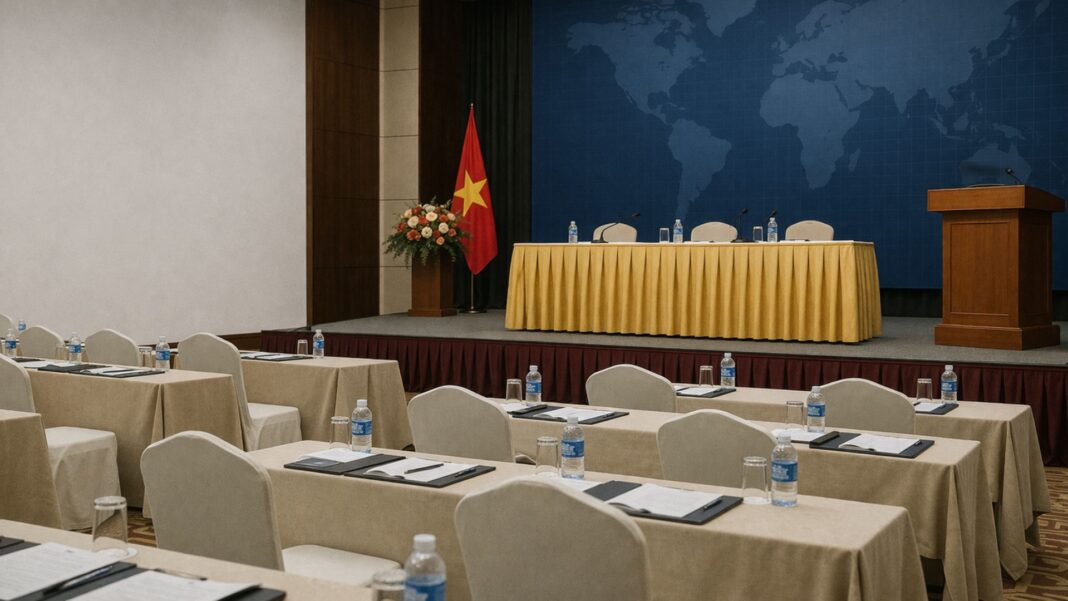

Vietnam’s State Securities Commission held its annual capital market development conference on March 20, 2026, outlining a two-pillar reform strategy and setting the stage for the country’s most consequential capital market milestone in decades. The conference, chaired by Minister of Finance Nguyen Van Thang, took place as Vietnam prepares for its reclassification to Secondary Emerging Market status under the FTSE Russell index framework, effective September 21, 2026, subject to an interim assessment result scheduled for publication on April 7, 2026.
Key Facts At A Glance
- The State Securities Commission, under the Ministry of Finance, convened the 2026 Securities Market Development Conference in Hanoi on March 20, 2026, under the theme “Developing the Stock Market, Contributing to Economic Growth.”
- The conference was chaired by Minister of Finance Nguyen Van Thang, with SSC Chairwoman Vu Thi Chan Phuong delivering the opening address.
- The SSC outlined two reform pillars: expanding market supply to support corporate capital mobilisation and stimulating investment demand to deepen market participation and liquidity.
- As of March 15, 2026, Vietnam’s stock market had 65 companies with a market capitalisation exceeding USD 1 billion, including six companies surpassing USD 10 billion. Investor accounts reached over 11.6 million, exceeding the target set under the Stock Market Development Strategy to 2030.
- Vietnam’s government has set a target of average GDP growth exceeding 10% per year for the 2026 to 2030 period. Total capital required for that period is estimated at approximately VND 38.5 million billion, of which state budget capital accounts for only around 20%.
- FTSE Russell announced on October 7, 2025, that Vietnam will be reclassified from Frontier to Secondary Emerging Market status effective September 21, 2026. The interim assessment result is scheduled for publication on April 7, 2026.
- The interim assessment will evaluate Vietnam’s progress in enabling direct access to global brokers for foreign institutional investors, the one remaining area flagged by FTSE Russell ahead of full reclassification.
- Vietnam’s KRX trading platform, launched in May 2025 in partnership with the Korea Exchange, has been cited by FTSE Russell as a material infrastructure improvement supporting the upgrade.
Background: A 30-Year Market Reaching An Inflection Point
March 20’s conference coincided with the 30th anniversary of Vietnam’s securities industry, a milestone that SSC Chairwoman Vu Thi Chan Phuong used to frame the urgency of reform. Over three decades, the Vietnamese stock market has grown from a nascent exchange into a market with more than 11.6 million investor accounts, a level that already exceeds the target set under the national Stock Market Development Strategy to 2030.
The Chairwoman described 2026 as the opening of a new development phase, one with higher demands for quality, efficiency, depth, and sustainability. The conference served as the primary policy forum for regulatory bodies and market participants to exchange views and propose solutions ahead of Vietnam’s most significant capital market event since the exchange was established.
The Two-Pillar Reform Framework
The SSC’s reform strategy, as presented at the March 20 conference, is organised into two parallel pillars.
On the supply side, the regulator is prioritising the refinement of the IPO mechanism to shorten the period between listing approval and first trading to fewer than 30 days, down from a previous standard of 90 days. The SSC is also working to support foreign direct investment enterprises in offering securities to the public and listing on Vietnamese exchanges, as well as accelerating the equitisation and divestment of state capital in enterprises with high levels of government ownership.
On the demand side, the SSC is focusing on three areas: developing institutional investors, attracting foreign capital, and improving the financial literacy and investment quality of individual market participants. SSC Vice Chairman Bui Hoang Hai disclosed at the conference that global financial institutions including UBS and Morgan Stanley have visited Vietnam and finalised service contracts with domestic providers in recent months, completing preparations to officially enter the market.
Minister Nguyen Van Thang, however, also identified persistent structural gaps. He noted that the market’s investor base remains skewed toward individual retail participants and lacks sufficient institutional depth, that corporate governance quality and information transparency need continued improvement, and that foreign capital continues to record net outflows despite positive market sentiment.
The FTSE Reclassification: What Is At Stake
FTSE Russell confirmed on October 7, 2025, that Vietnam will be reclassified from Frontier to Secondary Emerging Market status effective September 21, 2026. Vietnam will join China, India, Indonesia, and the Philippines in the secondary emerging market tier. The reclassification will be implemented in multiple tranches, beginning with removal from the FTSE Frontier Index Series and simultaneous inclusion in the FTSE Global Equity Index Series in conjunction with the September 2026 semi-annual review.
The single remaining condition flagged by FTSE Russell ahead of full reclassification is progress on enabling direct access to global brokers for foreign institutional investors. This is not a mandatory criterion for achieving Secondary Emerging Market status, which Vietnam has already formally met, but FTSE Russell has indicated it is important for effective index replication by passive funds. The result of the interim assessment will be published on April 7, 2026.
FTSE Russell has identified 28 Vietnamese stocks as likely constituents of the FTSE Global All Cap Index following reclassification, based on data as of December 31, 2024. These include large-cap names Hoa Phat Group, Vietcombank, Vingroup, and Vinhomes, alongside mid-cap constituents Masan Group, Sabeco, and Vinamilk. Vietnam’s projected weight in the FTSE Emerging Index is 0.22%, and 0.34% in the FTSE Emerging All Cap Index.
Analysts and the World Bank have estimated that an upgrade by both FTSE Russell and MSCI could generate cumulative foreign net inflows of up to USD 25 billion by 2030. FTSE Russell alone estimates passive inflows of approximately USD 6 billion from funds benchmarked to its Emerging Market indices.
Market Conditions On Conference Day
The March 20 conference took place against a challenging market backdrop. The VN-Index fell 51.32 points, or 3%, to close at 1,647.8 points on March 20, pressured by Middle East tensions and a sharp domestic fuel price increase. Foreign investors sold a net VND 1.9 trillion on the Ho Chi Minh Stock Exchange that session, underscoring the concern raised by SSC Vice Chairman Bui Hoang Hai that net foreign outflows remain a structural challenge despite the positive reclassification narrative.
Capital Requirement And The Market’s Assigned Role
Vietnam’s ambition to sustain average GDP growth exceeding 10% per year through 2030 creates an enormous capital mobilisation challenge. Total investment required for the 2026 to 2030 period is estimated at approximately VND 38.5 million billion. With state budget capital covering only around 20% of that requirement, the Ministry of Finance has formally identified the capital market as the primary channel for mobilising the remaining 80%. Minister Nguyen Van Thang described this as a task that is heavy and challenging but one that also opens significant opportunities for investors and financial institutions operating in Vietnam.