

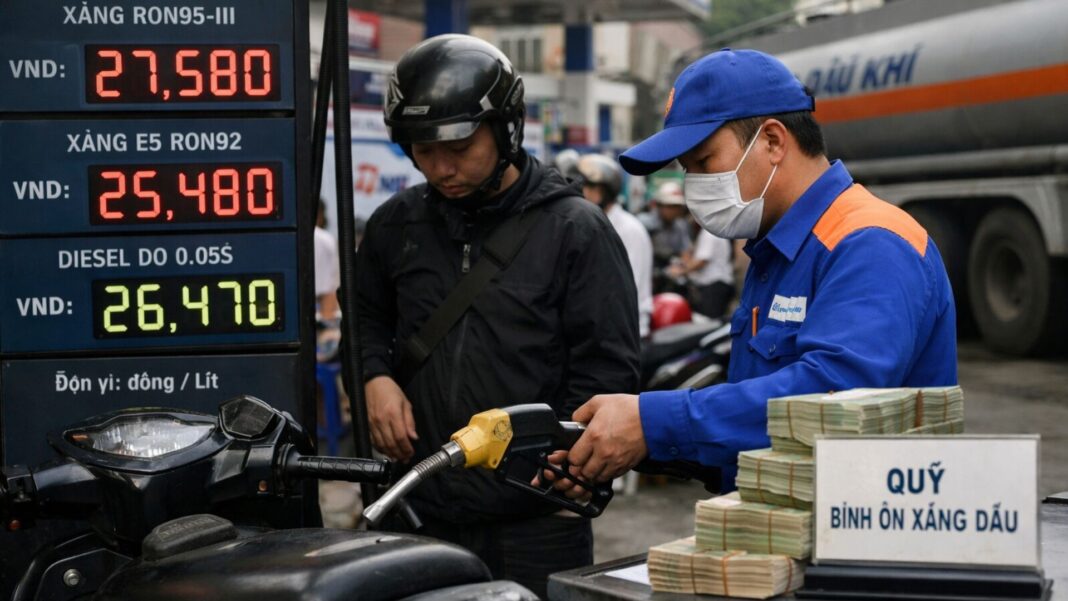

Vietnam’s government issued emergency legislation on March 9 cutting fuel import taxes to zero and activated its Petroleum Price Stabilisation Fund, as the country sought to manage fuel price volatility triggered by the disruption of the Strait of Hormuz.
Key Facts At A Glance
- Decree No. 72/2026 reduced preferential import taxes on gasoline, diesel, aviation fuel, and petrochemical raw materials to 0%, effective March 9 through April 30, 2026.
- Retail fuel prices were adjusted multiple times between March 7 and March 12, 2026, including both upward and downward movements as global benchmark prices fluctuated.
- Diesel prices rose by 7,207 VND per litre in the March 7 adjustment, then fell by approximately 4,247 VND per litre following the March 11 intervention.
- Kerosene recorded the sharpest increase, up 8,490 VND per litre on March 7, before being reduced in the subsequent adjustment.
- The Ministry of Industry and Trade issued urgent directive No. 1582/BCT-TTTN on March 11 to major petroleum traders and distributors, directing compliance with supply obligations.
- Vietnam has an estimated 20 days of fuel reserves; the IEEFA assessed that the country’s planned procurement of 4 million barrels of non-Middle Eastern crude represents approximately six days of consumption.
- Vietnam’s two domestic refineries, Dung Quat and Nghi Son, were directed to maintain stable operations with immediate reporting obligations in the event of any technical disruption.
The Vietnamese government moved on multiple fronts within a compressed timeframe as global oil prices surged following the closure of the Strait of Hormuz on February 28, 2026. On March 9, the government published Decree No. 72/2026, cutting preferential import taxes on gasoline, diesel, aviation fuel, and several petrochemical raw materials to zero percent. The decree took immediate effect and was set to remain in force through April 30, 2026. The measure was designed to ease import costs for domestic fuel traders and reduce the pass-through of global price increases to retail consumers.
The decree came two days after the Ministry of Industry and Trade and the Ministry of Finance had already made a significant upward adjustment to retail fuel prices, effective from 3 PM on March 7. That adjustment reflected a spike in world crude prices in the days immediately following the onset of hostilities. E5RON92 gasoline rose by 3,777 VND per litre, RON95-III gasoline by 4,707 VND per litre, diesel by 7,207 VND per litre, and kerosene by 8,490 VND per litre. Fuel oil increased by 3,831 VND per kilogram in the same period.
Stabilisation Fund Deployed
Following the price spike, authorities moved to deploy the Petroleum Price Stabilisation Fund. On March 11, the Ministry of Industry and Trade issued urgent document No. 1582/BCT-TTTN to key petroleum wholesalers and distributors, instructing them to manage prices under a market mechanism with state regulation. The ministry and the Ministry of Finance directed the Stabilisation Fund to contribute across multiple fuel categories: 4,000 VND per litre for biofuel, unleaded gasoline, kerosene and fuel oil; 5,000 VND per litre for diesel; and 4,000 VND per kilogram for fuel oil. The combined effect of the fund allocation was a sharp retail price reduction, effective from 10 PM on March 11. Diesel fell to a maximum of 26,470 VND per litre, kerosene to 24,419 VND per litre, and fuel oil to 19,001 VND per kilogram.
By March 12, international crude benchmarks were again rising, with Brent crude surpassing USD 100 per barrel in Asian trading. Despite the global rebound, domestic prices remained lower due to the stabilisation fund drawdown, creating a widening gap between world market prices and regulated retail prices, a dynamic that places fiscal pressure on the fund’s sustainability.
Supply Chain Directives
The Ministry of Industry and Trade also addressed supply chain integrity directly. Key petroleum traders were required to adhere to their minimum total petroleum supply obligations for 2026, diversify import sources, and maintain statutory reserves. Businesses were instructed to complete their March import plans and urgently prepare April procurement schedules. The Dung Quat and Nghi Son refineries were directed to maintain stable operations and fire safety compliance, with mandatory immediate reporting to the ministry in the event of any technical incident or maintenance shutdown.
The ministry additionally prohibited hoarding at all levels of the supply chain, from primary distributors to retail outlets, citing a need to prevent supply disruptions following reports that hoarding had occurred in some localities in the days after the March 7 price increase. By March 8, reports indicated that hoarding had diminished in most areas, though border localities including Tay Ninh, Gia Lai, and Nghe An continued to see cross-border purchasing activity, primarily by residents from Laos entering Vietnam to buy fuel.
Reserve Adequacy Concern
Separately, Vietnam announced plans to procure approximately 4 million barrels of crude oil from non-Middle Eastern suppliers to partially offset disrupted Qatari and Gulf supply flows. Researchers at the Institute for Energy Economics and Financial Analysis assessed that this volume represents roughly six days of national consumption. Based on state media reporting that Vietnam holds approximately 20 days of fuel reserves, the IEEFA characterised the country as being at elevated risk of shortages without sustained additional crude inflows if the Hormuz disruption persists.
Vietnam’s vulnerability is structural: it relies on imported crude for both its domestic refineries and on refined product imports to supplement domestic output. Its Power Development Plan 8 targets 22,524 MW of LNG-fired electricity generation by 2030, meaning the country’s longer-term grid build-out is directly tied to LNG procurement reliability, a factor now under acute stress.