

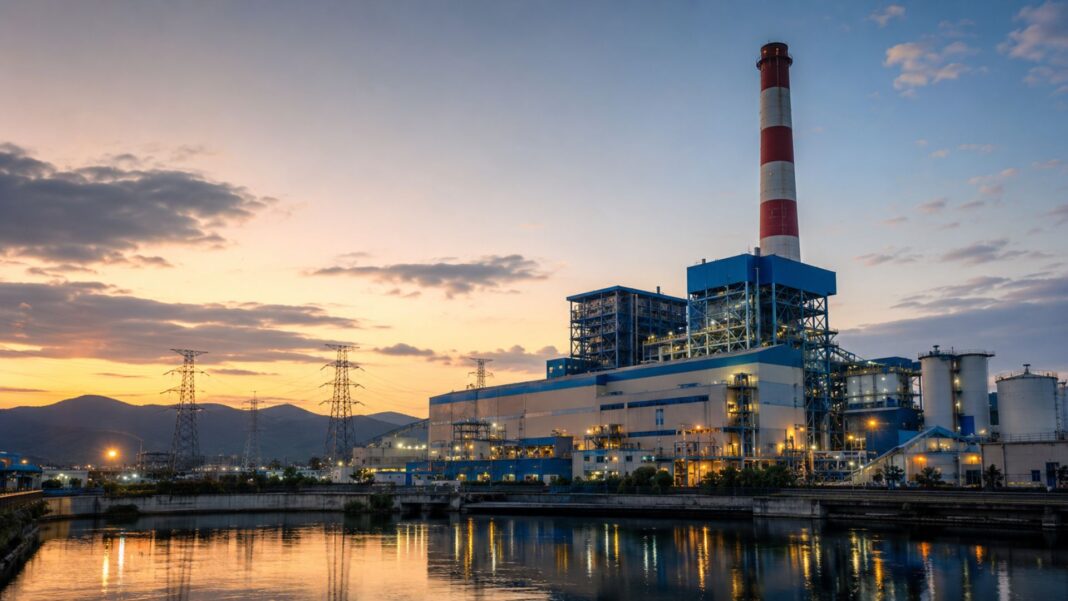

Vietnam Electricity and national grid authorities are deploying a multi-scenario contingency framework to prevent power shortfalls through the 2026 dry season peak, as rising electricity demand, El Nino-driven hydropower constraints, and imported fuel supply volatility converge on the national grid simultaneously.
Key Facts At A Glance
- Vietnam Electricity has described the national power system as facing “dual pressure” since the start of 2026: surging electricity demand and geopolitical uncertainties affecting imported fuel supplies.
- The national grid recorded a 2026 peak of 51,691 MW on April 7, up approximately 12 percent year-on-year.
- El Nino is forecast to reduce water inflows to hydropower reservoirs during the April-to-July peak season.
- EVN is targeting a 3 percent reduction in total national electricity consumption in 2026 and a 10 percent reduction during the peak dry-season months.
- The Quang Trach I thermal power plant, with a total investment of over VND 42,000 billion, entered commercial operation in May 2026, adding approximately 9 billion kWh of annual capacity.
- BESS deployment targets: Northern Power Corporation 530 MW, Hanoi Power Corporation 275 MW, National Power Transmission Corporation 300 MW.
- EVN plans to commence construction on 295 projects and energize 303 power grid projects in 2026 alone.
- Demand is projected to grow at 10-12 percent annually through 2030, requiring up to 10,000 MW of new capacity added per year.
A Grid Under Compound Pressure
Vietnam Electricity’s assessment of the 2026 dry season marks a shift from routine contingency planning to coordinated emergency management. Nguyen Manh Quang, deputy head of EVN’s Business and Power Purchase Department, described the pressure as originating from two simultaneous forces: domestic demand growth driven by industrial expansion, artificial intelligence infrastructure, and electric vehicle adoption, and externally from geopolitical disruptions in the Middle East that have elevated the cost and availability of imported coal and LNG.
The Ministry of Industry and Trade has confirmed that tensions around the Strait of Hormuz have directly affected global LNG supply and prices, while also indirectly pressuring coal markets through rising maritime transportation costs. Vietnam’s exposure to LNG import risk is currently limited relative to neighbors such as Thailand, where LNG accounts for around 60 percent of power generation. Nevertheless, Vietnam’s imported coal dependency for thermal generation in the north creates supply chain exposure that authorities are actively managing through diversified sourcing and increased domestic stockpile targets.
The April 7 peak of 51,691 MW, representing a 12 percent increase over the same period in 2025, arrived earlier in the season than anticipated and has since been treated as a structural signal rather than a statistical outlier. EVN General Director Nguyen Anh Tuan stated the organization had implemented flexible operational plans and coordinated with fuel suppliers to minimize risk to electricity production.
New Capacity Coming Online
The Quang Trach I thermal power plant in Quang Binh province entered commercial operation in May 2026, completing a milestone that had been tracked as a critical near-term supply buffer. The plant adds approximately 9 billion kWh of electricity per year to the national grid and was developed with a total investment of over VND 42,000 billion. Grid connection for its first unit occurred in April. The project had been identified by EVN leadership as one of the key supply additions required to prevent shortfalls during the second quarter of 2026.
Several transmission infrastructure projects have also been accelerated for second-quarter completion. These include the 500/220 kV Nho Quan-Phu Ly-Thuong Tin transmission line, the 220 kV Nhon Trach 3 power plant-Long Thanh line, the 220 kV West Hanoi-Thanh Xuan line, the 220 kV Dai Mo substation, and 110 kV lines serving Phu Quoc island, the last of which has been specifically flagged as required for APEC-related event preparedness. Additional projects in the pipeline include the Quang Trach II and III LNG-fired plants, the expanded Tri An hydropower plant, and the Bac Ai pumped-storage hydropower facility.
Demand Management And Storage Deployment
Prime Minister Pham Minh Chinh formalized the government’s supply security posture through Directive No. 10/CT-TTg, directing ministries, localities, and enterprises to target a minimum 3 percent reduction in total national electricity consumption in 2026 and a minimum 10 percent reduction during peak hot months. Industrial parks and large electricity consumers are being encouraged to shift production schedules away from peak hours. Load reduction of at least 3,000 MW during peak periods has been identified as a target.
EVN is simultaneously proposing an adjustment to time-of-use tariff structures, with the peak pricing period potentially extended from 6:30 p.m. to 10:30 p.m. to better reflect the shifting demand curve driven by evening electric vehicle charging and residential cooling demand. Incentive mechanisms for demand response participants are also under study.
On storage, EVN has assigned differentiated BESS targets across its subsidiary corporations. The Northern Power Corporation is responsible for 530 MW of battery capacity, the Hanoi Power Corporation for 275 MW, and the National Power Transmission Corporation for approximately 300 MW. These deployments are intended to improve grid stability as variable renewable energy, which now accounts for approximately 26 percent of Vietnam’s total installed capacity, increases the frequency and depth of grid ramp requirements.
Rooftop Solar As Near-Term Supply Supplement
One of EVN’s most operationally accessible levers for the 2026 dry season is the accelerated deployment of self-produced and self-consumed rooftop solar. Power corporations have simplified online registration procedures, and EVN has proposed green credit policies and preferential lending mechanisms to lower the barrier to residential and commercial installations. The government views rooftop solar as the fastest deployable incremental supply source that does not require grid-scale procurement timelines, and authorities have specifically linked its promotion to the goal of reducing daytime peak grid pressure.
Investment Scale And Structural Outlook
EVN Chairman Dang Hoang An indicated the corporation is targeting approximately USD 5 billion in annual capital investment through 2030, totaling approximately USD 25 billion over the five-year period. The revised Power Development Plan VIII sets a target of total installed capacity of over 183,000 MW by 2030. Meeting that target requires adding between 8,000 and 10,000 MW of new capacity per year, compared to an average of just over 3,000 MW per year during 2021-2024.
Economist Can Van Luc noted that electricity demand growth, which ran at approximately 8 percent annually during 2021-2025, could accelerate to 10-12 percent annually through 2030, reflecting the government’s mandatory double-digit GDP growth target and its attendant industrial and digital infrastructure demands. Vietnam’s power system is currently the second largest in Southeast Asia and ranks 22nd globally, with total installed capacity of 87,600 MW as of early 2026.