

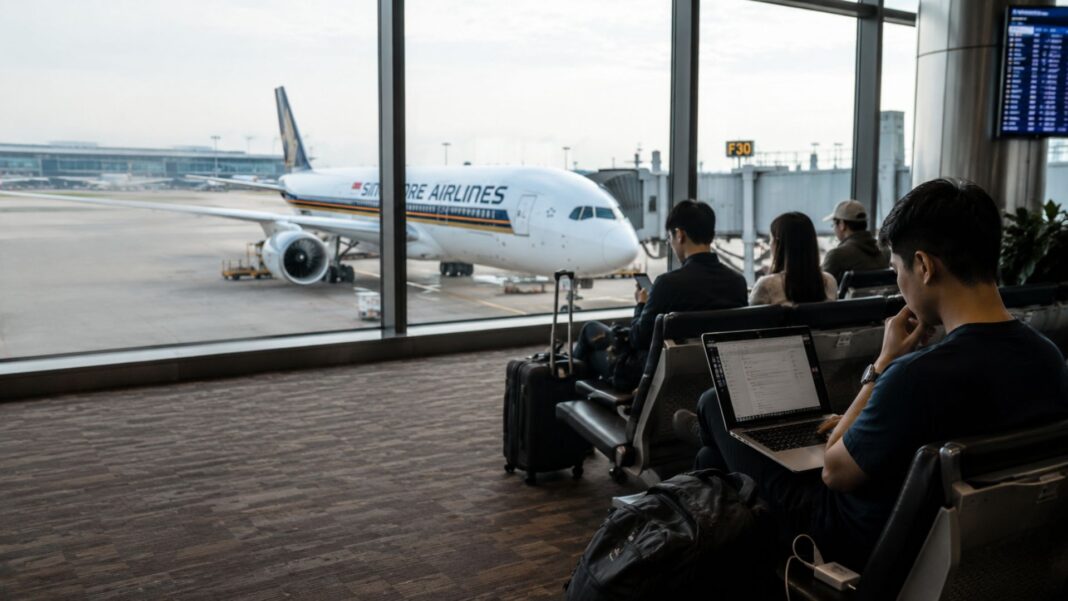

Singapore Airlines confirmed on 4 May 2026 that it has chosen SpaceX’s Starlink low Earth orbit satellite network to upgrade inflight connectivity across its Airbus A350-900 long-haul, A350-900 ultra-long-range, and A380 aircraft, with rollout beginning in Q1 2027 and completion targeted by end of 2029. The agreement positions the carrier to deliver gate-to-gate broadband connectivity free of charge to all cabin classes, extending its existing complimentary Wi-Fi policy to a significantly faster and more reliable platform.
Key Facts At A Glance
- Announcement date: 4 May 2026, via official Singapore Airlines press release
- Aircraft covered: Airbus A350-900 long-haul, A350-900 ultra-long-range, and A380, approximately 53 aircraft
- Aircraft not covered: Boeing 737 MAX 8, 777-300ER, 787-10, and A350-900 medium-haul variants
- Rollout start: Q1 2027, progressive through end of 2029
- Technology: Starlink LEO satellite network, more than 10,000 satellites; Aero Terminal supports up to 1 Gbps per antenna
- Pricing: Complimentary for Suites, First Class, Business Class, PPS Club members, and KrisFlyer members in Premium Economy and Economy; non-KrisFlyer Economy passengers may enrol free on board
- Key executives quoted: Yeoh Phee Teik, Senior Vice President Customer Experience, Singapore Airlines; Jason Fritch, Vice President Starlink Enterprise Sales, SpaceX
- Competitive context: Starlink already operational with Emirates, Qatar Airways, Delta Air Lines, United Airlines, and Alaska Airlines
Article Body
Singapore Airlines announced on 4 May 2026 that it has selected SpaceX’s Starlink as the provider for its next-generation inflight broadband connectivity, covering its Airbus A350-900 long-haul, A350-900 ultra-long-range, and A380 aircraft. The progressive rollout begins in the first quarter of 2027 and is expected to reach all eligible aircraft by the end of 2029. The announcement, made via the airline’s official newsroom, confirms a transition the industry had widely anticipated following Singapore Airlines’ disclosure late in 2025 that it would be moving to low Earth orbit satellite connectivity.
From Geostationary To Low Earth Orbit
Singapore Airlines’ existing inflight Wi-Fi infrastructure relies on geostationary orbit satellites positioned approximately 35,800 kilometres above Earth. While this technology has supported the carrier’s complimentary Wi-Fi policy across its fleet, geostationary systems are subject to inherent latency and bandwidth constraints that affect the quality of video streaming, video calls, and large file transfers. Starlink’s constellation, which has surpassed 10,000 satellites in low Earth orbit at approximately 550 kilometres altitude, dramatically reduces signal travel distance and the resulting latency. The Starlink Aero Terminal installed on aircraft supports up to 1 Gbps per antenna, enabling gate-to-gate connectivity throughout a flight.
Yeoh Phee Teik, Senior Vice President Customer Experience at Singapore Airlines, said: “Singapore Airlines already offers the world’s most comprehensive complimentary in-flight Wi-Fi across our entire fleet. Starlink will take this to the next level by delivering next-generation high-speed connectivity, enabling customers to stay entertained, connected, and productive throughout their journey, with a smoother and seamless experience from take-off to landing.”
Jason Fritch, Vice President of Starlink Enterprise Sales at SpaceX, said: “Customers and crew will soon experience seamless, low-latency connectivity as they travel. Whether flying long-haul or ultra-long-haul distances, Starlink is redefining what is possible for leisure and business travellers alike.”
Fleet Coverage And Access Policy
The Starlink upgrade applies to three aircraft types that form the backbone of Singapore Airlines’ long-haul network: the A350-900 in long-haul configuration, the A350-900 ultra-long-range variant used on the carrier’s longest nonstop routes including Singapore–New York, and the A380 superjumbo deployed on high-demand intercontinental corridors. Boeing 737 MAX 8, 777-300ER, 787-10, and A350-900 medium-haul aircraft are not included in the current rollout.
Singapore Airlines will maintain its existing complimentary Wi-Fi policy on Starlink-equipped aircraft, extending free unlimited access to passengers in Suites, First Class, Business Class, and PPS Club, as well as to KrisFlyer members in Premium Economy and Economy. Passengers in the rear cabin who are not KrisFlyer members may enrol in the free programme online or on board via KrisWorld.com to access the same complimentary service.
Competitive And Industry Context
Singapore Airlines joins a growing roster of major carriers that have selected Starlink for inflight broadband, including Emirates, Qatar Airways, Delta Air Lines, United Airlines, and Alaska Airlines. The adoption by a carrier consistently ranked among the world’s leading airlines is widely regarded as confirmation that LEO-based connectivity has moved from experimental deployment to accepted industry standard. At the time of the announcement, Singapore Airlines already offered complimentary Wi-Fi across its entire fleet, a policy that preceded most global competitors. The Starlink upgrade is designed to address the quality gap between that existing policy and the performance expectations of increasingly connected long-haul travellers.
The three-year rollout timeline, running from Q1 2027 to end of 2029, is longer than the deployment schedules of some competing carriers, a difference attributed in part to the volume and complexity of retrofitting widebody aircraft operating on continuous long-haul schedules. The A350-900 long-haul cabin refits already scheduled for Q2 2026 will proceed without Starlink hardware initially, with the LEO system to be added separately in a subsequent installation phase.