

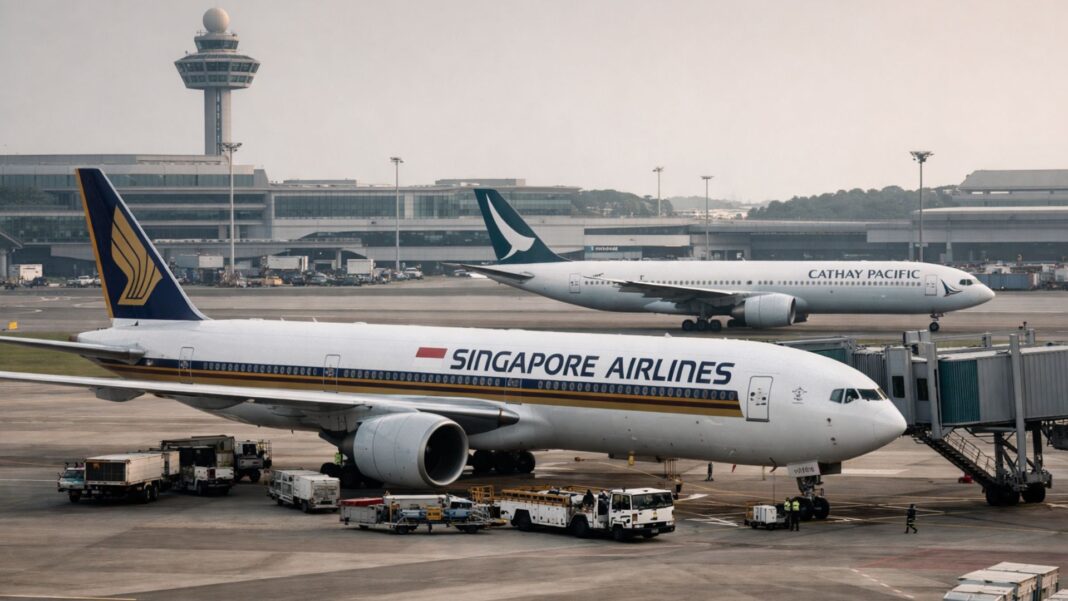

Singapore Airlines and Cathay Pacific have emerged as likely near-term beneficiaries of the Gulf aviation crisis triggered by Middle East airspace closures beginning February 28, 2026, as disrupted Europe-Asia traffic corridors redirect passenger flows through Southeast and Northeast Asian hubs. The disruption has compressed seat availability on key Asia-Europe routes to historic lows while pushing fares to multiples of their normal levels.
Key Facts At A Glance
- Crisis trigger: U.S.-Israeli strikes on Iran, February 28, 2026, followed by Iranian retaliation targeting Gulf states
- Airspace closed or severely restricted: Iran, Iraq, Israel, Kuwait, Qatar, Syria, Bahrain, and the UAE
- Dubai International Airport (DXB) and Al Maktoum International (DWC) both fully closed from March 1, 2026; Dubai Airports reported over 700 flight cancellations following the UAE’s partial airspace closure
- Singapore Airlines suspended at minimum six flights, including SQ494/495 (Singapore–Dubai) and Scoot TR596/597 (Singapore–Jeddah)
- Cathay Pacific Hong Kong–London one-way economy fare reached approximately USD 2,705 for March 11, against a typical fare of roughly USD 648 later in the month.
- Qantas Sydney–London had no economy availability until March 17, with that seat priced at approximately USD 2,220.
- Operating costs per long-haul flight estimated to have risen between 3 and 8 percent due to rerouting and fuel exposure
- Changi Airport, Suvarnabhumi Airport, and Kuala Lumpur International Airport are absorbing redirected long-haul transit flows
When hostilities broke out on February 28, 2026, involving the United States, Israel, and Iran, the immediate consequence for global aviation was the near-simultaneous closure or severe restriction of airspace across eight countries in and around the Middle East. The effect on the world’s busiest transcontinental air corridor — linking Europe, the Gulf, and Asia — was rapid and severe.
The crisis was triggered by U.S.-Israeli strikes on Iran on February 28, 2026, prompting Tehran to retaliate with munitions targeting several Gulf states. Airspace across Iran, Iraq, Israel, Kuwait, Qatar, Syria, and Bahrain is now closed to civilian traffic, effectively cutting off some of the most heavily traveled corridors in global aviation.
Dubai International Airport (DXB) and Al Maktoum International (DWC) halted operations indefinitely. Dubai Airports reported over 700 flight cancellations after the UAE partially closed its airspace. Hamad International Airport (DOH) operations were suspended following the total closure of Qatari airspace. Etihad Airways suspended all departures and arrivals at Abu Dhabi International Airport. Iran, Iraq, and Kuwait closed their airspaces entirely.
Redirected Demand And The Asian Hub Advantage
Singapore Airlines and Cathay Pacific could see short-term gains as Middle East airspace closures disrupt major Gulf hubs and reroute global traffic flows. As Gulf carriers scale back operations, airlines with strong nonstop networks between Asia and Europe may temporarily benefit from shifting passenger demand. Singapore Airlines and Cathay Pacific operate multiple direct routes to major European cities, giving them a structural advantage when Gulf hubs become inaccessible.
The fare data confirms how sharply demand has been compressed. Cathay Pacific’s Hong Kong to London route showed no available economy seats until March 11, 2026, with the earliest ticket priced at around USD 2,705 one-way, compared to a more typical fare of roughly USD 648 later in the month. Qantas had no economy availability on its Sydney to London service until March 17, 2026, with that seat going for approximately USD 2,220.
According to a Reuters report, Australia’s Flight Centre has seen a 75% surge in calls to its stores and emergency lines. Its Global Managing Director Andrew Stark told Reuters that customers are already adapting, rebooking via Singapore, China, and North American hubs such as Houston. Reuters reported that analysts at Alton Aviation identified Singapore Airlines and Cathay Pacific as likely short-term beneficiaries, given their established nonstop networks between Asia and Europe.
Thai Airways is reporting fully booked European flights as travelers seek to avoid Middle East transit altogether, according to Thailand’s Transport Minister.
Southeast Asian Hubs as Operational Pivots
As airlines execute emergency rerouting plans, major Southeast Asian hubs are absorbing diverted traffic. Singapore’s Changi Airport, Bangkok’s Suvarnabhumi Airport, and Kuala Lumpur International Airport are seeing immediate increases in transit flows as carriers and passengers bypass traditional Gulf connections. Airlines are introducing enhanced stopover and city tour options tailored to itineraries now commonly routed Europe–Southeast Asia–Australia via Singapore or Bangkok.
Singapore Airlines and Scoot suspended all flights to the Middle East, including SQ494/495 (Singapore–Dubai) and Scoot flights TR596/597 (Singapore–Jeddah). Malaysia Airlines was forced to recall aircraft mid-flight: MH160 (Kuala Lumpur–Doha) turned back and returned to KLIA; MH156 (Kuala Lumpur–Jeddah) was diverted to Chennai, India, before returning to Malaysia.
Thai Airways reported minimal impact on its European schedule because it does not currently use Iranian or Israeli airspace. However, it adjusted paths to avoid the Pakistan-Afghanistan border as an extra precaution, adding roughly 20 minutes to some European flights.
Operational Cost Pressures
The demand uplift for carriers such as Singapore Airlines and Cathay Pacific is offset by rising operating costs affecting all long-haul carriers across the region.
Airlines must avoid closed airspace, and alternative routes can add 15 to 60 minutes of flying time depending on the sector. Extended flight times increase fuel burn and crew expenses. In some cases, airlines may need to impose payload restrictions to carry additional fuel, which reduces available cargo capacity and affects revenue streams. According to Business Times, consultants estimate that total operating costs per long-haul flight could rise between 3 and 8 percent, depending on fuel price movements and routing complexity.
Subhas Menon, head of the Association of Asia Pacific Airlines, told Reuters the situation carries a real price: “Right now the whole of the Middle East is out of bounds, which is a high price for some airlines. If Europe can only be served at a high cost, airline profitability will be undermined. At the end of the day, the price to pay is connectivity.”
Longer-Term Structural Implications
Airlines typically hedge 30 to 60 percent of near-term fuel requirements for three to 12 months. This strategy offers temporary insulation from sudden oil spikes but does not eliminate long-term exposure if prices remain elevated. A sustained reduction in Asia-Europe capacity, combined with higher fuel costs and longer routings, could gradually lift both passenger fares and air freight rates.
For now, Asia-Pacific carriers may benefit from redirected passenger flows. Over the longer term, however, persistent instability in the Gulf could reshape cost structures and place renewed pressure on ticket pricing across intercontinental routes.
As of mid-March 2026, the underlying conflict remains unresolved and publicly available information on further operational developments remains limited. Carriers across the region have indicated they are monitoring conditions on a day-by-day basis.