

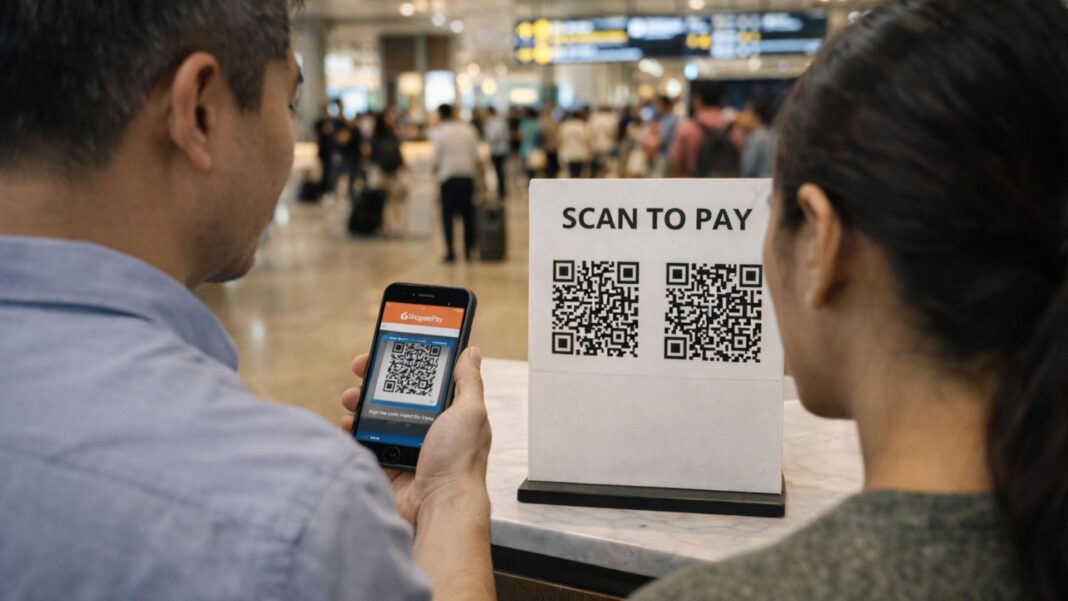

Sea Limited’s payments arm ShopeePay has partnered with Ant International’s Alipay+ to give Singapore users access to QR code payments at over 150 million merchants across more than 100 markets, the wallet’s first cross-border payments offering. The feature launches with coverage in 28 countries and regions, including Malaysia, South Korea, and Australia, with additional markets to be added progressively. The service connects to national payment systems abroad, including DuitNow in Malaysia and ZeroPay in South Korea, allowing users to pay by scanning local merchant QR codes through the ShopeePay app without currency exchange or physical cash.
Key Facts At A Glance
- Announcement date: March 5, 2026, Singapore
- Partnership: ShopeePay (Sea Limited) × Alipay+ (Ant International)
- This is ShopeePay’s first cross-border payments product
- Coverage at launch: 28 countries and regions, with 150+ million merchant acceptance points across 100+ markets
- Markets include Malaysia (DuitNow), South Korea (ZeroPay), Australia, and markets across Europe and the Americas
- Expansion planned: additional countries to be added; feature to extend to other regional ShopeePay markets beyond Singapore
- Singapore digital wallet transaction value is projected to reach S$89 billion by 2027 and to account for 44 percent of in-store payment value by 2030
ShopeePay, the digital payments service operated by Sea Limited through its SeaMoney financial services arm, launched its first cross-border payments product on March 5, 2026 through an integration with Alipay+, the unified wallet gateway operated by Ant International, the overseas payments division of Ant Group.
The feature allows ShopeePay users in Singapore to scan merchant QR codes when travelling or transacting abroad, paying directly from their ShopeePay wallet without needing physical currency or a separate foreign exchange process. At launch, the service is active in 28 countries and regions, giving access to over 150 million merchant acceptance points across more than 100 markets globally.
How The Integration Works
The technical architecture of the offering routes ShopeePay transactions through the Alipay+ ecosystem, which functions as a multilateral gateway connecting multiple domestic wallets and national payment systems under a shared acceptance framework. Through this integration, ShopeePay users in Singapore gain access to the same merchant network already available to other Alipay+ partner wallets, including connections to national QR infrastructures such as DuitNow in Malaysia and ZeroPay in South Korea.
The Alipay+ model does not require merchants to separately onboard each foreign wallet. Instead, merchants already accepting Alipay+ — whether in retail, food and beverage, transport, or other categories — automatically gain the ability to receive payments from any connected wallet in the network. For ShopeePay, this dramatically expands its effective merchant footprint at launch without requiring country-by-country commercial negotiation.
Benjamin Tan, Head of ShopeePay Singapore, said the cross-border feature addresses a gap that SEA wallet users have long encountered when travelling: “QR payments have become a trusted and integral part of everyday life in Singapore, but that experience has not always travelled well across borders. When overseas QR acceptance is fragmented, consumers often fall back on cards that may not be widely accepted by smaller merchants and can come with unclear foreign exchange costs.”
Regional Context And ASEAN Payment Connectivity
The ShopeePay–Alipay+ partnership arrives as cross-border QR connectivity across Southeast Asia is accelerating through both bilateral central bank agreements and multilateral infrastructure initiatives. Bilateral QR linkages, connecting Singapore’s PayNow and SGQR system to counterparts in Thailand (PromptPay), Malaysia (DuitNow), Indonesia (QRIS), and India (UPI) have established real-time retail payment corridors across the region. Malaysia alone recorded 11.8 million cross-border QR transactions worth RM967 million in the first half of 2025, reflecting rapid consumer uptake.
Alongside bilateral links, the Bank for International Settlements’ Project Nexus, a hub-and-spoke multilateral framework involving central banks from Malaysia, Singapore, Thailand, Indonesia, the Philippines, and India, is advancing toward live implementation and is expected to further simplify cross-border retail payment connectivity across ASEAN this year.
Against this backdrop, the ShopeePay–Alipay+ integration represents a commercially led acceleration of cross-border QR reach, operating through the private sector Alipay+ gateway rather than central bank infrastructure. The partnership gives ShopeePay competitive parity with other Singapore wallets that have previously connected to Alipay+, including those offered by OCBC Bank and EZ-Link, while establishing Sea Limited’s payments arm as a participant in the region’s expanding international QR ecosystem.
Expansion Plans
ShopeePay confirmed the cross-border feature is expected to expand to additional markets beyond the initial 28, and that the capability will extend over time to ShopeePay users in other regional markets, including Sea Limited’s operations across Southeast Asia and Brazil. Ant International’s Head of Strategic Partnership Office for Alipay+, Pan Yan, said the partnership would continue to grow ShopeePay’s reach across Southeast Asia.