

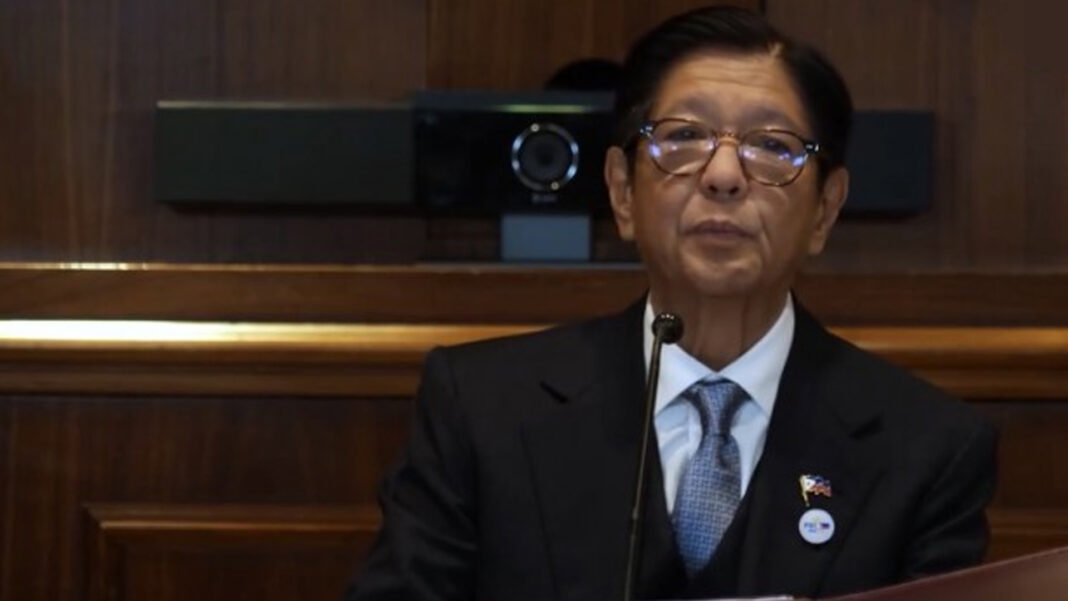

President Ferdinand R. Marcos Jr. returned to the Philippines late Wednesday night after what he described as a “very productive” working visit to New York, where he pushed for peace in global conflicts, rallied support for the country’s United Nations Security Council (UNSC) bid, and promoted investment opportunities in the Philippines.
The plane carrying Marcos and his delegation arrived at 11:29 p.m. Wednesday, according to Malacañang.
During the visit, Marcos addressed the 70th Session of the Commission on the Status of Women (CSW70) at the UN headquarters, where he highlighted the importance of empowering women as a measure of national progress.
In his remarks, the President emphasized the importance of education and unity in confronting violence against women and increasing women’s participation in decision-making across sectors.
Marcos also met with UN Secretary-General António Guterres, reaffirming the Philippines’ commitment to the UN and to multilateral cooperation.
During the special session of the UN General Assembly (UNGA) attended by representatives of 193 member states, the President stressed the importance of the rule of law, multilateralism, and the peaceful settlement of disputes.
He also reiterated the Philippines’ bid for a non-permanent seat at the UNSC for the 2027–2028 term, noting that the country could serve as a voice for the Indo-Pacific region, developing countries, climate-vulnerable nations, and middle-income economies.
On the sidelines of the visit, Marcos met with business leaders and investors to promote economic cooperation with the Philippines.
Among them were officials from the U.S. Medical Glove Company, which is exploring plans to build a manufacturing facility in the country that could generate more than 2,000 jobs for Filipinos.
The President also met with senior officials from J.P. Morgan, where discussions focused on global economic developments, geopolitical tensions, and their potential impact on financial markets and oil prices. (PNA)