

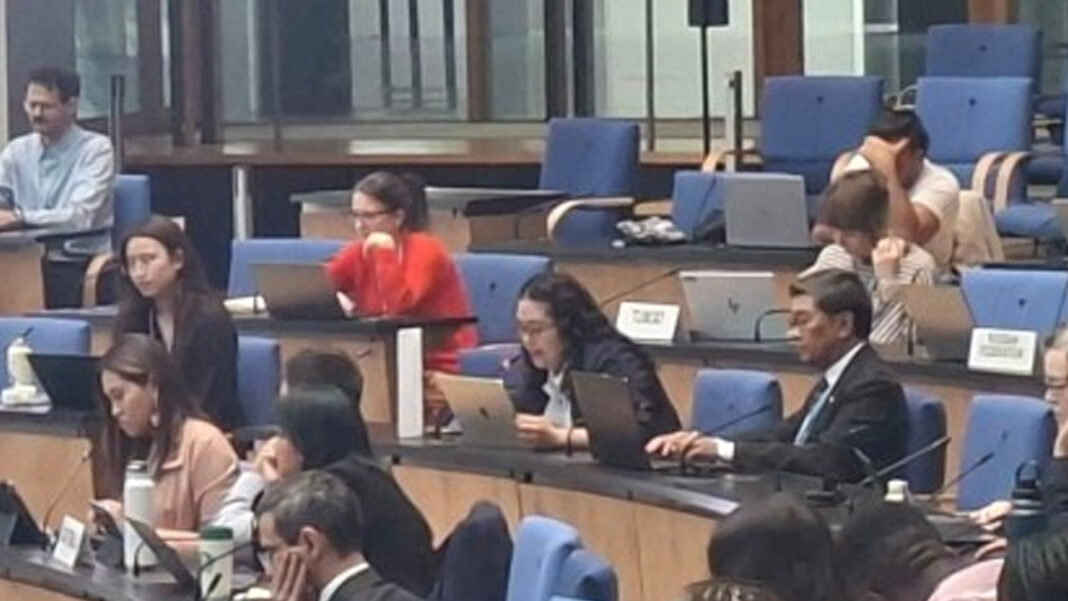

The Philippines called for stronger implementation of climate finance commitments and greater support for developing countries during the 64th Sessions of the Subsidiary Bodies (SB64) of the United Nations Framework Convention on Climate Change (UNFCCC) held in Bonn, Germany on June 8-18.
Delivering the country’s closing statement, Climate Change Commission (CCC) Commissioner and Head of Delegation Atty. Rachel Anne Herrera underscored the need for climate commitments to translate into concrete action and resilience, particularly for countries vulnerable to the climate crisis.
The Philippines highlighted climate finance as a key priority, expressing concern over declining pledges and shifting priorities that threaten the sustainability of international climate finance institutions.
The country called for new, additional, predictable and scaled-up public finance from developed countries to support developing nations’ adaptation, mitigation and loss and damage efforts.
“We express serious concern about the increasingly unpredictable state of climate finance, including reductions in pledges, and shifting priorities that threaten the sustainability and operations of the institutions that we have agreed to establish,” Herrera said as quoted in a news release on Sunday.
“We call for new, additional, predictable, and scaled up public finance from developed country Parties to support the GEF [Global Environment Facility], GCF [Green Climate Fund], AF [Adaptation Fund], and FRLD [Fund for responding to Loss and Damage]. As these funding windows are replenished, contributions must reflect the increasing needs of developing country Parties in adaptation, mitigation, and loss and damage,” she added.
The country’s position has been built on priorities advanced by the Philippine Delegation (PhilDel) throughout SB64, including calls to strengthen outcomes under the Climate Finance Work Program and to ensure that agreements reached under the UNFCCC process deliver action at the scale and speed required by current realities, especially for vulnerable countries and communities.
At the opening of the negotiations, the Philippines emphasized that climate commitments must translate into measurable action, and urged Parties to advance progress on climate finance, adaptation and implementation support.
The country also stressed that climate action must remain anchored in the principles of equity and common but differentiated responsibilities and respective capabilities.
Throughout SB64, the PhilDel actively participated in workshops and negotiations on climate finance, transparency, adaptation and agriculture and food security.
The delegation engaged in discussions under the Climate Finance Work Program, where representatives highlighted the importance of ensuring that the program’s scope, format and modalities effectively support its intended mandate.
The PhilDel also participated in discussions on financial and technical support for developing countries under the Enhanced Transparency Framework, and in an Interactive Dialogue to ensure that climate finance mechanisms promote gender equity.
Meanwhile, the CCC shared the Philippines’ experience in preparing its first Biennial Transparency Report (BTR1) using domestic resources while securing support for future transparency reporting requirements, demonstrating the country’s commitment to strengthening climate transparency and accountability.
The Philippines is participating in international negotiations such as SB64, working closely with the Group of 77 (G77), to advance national priorities. These activities advance President Ferdinand R. Marcos Jr.’s agenda on climate resilience and sustainable development, while advocating for climate justice, equity, and stronger support for developing countries, particularly in climate finance, adaptation, technology transfer, and capacity building.
The SB64 served as a key platform for technical negotiations under the UNFCCC, helping lay the groundwork for decisions to be taken at the 31st Conference of the Parties (COP31) later this year. (PNA)