
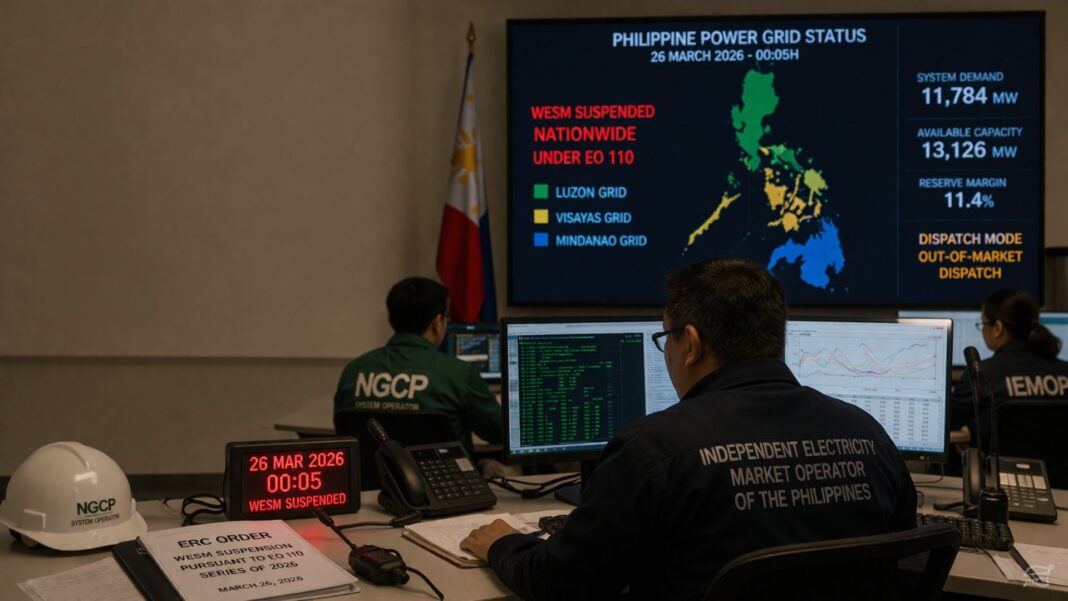

The Energy Regulatory Commission suspended the Wholesale Electricity Spot Market across all three Philippine grids on March 26, 2026, and activated a Modified Administered Pricing mechanism on April 1 as the country’s national energy emergency, declared under Executive Order 110, entered its second week. The intervention replaced competitive spot market clearing with technology-specific state-administered rates, marking the first simultaneous suspension of the WESM in Luzon, Visayas, and Mindanao in the market’s operational history.
Key Facts At A Glance
- The ERC suspended WESM operations across all three grids effective March 26, 2026, pursuant to EO 110, Series of 2026
- The DOE transmitted the suspension recommendation to the ERC on March 25; the ERC issued the order the following day
- Modified Administered Pricing was finalized and activated on April 1, 2026, after stakeholder consultation
- Under the Modified AP framework: coal plants receive a fixed rate; natural gas plants are compensated at contracted prices; hydro and geothermal sources receive administered pricing with preferential dispatch; oil-based plants are paid administered prices when dispatched or contracted
- IEMOP simulations projected WESM prices could exceed PHP 9 per kWh without intervention, against a February average of approximately PHP 3.50–5.00 per kWh
- Average spot power prices rose 58 percent in March; Visayas and Mindanao prices were reported to have nearly doubled
- The suspension remains in effect until the ERC issues a Notice of Market Resumption; no date has been set
- A PHP 20-billion emergency energy security fund was separately allocated to PNOC and PNOC Exploration Corp. to procure refined petroleum products and augment domestic fuel inventories
The Philippine Wholesale Electricity Spot Market, operated by the Independent Electricity Market Operator of the Philippines under the Electric Power Industry Reform Act, functions as the central venue for electricity trading across the country’s three interconnected grids. Generators offer capacity into the market and clearing prices are set in real time based on supply and demand conditions. The market has operated continuously since 2006, with administered pricing used only in limited instances and never simultaneously across all three grids.
The proximate cause of the suspension was the Strait of Hormuz closure beginning in early March 2026, following military strikes by the United States and Israel on Iran. The closure disrupted approximately 20 percent of global seaborne oil trade and a comparable share of LNG volumes. For the Philippines, which imports nearly all of its oil and a substantial share of its natural gas requirements, the impact was immediate. Fuel prices at the pump rose sharply in early March, and the IEMOP’s dispatch models signaled that spot electricity prices would follow as oil-fired peaking plants and LNG-fueled combined-cycle facilities faced sharply higher input costs.
The Suspension Decision
Energy Secretary Sharon Garin issued an advisory on March 25, 2026, directing generation companies, the NGCP, IEMOP, distribution utilities, electric cooperatives, and ancillary service providers to adopt special operating guidelines under the national emergency framework. The advisory directed full utilization of renewable energy and indigenous sources, and called for the maximum dispatch of coal-fired power plants, which the DOE projected could reduce WESM price exposure by up to PHP 2 per kWh. The DOE simultaneously transmitted a formal recommendation to the ERC to suspend WESM operations.
The ERC acted on March 26, effective at dispatch interval 0005H of that day’s trading window, directing IEMOP and the NGCP System Operator to comply with the suspension order. The regulator cited the inadequacy of prevailing historical market prices from January and February as a reference for administered rates, noting that those benchmarks no longer reflected conditions shaped by geopolitical disruption and constrained fuel supply.
The Philippines’ power generation mix at the time of suspension comprised approximately 60 percent coal, 22 percent renewables, 18 percent natural gas, and less than 5 percent oil-based generation. The WESM suspension concentrated dispatch control within the DOE and ERC rather than the competitive market, a structural shift with direct implications for bilateral contract exposures, feed-in tariff obligations, and the settlement positions of all market participants.
Modified Administered Pricing
The Modified Administered Pricing mechanism, finalized for implementation on April 1, introduced technology-specific compensation in place of nodal spot prices. The framework addressed the core regulatory problem: historical administered prices, ordinarily calculated from recent trading interval data, were themselves distorted by the pre-crisis price environment and could not accurately capture current fuel costs under emergency conditions.
Under the finalized scheme, coal-fired facilities receive a fixed administered rate. Natural gas plants are compensated at their contracted fuel prices, insulating them from spot LNG price volatility. Renewable sources including hydropower and geothermal operate under administered pricing with preferential dispatch priority, consistent with the DOE’s directive to maximize indigenous generation. Oil-based plants are compensated through administered prices only when they are dispatched or operating under contract, limiting their cost exposure to the market as a whole.
ERC Chairperson and Chief Executive Officer Francis Saturnino Juan described the framework as a balance between consumer protection and generator viability. Characterizing the measures as temporary, he said the goal was to ensure stable supply while cushioning households and businesses from direct exposure to global fuel market volatility.
The suspension also triggered obligations for distribution utilities to submit end-of-month reportorial requirements on generation charge computations and actual customer billings, enabling the ERC to monitor the downstream pass-through of emergency pricing adjustments.
Fiscal Provisions
Alongside the market suspension, the Department of Energy and the Department of Budget and Management allocated PHP 20 billion to PNOC and PNOC Exploration Corp. to procure refined petroleum products, augment LPG supply, and build domestic fuel inventories to as much as two million barrels. A detailed implementation timeline had not been released as of publication.