

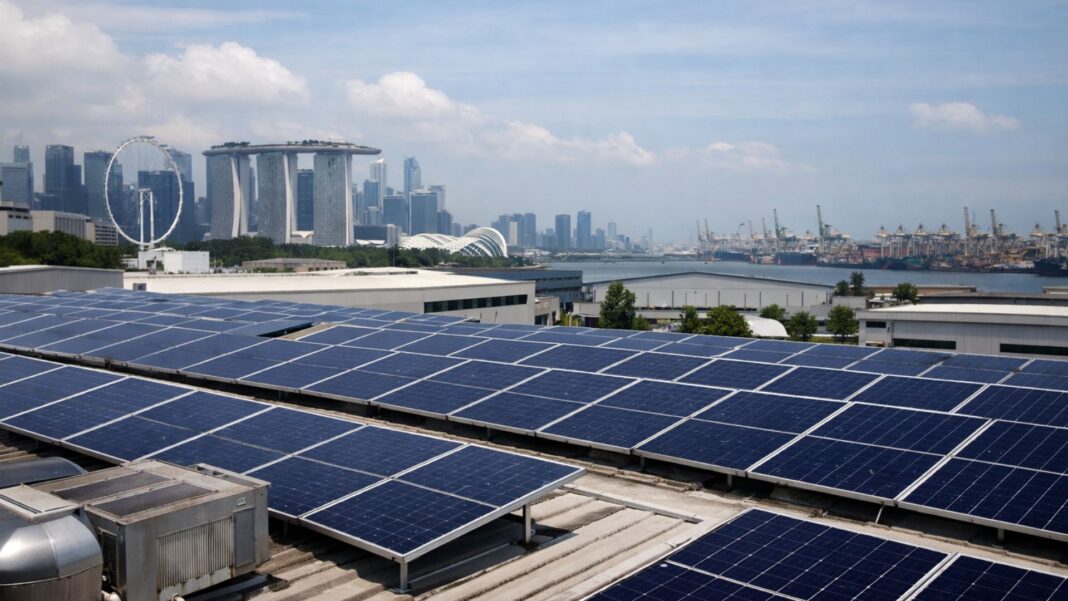

Peak Energy acquired a nearly 10 MW portfolio of operating rooftop solar assets in Singapore from Maiora Renewable Energy Pte Ltd on March 12, 2026, as corporate demand for domestically sourced renewable energy accelerates amid LNG price volatility triggered by the Strait of Hormuz closure. The transaction follows Singapore’s upgrade of its national solar deployment target to 3 GWp by 2030, announced under Budget 2026.
Key Facts At A Glance
- Acquired portfolio: nearly 10 MW of operating rooftop solar assets in Singapore
- Seller: Maiora Renewable Energy Pte Ltd, which has operated in Singapore for over a decade
- Buyer: Peak Energy, wholly owned by Stonepeak, an infrastructure-focused alternative investment firm with approximately $84 billion in assets under management
- Peak Energy is in advanced discussions with Singapore industrial and commercial buyers on long-term virtual power purchase agreements for locally sourced renewable energy
- Singapore’s 2030 solar target was raised from 2 GWp to 3 GWp under Budget 2026 following early achievement of the 2 GWp milestone in 2025; rooftop solar accounts for more than 80% of total installed capacity
- Natural gas accounts for approximately 95% of Singapore’s electricity generation; the EMA projects solar can realistically supply up to 10% of Singapore’s projected energy needs by 2050
- Maiora stated it is redirecting development focus to Taiwan and the Philippines following the Singapore asset sale
Peak Energy completed the acquisition of a nearly 10 MW operating rooftop solar portfolio in Singapore from Maiora Renewable Energy Pte Ltd on March 12, 2026. The transaction increases the volume of domestic distributed generation that Peak Energy can aggregate for Singapore-based industrial and commercial buyers, and positions the company to offer long-term virtual power purchase agreements for locally sourced renewable electricity.
Peak Energy Chief Executive Officer Gavin Adda described the acquisition as part of a strategy to combine operating assets with newly developed ones in order to offer corporate buyers off-site power purchase agreements on standardized terms from a financially credible counterparty. Peak Energy is wholly owned by Stonepeak, an alternative investment firm specializing in infrastructure with approximately $84 billion in assets under management. Stonepeak’s balance sheet backing is specifically cited by the company as central to its ability to provide the contractual certainty that large industrial buyers require.
Maiora Renewable Energy Managing Partner Marzio Keiling said Singapore had served as a strategic hub for the company’s regional operations for more than a decade, and that the transition of Singapore assets to Peak Energy reflected a decision to redirect Maiora’s development focus to Taiwan and the Philippines, where the company identified stronger growth prospects at scale.
The Singapore Solar Context
The acquisition coincides with an upward revision to Singapore’s national solar deployment target. Singapore’s Energy Market Authority announced under Budget 2026 that the country had surpassed its previous 2 GWp solar milestone during 2025, and raised the 2030 target to 3 GWp. Rooftop solar accounts for more than 80% of total installed capacity, reflecting the structural reality that land constraints make utility-scale solar development impractical in a city-state of Singapore’s geography. EMA’s own analysis indicates solar can realistically contribute only up to approximately 10% of Singapore’s projected electricity needs by 2050, underlining the ceiling on domestic renewable supply regardless of deployment ambition.
Natural gas continues to supply approximately 95% of Singapore’s electricity, with the majority of that gas sourced as LNG through import contracts and spot markets. Singapore established a state LNG procurement entity, GasCo, in 2025 to centralize gas purchasing and build supply diversification. The Strait of Hormuz disruption that began in late February 2026 has sharpened exposure to this dependence, with Singapore’s Minister for Energy calling on households to prepare for higher electricity bills as LNG spot prices rose 40 to 60% in the weeks following the initial conflict.
The Corporate Procurement Shift
Corporate renewable procurement in Singapore is being reshaped by a converging set of pressures. LNG price volatility is the most immediate, directly feeding into wholesale electricity costs and undermining the price stability that large energy consumers require to manage their Scope 2 emissions budgets. Cross-border low-carbon electricity imports, which were widely anticipated as a supplementary supply source, remain constrained: many approved projects are still progressing through conditional licensing and regulatory processes across multiple jurisdictions, and the pricing at which those imports will arrive has become increasingly uncertain.
Against this backdrop, domestically generated rooftop solar — though limited in aggregate volume — offers industrial and commercial buyers something that neither grid imports nor contracted LNG can easily provide: a fixed-price, locally originated source of electricity that is structurally insulated from geopolitical supply disruptions. Peak Energy’s strategy of aggregating distributed rooftop capacity across multiple sites and offering standardized VPPA contracts to corporate offtakers is designed to address the volume challenge that has historically limited the commercial viability of rooftop solar for large buyers.
Peak Energy stated it currently has close to 300 MW of operating projects across Asia, with operations in seven countries. The Singapore acquisition adds to an existing presence that includes a prior rooftop acquisition and a VPPA agreement with Arkema Pte Ltd for its Symphony Plant on Jurong Island.