

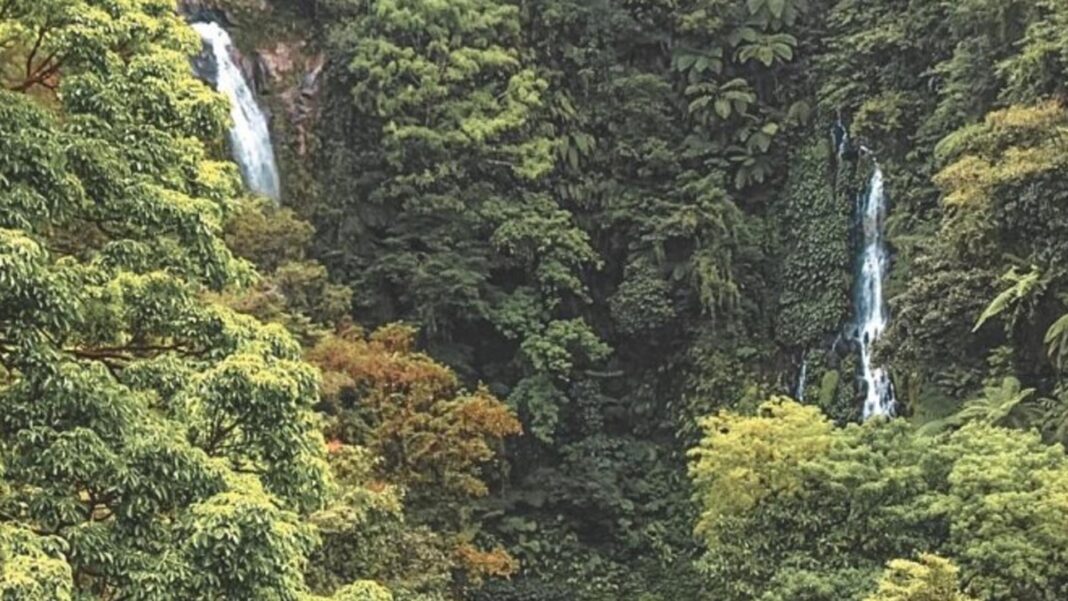

President Ferdinand R. Marcos Jr. has signed into law three measures declaring parcels of land in Guimaras, Quezon and Albay provinces as protected areas.
Marcos on July 9 signed Republic Acts (RAs) 12225, 12226, and 12227, adding parcel of land in Nueva Valencia, Guimaras; San Andres, Quezon; and Polangui and Oas municipalities and Ligao and Tabaco cities all in Albay to the list of areas protected under the National Integrated Protected Areas System (NIPAS).
According to RA 12225, the protected area in Nueva Valencia, Guimaras will be classified as national park, which will be known as Taklong and Tandog Group of Islands Natural Park.
RA 12226 declares the Alibijaban Wilderness Area in San Andres, Quezon as a protected area under the category of protected landscape and seascape, which be referred to as the Alibijaban Protected Landscape and Seascape (APLS).
Based on RA 12227, the protected area in Polangui and Oas municipalities, as well as Ligao and Tabaco cities in Albay province, will be referred to as the Mt. Masaraga Protected Landscape.
“As such, the State shall ensure the conservation, protection, management, and rehabilitation of the area. It is likewise recognized that effective administration of this area is possible only through cooperation among the national government, local government units (LGUs), concerned non-governmental organizations (NGOs) private entities, and local communities,” the laws read.
“The use and enjoyment of this area must be consistent with the principles of biological diversity and sustainable development.”
The new laws create Protected Area Management Boards (PAMBs) to oversee and manage the sites in three provinces.
The PAMBs will be composed of officials from the Department of Environment and Natural Resources, legislators, government agencies, local government units (LGUs), indigenous people’s groups, and non-government organizations.
A trust fund will likewise be established for purposes of financing projects of the protected areas.
The PAMB will retain 75 percent of all revenues raised, which will be deposited to the Protected Area-Retained Income Account in any authorized government depository bank within the locality.
The fund may be augmented by grants, donations, and endowment from domestic or foreign sources.
“The fund shall be deposited in full as a special account in the National Treasury and disbursements therefrom shall be made solely for the protection, maintenance, administration, and management of the NIPAS and duly approved projects endorsed by the PAMB in accordance with existing accounting, budgeting, and auditing rules and regulations,” according to the laws.
The fund, the RAs stressed, must not be used for personal services expenditures.
The LGUs are directed to continue the imposition of taxes and collection of all other fees they have traditionally collected, including business permits, property tax and rentals of local governments’ facilities.
The laws take effect 15 days after publication in the Official Gazette or in a newspaper of general circulation. (PNA)