

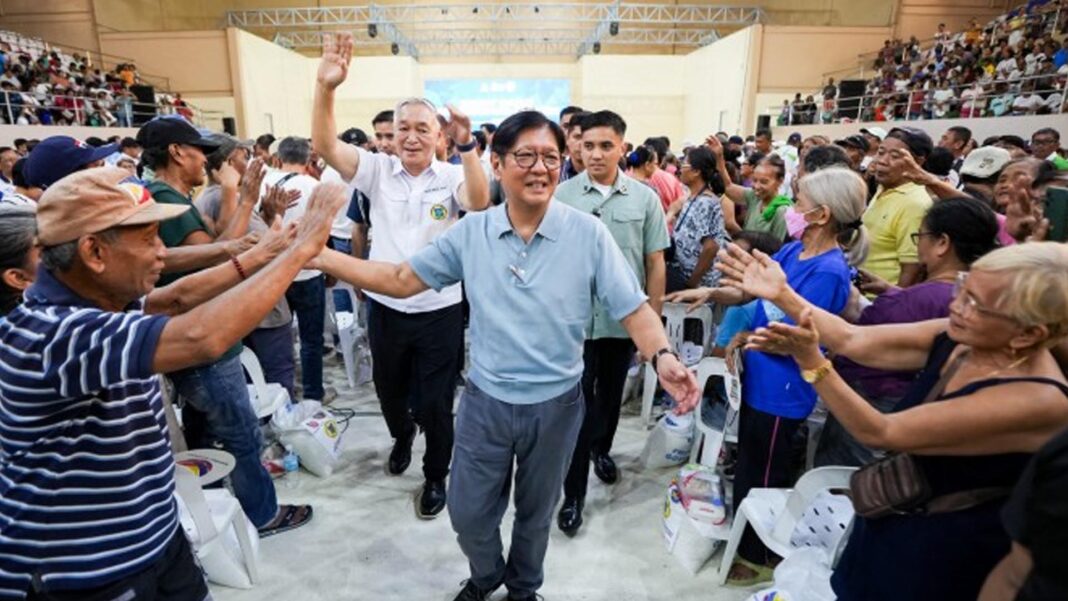

President Ferdinand R. Marcos Jr. advanced a series of initiatives aimed at widening public access to government assistance and services, highlighting the administration’s push for more inclusive and people-centered governance.
Throughout the week, the President’s engagements underscored a consistent focus on ensuring that national policies translate into tangible benefits for more communities.
Marcos rolled out on Thursday community-based assistance under the “Bawat Bayan Makikinabang” program, integrating rice distribution, educational support, and local development funding.
The initiative benefits vulnerable sectors, including solo parents, farmers, indigenous peoples, persons with disabilities, and low-income families.
Each covered village received funding for priority projects and educational assistance for qualified students.
The initiative was complemented by the Bagong Pilipinas Rice Program, which provides subsidized rice sourced from local farmers to strengthen food security.
Expanded healthcare access
Marcos also visited several hospitals this week as part of ongoing efforts to strengthen access to affordable, high-quality healthcare services nationwide.
He visited The Medical City in Pasig City to inspect hospital services and assess the implementation of the expanded Philippine Health Insurance Corp. (PhilHealth) benefits, including improved maternity care and outpatient emergency coverage.
Marcos also went to Clark, Pampanga on Thursday to tour the newly established Pampanga Provincial Hospital – Clark, a major addition to public healthcare infrastructure that will serve the Clark Freeport Zone and nearby areas.
The facility is a Level II hospital equipped with modern diagnostic and clinical services, expected to serve residents, workers, and investors in the growing economic zone.
The hospital is also being positioned for accreditation under PhilHealth’s Yaman ng Kalusugan Program, which provides comprehensive primary care services.
On Friday, Marcos led the inauguration of the Brain and Spine Center of the Cagayan Valley Medical Center in Tuguegarao City, Cagayan, marking a milestone under Republic Act 11959, or the Regional Specialty Centers Act.
Equipped with advanced diagnostic and surgical technologies, the newly inaugurated facility is designed to treat neurological conditions, such as stroke, epilepsy, and spinal disorders, bringing specialized care closer to patients in Cagayan Valley and nearby provinces.
Marcos also announced plans to establish at least 349 specialty centers by 2028 to address long-standing gaps in access to specialized care.
Economic, social protection measures pushed
On the policy front, the proposed Unified Package for Livelihoods, Industry, Food, and Transport (UPLIFT) bill is being considered as a priority measure under the administration’s legislative agenda, Malacañang said on Tuesday.
UPLIFT is designed as a whole-of-government framework to address external economic pressures, including fuel price shocks.
The measure complements ongoing social protection and livelihood programs under the administration’s broader development strategy.
Marcos also directed concerned agencies to expedite priority projects with “multiplier effects” on the economy, particularly those that generate jobs, improve food security, and ease inflation pressures.
Stronger international partnerships
Marcos started the week with a bilateral meeting with Paraguayan President Santiago Peña Palacios.
On Monday, he welcomed Palacios at Malacañan Palace in Manila, where both leaders committed to expanding cooperation in agriculture, trade, renewable energy, and people-to-people exchanges.
Both leaders also witnessed the signing of agreements on diplomatic training and visa waiver arrangements for holders of ordinary passports.
Paraguay also expressed its intention to accede to the Treaty of Amity and Cooperation in Southeast Asia, signaling stronger multilateral ties.
Global support for economic resilience
On Friday, the Asian Development Bank (ADB) signaled its readiness to extend up to USD1.75 billion in additional financing to support the Philippines’ response to external economic challenges.
The offer was made during Marcos’ meeting with ADB president Masato Kanda at Malacañan Palace.
The commitment is expected to bolster the country’s fiscal resilience, strengthen social protection programs, and support energy and food security measures. (PNA)