


Myanmar’s rubber sector closed the 2025-2026 financial year with exports of approximately 300,000 tonnes, generating over USD 400 million in revenue, according to the Myanmar Rubber Planters and Producers Association, with China remaining the dominant buyer and quality constraints continuing to suppress per-tonne prices below international benchmark rates.
Myanmar exported approximately 300,000 tonnes of natural rubber in the 2025-2026 financial year ending March 2026, earning more than USD 400 million in export revenue, according to the Myanmar Rubber Planters and Producers Association. China absorbed the largest share of shipments, accounting for approximately 75% of total export volume, with the balance distributed among Malaysia, Indonesia, Vietnam, India, and Japan. Despite meeting its annual export volume target, Myanmar’s rubber commanded prices of USD 1,700 to USD 1,900 per tonne, compared to a prevailing international benchmark of approximately USD 2,150 per tonne, a gap attributed by the industry body to quality deficiencies in the exported product.
Key Facts At A Glance
- Myanmar exported approximately 300,000 tonnes of natural rubber in FY2025-2026, meeting the MRPPA’s annual export target
- Total export revenue exceeded USD 400 million for the financial year
- Myanmar’s rubber fetches USD 1,700 to USD 1,900 per tonne against an international benchmark price of approximately USD 2,150 per tonne
- China accounts for approximately 75% of Myanmar’s rubber export volume
- Remaining buyers include Malaysia, Indonesia, Vietnam, India, Japan, and Singapore
- Myanmar holds over 1.64 million acres of rubber plantations across nine states and regions
- Domestic rubber consumption stands at approximately 20,000 tonnes annually, with the remainder directed to export markets
- Adverse weather during the October-November 2025 harvest period delayed production and constrained export volumes during peak season
Myanmar’s Rubber Export Position In FY2025-2026
The Myanmar Rubber Planters and Producers Association confirmed in early May 2026 that the country’s rubber sector delivered approximately 300,000 tonnes of natural rubber to international markets in the 2025-2026 financial year, in line with the association’s stated export targets. Total export earnings exceeded USD 400 million for the year.
The financial year represents a step down from the prior period. Myanmar’s rubber exports in the 2024-2025 financial year generated approximately USD 500 million from a similar volume of 300,000 tonnes, with the difference in revenue attributable to a moderate softening in global rubber prices over the 2025-2026 period. The MRPPA had set an aspirational export target of 350,000 to 380,000 tonnes for FY2025-2026, a level that was not reached due to weather disruptions during the peak harvesting months of October through January.
Weather And Supply Constraints
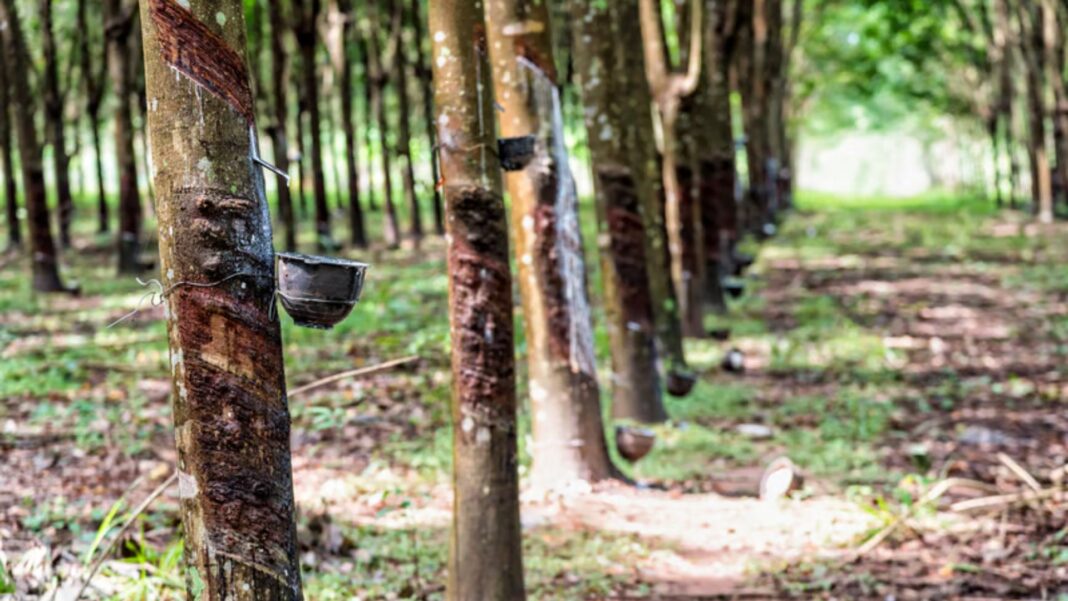
An MRPPA official attributed the shortfall relative to the higher export target to sustained rainfall in October and November 2025, which disrupted the rubber tapping season across Myanmar’s primary production zones. Rubber cultivation in Myanmar is concentrated in Mon and Kayin states and the Taninthayi Region, with additional production from Bago, Ayeyawady, and Yangon regions, as well as Shan and Kachin states. The sector operates across more than 1.64 million acres of rubber plantations and produces approximately 300,000 tonnes annually, with domestic consumption of around 20,000 tonnes leaving the bulk available for export.
The MRPPA also noted a shortage of rubber tappers as a structural constraint, adding to the weather-related disruption in achieving higher output volumes. These supply-side factors, combined with softening global prices in the second half of 2025, contributed to the gap between the aspirational target and final export volumes.
Quality Deficit And Pricing Disadvantage
Myanmar’s rubber exports continue to trade at a discount to prevailing international benchmark prices. While the global market price for natural rubber stood at approximately USD 2,150 per tonne during FY2025-2026, Myanmar’s rubber achieved realisations of only USD 1,700 to USD 1,900 per tonne, a discount of approximately 12% to 21%, according to the MRPPA. The association has attributed this pricing gap to quality requirements set by international buyers, including consistency and standardisation criteria that Myanmar’s rubber frequently fails to meet.
The quality discount is a structural feature of Myanmar’s rubber export position. Unlike Thailand and Malaysia, which command premium prices due to consistent rubber quality and standardised grading, Myanmar’s rubber exhibits raw material variability that creates compliance difficulties for downstream manufacturers, particularly tyre producers with strict material specification requirements. Efforts to address the quality gap, including the development of a central rubber market at Mawlamyine in Mon State, have been ongoing for several years without a material improvement in the country’s pricing position in international markets.
Regional Trade Flows And Buyer Concentration
China dominates Myanmar’s rubber export market, absorbing approximately 75% of total annual export volume. The concentration of exports to a single buyer creates dependency risk for Myanmar’s rubber sector, particularly given that China-sourced demand can be subject to shifts in domestic processing capacity and economic conditions. Secondary markets, including Malaysia, Indonesia, Vietnam, India, Japan, and Singapore, collectively account for the remaining 25% of Myanmar’s rubber export volume.
Singapore and Malaysia serve as both end-market buyers and transit hubs for Myanmar’s rubber entering broader regional commodity supply chains. Indonesia’s rubber processing industry is another significant downstream consumer. The export volume directed to these secondary markets provides a degree of diversification from China exposure but remains limited in scale.
Revenue Context And Sector Importance
Myanmar’s rubber sector generates between USD 250 million and USD 500 million in export revenue annually, making it one of the country’s more significant agricultural commodity export earners. The FY2025-2026 result of over USD 400 million falls within the upper portion of this historical range, despite the per-tonne pricing disadvantage relative to benchmark levels.
The rubber sector’s export contribution is notable in the context of Myanmar’s constrained foreign exchange earnings environment. However, without resolution of the quality gap and the associated pricing discount, the sector’s revenue ceiling will remain below what volume targets alone would suggest is achievable. The MRPPA has consistently identified quality improvement and market diversification beyond China as priorities, though investment in processing infrastructure to achieve standardised grading at scale has been limited.