

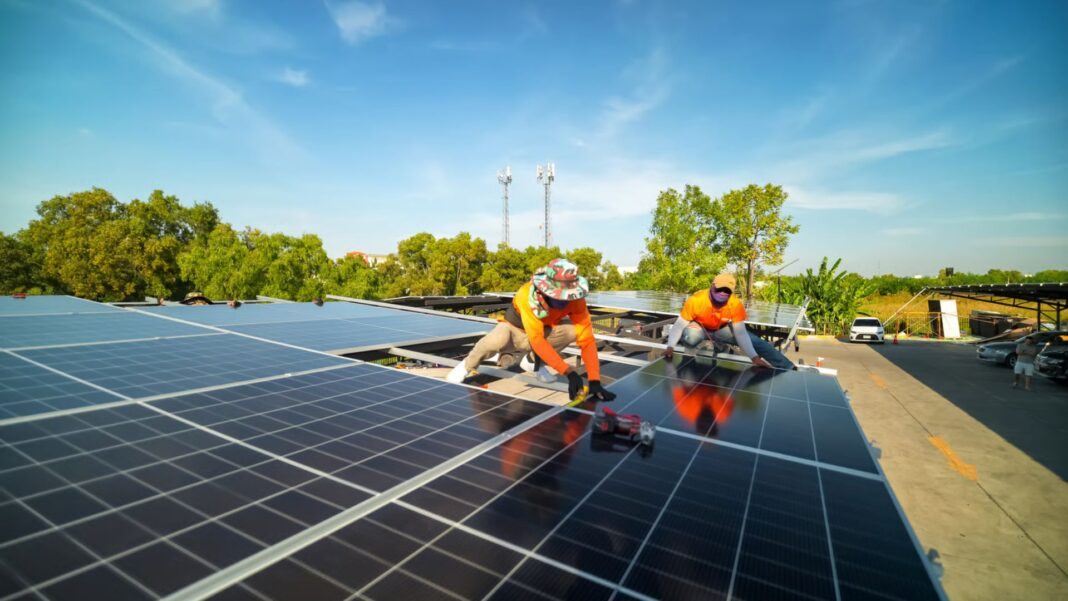

Solarvest Holdings Berhad has completed its largest corporate renewable energy development to date under Malaysia’s Corporate Green Power Programme, delivering 108 megawatts-peak of solar capacity to supply Micron Technology and NTT Global Data Centers, as the company accelerates its pipeline in response to fossil fuel cost pressures driven by the Strait of Hormuz disruption. The completion, announced in mid-April 2026, coincides with a broader push by Solarvest to compress project delivery timelines and reach at least 5 gigawatts of total new capacity through 2028.
Key Facts At A Glance
- Solarvest Holdings Berhad completed two Corporate Green Power Programme (CGPP) projects with a combined capacity of 108 MWp and total investment of approximately USD 75 million.
- Offtakers include Micron Technology Inc. (plants in Penang and Muar) and NTT Global Data Centers, with Texas Instruments Inc. also receiving supply under the corporate partnership programme.
- Completion of the Kulim, Kedah plant (29.99 MWac) was announced April 14, 2026, in a ceremony attended by Malaysia’s Deputy Prime Minister and Minister of Energy Transition and Water Transformation Fadillah Yusof.
- Solarvest is targeting the addition of approximately 1.3 GW of solar capacity in 2026 and at least 5 GW more through 2028, including large-scale projects for grid operator Tenaga Nasional Berhad starting in 2027.
- Battery storage costs in Malaysia have fallen to approximately USD 90–100 per kilowatt-hour, down from around USD 230 per kilowatt-hour a year earlier.
- Solarvest CEO Davis Chong is in active discussions with regulators to reduce large-scale project delivery timelines from the current 18–24 months to 12–16 months.
- Reccessary reports that Solarvest’s next growth phase is being shaped by AI-driven data center demand and regional expansion plans covering Vietnam and the Philippines.
Corporate Solar At Scale
Solarvest Holdings Berhad completed its two largest Corporate Green Power Programme projects to date in April 2026, bringing a combined solar capacity of 108 megawatts-peak into operation to supply major industrial and data center clients across Peninsular Malaysia.
Under Malaysia’s CGPP framework, corporate consumers enter into virtual power purchase agreements, receiving renewable energy certificates and procuring clean electricity through the national grid without owning or installing generation assets on their own premises. Solarvest served as the Solar Power Producer across the two projects, in joint ventures with TNB Renewables Sdn. Bhd. and ES Sunlogy Berhad’s subsidiary Savelite Engineering Sdn. Bhd., with a total capital outlay of approximately USD 75 million.
The Kulim, Kedah facility, rated at 29.99 MWac and developed through a joint venture vehicle called Selarong Pertama Energy Sdn. Bhd., supplies renewable energy virtually to Micron Memory Malaysia Sdn. Bhd.’s Penang operations. The April 14 completion ceremony was attended by Deputy Prime Minister and Minister of Energy Transition and Water Transformation Fadillah Yusof, along with representatives from Tenaga Nasional Berhad, TNB Renewables, Solarvest, and ES Sunlogy Berhad. A separate project supplying NTT Global Data Centers and additional Micron facilities in Muar brings the combined CGPP portfolio under this program batch to 108 MWp.
Demand Surge From Fossil Fuel Price Shock
Solarvest CEO Davis Chong told Bloomberg on April 14 that the company is seeing a rise in corporate demand for renewable energy driven directly by the fuel cost environment created by the Iran war and the effective closure of the Strait of Hormuz since late February 2026. Chong noted that fossil fuel-linked energy bills for industrial users are expected to rise further in the second half of the year, and that this is pulling forward demand for solar offtake agreements from manufacturers and data center operators seeking to lock in predictable electricity costs.
Malaysia generates the bulk of its electricity from imported natural gas and coal, and energy-intensive manufacturers such as semiconductor plants and data centers face direct exposure to tariff increases as fuel costs rise. The CGPP model, which allows corporate consumers to contract renewable energy virtually, insulates offtakers from spot power market volatility by fixing or indexing their effective electricity costs through long-term agreements.
Chong confirmed that solar panel and battery prices remain stable to lower, as supply chains from China are not materially affected by the Hormuz conflict. Battery storage costs in Malaysia have declined to USD 90–100 per kilowatt-hour, down from approximately USD 230 per kilowatt-hour a year earlier, a reduction that improves the economics of co-located storage systems and grid balancing infrastructure.
Pipeline And Timeline Acceleration
Beyond the completed CGPP batch, Solarvest is targeting the addition of approximately 1.3 GW of new solar capacity in 2026 and at least 5 GW more through 2028. The company is also preparing to roll out large-scale projects for Tenaga Nasional Berhad starting in 2027, building on an existing 470 MWac project at Windsor Estate in Larut and Matang, Perak, contracted in December 2025 under the LSS PETRA 5+ Programme and scheduled for commercial operation in the first quarter of 2028.
To accommodate the accelerated pipeline, Chong said Solarvest is engaged in active discussions with Malaysian energy regulators to shorten the typical large-scale project delivery timeline from 18–24 months to 12–16 months. Permitting and interconnection processes are the primary bottleneck. Reccessary reported that the company’s next growth phase is being shaped by AI-driven data center expansion across the region, with Solarvest eyeing market entry in Vietnam and the Philippines alongside its existing Malaysian operations.
Regional Context
The CGPP completions arrive at a moment when Malaysia’s industrial energy consumers are recalibrating procurement strategies. Unsubsidised diesel prices in Peninsular Malaysia had risen from RM3.12 per litre before the Hormuz disruption to RM6.72 per litre by mid-April 2026. Under these conditions, long-term renewable energy agreements priced independently of fossil fuel benchmarks have taken on a more direct financial value for manufacturers and data centers.
Solarvest’s corporate solar work also intersects with Malaysia’s broader National Energy Transition Roadmap, which targets 40% renewable energy capacity by 2050. The CGPP program is one of the primary mechanisms through which the government is enabling corporate demand to drive renewable build-out without requiring on-site installation, keeping grid-connected solar supply growing in parallel with Malaysia’s centralized large-scale solar auction program.