

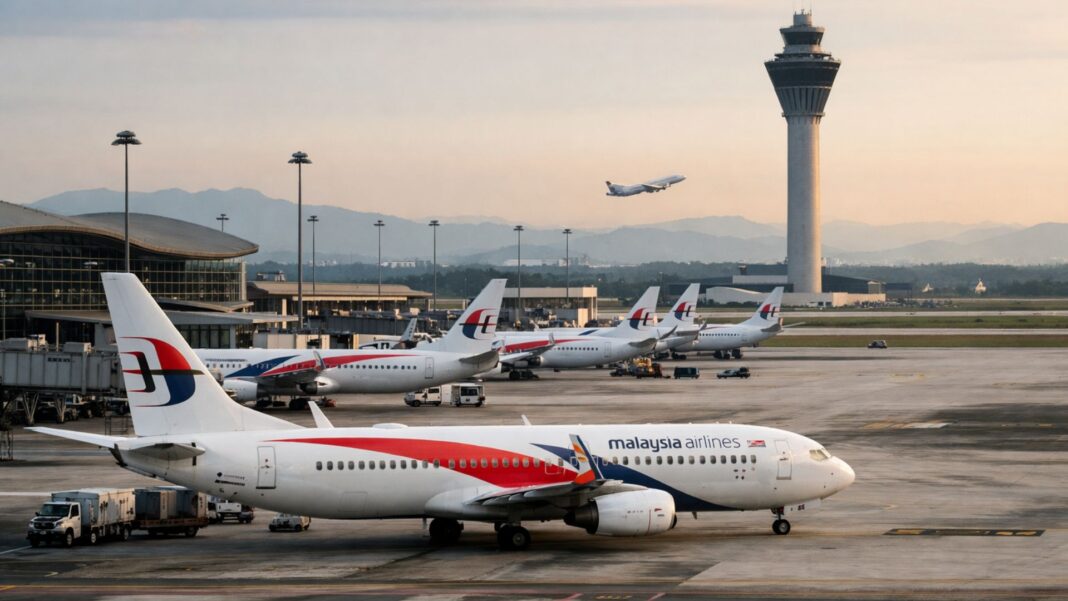

Malaysia Aviation Group announced on April 5, 2026, a significant expansion of Malaysia Airlines’ East Asia network, adding daily services to two new Chinese cities and reinstating Fukuoka, Japan, as a destination for the first time in nearly two decades. The move positions Kuala Lumpur International Airport as a strengthened gateway between Southeast Asia and a growing cluster of East Asian markets.
Key Facts At A Glance
- Malaysia Airlines will launch daily flights from Kuala Lumpur to Shenzhen, China, from July 1, 2026, operating seven times weekly
- Daily service to Changsha, China, begins July 8, 2026, also at seven flights per week
- Fukuoka, Japan, returns to the network on September 2, 2026, with five weekly flights, making Malaysia Airlines the sole nonstop carrier on the route
- The airline last operated Kuala Lumpur–Fukuoka in September 2006, a gap of nearly 20 years
- Ticket sales for all three new routes opened April 3, 2026
- The additions bring Malaysia Airlines’ China network to nine destinations
- Passenger load factors averaged approximately 90% on Japan routes and 85% on China routes in the first quarter of 2026
- Malaysia Airlines has taken delivery of 10 Airbus A330neo and 14 Boeing 737-8 aircraft to date, targeting a mainline fleet of 160 aircraft by 2035
A Measured Expansion Into High-Growth Corridors
Malaysia Aviation Group announced the network expansion at a press conference timed to coincide with the Malaysia Association of Tour and Travel Agents Fair 2026, where the group also unveiled the MAG Arena, recognized by both the Asia Records and ASEAN Records as Asia’s largest airline trade pavilion at a consumer travel fair, spanning approximately 46,000 square feet.
Captain Nasaruddin A. Bakar, President and Group Chief Executive Officer of MAG, framed the expansion as a direct response to demonstrated demand. He cited first-quarter 2026 load factors, noting Japan routes averaged approximately 90% and China routes approximately 85%, supported by mutual visa-free arrangements between Malaysia and China.
The three new routes represent distinct market profiles. Shenzhen, adjacent to Hong Kong and positioned as a major technology and finance hub, is expected to draw primarily corporate traffic. Changsha, capital of Hunan Province, is an emerging outbound leisure market with a growing middle class. Fukuoka, the principal gateway to Japan’s Kyushu island, appeals to leisure travelers through a combination of culinary culture, coastal access, and onward connectivity to regional attractions.
Sole Operator On The Fukuoka Corridor
The Fukuoka resumption carries commercial significance beyond frequency. At launch, Malaysia Airlines will operate as the only carrier offering a nonstop Kuala Lumpur–Fukuoka service, a distinction that has strategic value for both pricing and brand positioning. The airline previously operated the route but suspended it during earlier network restructuring in 2006.
The Fukuoka announcement is also aligned with a broader Japanese network strategy. Malaysia Airlines currently operates services to Tokyo and Osaka. Adding Fukuoka diversifies Japan connectivity beyond the two established hubs and responds to a travel industry push toward distributing tourist traffic beyond Tokyo and Osaka.
Fleet Deployment And Long-Term Targets
MAG confirmed the new routes are underpinned by recent fleet deliveries. The group has taken delivery of 10 Airbus A330neo and 14 Boeing 737-8 aircraft, with an ambition to grow the mainline fleet to 160 aircraft by 2035 and serve 106 destinations. Aircraft type assignments for the specific new routes were not specified in the official release.
Beyond East Asia, the airline is simultaneously increasing frequencies on existing routes. Manila will grow from 21 to 28 weekly flights from July 1. Brisbane will increase from five to seven weekly flights from August 16. Colombo will scale from seven to ten weekly flights by May 2026. In parallel, two ad-hoc Kuala Lumpur–London Heathrow flights on April 18 and 22 address passenger displacement caused by ongoing Middle East carrier disruptions.
The expansion is positioned as a central pillar of both the Visit Malaysia 2026 campaign and MAG’s stated ambition to rank among the world’s top 10 global airlines by 2030.