

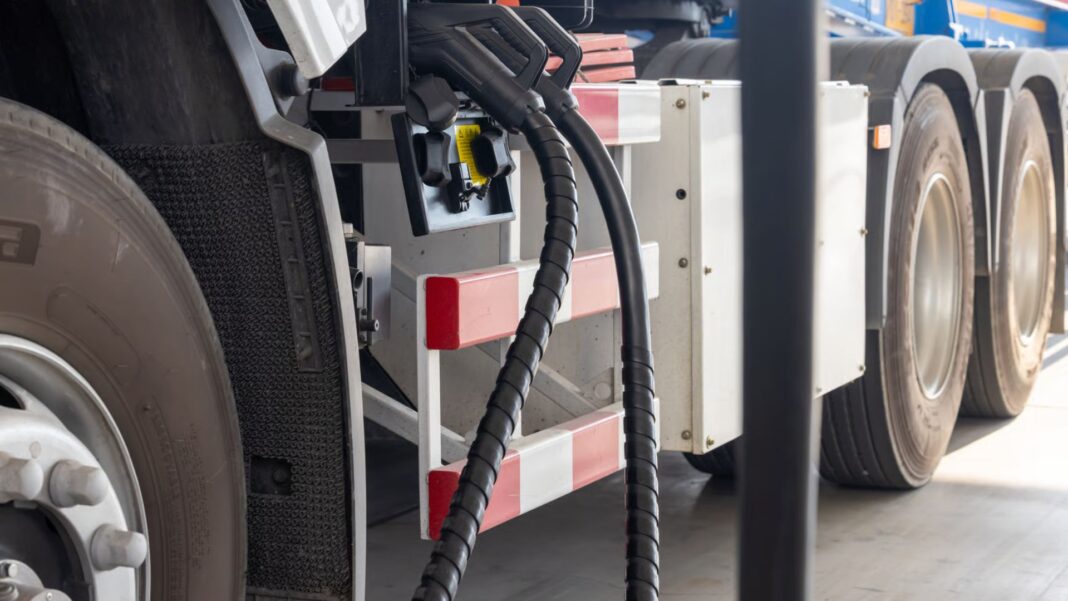

Electricité du Laos led the signing of a memorandum of understanding with 27 public and private sector partners on April 11, 2026, committing to a coordinated national push for electric truck adoption as the country struggles with acute fuel shortages driven by the closure of the Strait of Hormuz. The initiative reflects Laos’ structural position as one of Southeast Asia’s most exposed economies: landlocked, without domestic refining capacity, and almost entirely dependent on fuel product imports from Thailand.
Key Facts At A Glance
- MOU signed April 11, 2026, involving Electricité du Laos and 27 partners including transport companies, EV suppliers, infrastructure developers, and financial institutions
- Initiative triggered by Prime Minister’s Order No. 40, issued March 13, 2026, calling for urgent fuel shortage response measures
- Electric trucks currently range 100 to 150 kilometers per charge versus 500 to 600 kilometers for conventional vehicles
- Upfront cost of electric trucks more than double that of conventional alternatives
- Laos imports approximately 97% of its fuel from Thailand; it has no domestic oil refining capacity
- Over 40% of Laos’ approximately 2,538 filling stations were closed in mid-March 2026 due to supply disruptions
- Diesel prices in Laos more than doubled between February 26 and March 28, from LAK19,970 to LAK44,340 per liter
- Laos’ gross government debt exceeds 80% of GDP; foreign reserves cover approximately two and a half months of imports
- ADB projected Laos’ economic growth at 4% for 2026, below government targets
- Transport companies required to ensure EVs account for at least 10% of their fleets by end of 2026 under earlier directives
The Structural Vulnerability Behind The Initiative
Laos occupies a position in the regional fuel supply chain that makes it acutely exposed to any disruption in neighboring markets. The country has no oil refinery and no domestic crude production of consequence. According to reporting from The Diplomat and Al Jazeera citing analysis by the Economic Research Institute for ASEAN and East Asia, Laos sources approximately 97% of its fuel from Thailand, with the remainder supplied by Vietnam. When Thailand moved to restrict petroleum exports following the onset of the Strait of Hormuz crisis in late February 2026 — banning most exports except to Cambodia and Laos under existing bilateral energy cooperation agreements — Laos remained partially shielded but still faced severe supply compression.
The consequences were immediate. By mid-March 2026, more than 40% of the country’s approximately 2,538 filling stations had closed due to non-delivery of fuel products. Diesel prices more than doubled in the span of one month, moving from LAK19,970 per liter on February 26 to LAK44,340 by March 28, according to reporting by the Laotian Times cited in The Diplomat. Long queues formed at remaining open stations across Vientiane, and the government moved quickly to implement demand-side emergency measures including a four-day university week, rotating civil service schedules, and mandatory caps on EV registration fees alongside increased charges for fuel-powered vehicle registration.
The April 11 Agreement: Scope And Structure
Prime Minister’s Order No. 40, issued March 13, provided the policy basis for the electric vehicle initiative, directing urgent action to address fuel shortages and price volatility. The April 11 memorandum of understanding, led by Electricité du Laos and signed at a ceremony attended by Deputy Prime Minister Saleumxay Kommasith, Central Bank Governor Bounkham Vorachit, and Minister of Industry and Commerce Malaithong Kommasith, formalizes a four-pillar cooperative framework covering vehicle supply, charging infrastructure, transport operations, and financing.
Under the agreement, partners will work to build charging and battery-swapping stations for heavy vehicles, develop a centralized digital platform to manage energy use and fleet charging schedules, and introduce financial products to support businesses transitioning to electric fleets. The 27 signatories include transport companies, electric vehicle suppliers, infrastructure developers, and financial institutions, with Banque pour le Commerce Extérieur Lao identified among the financing partners.
Akhomdeth Vongxay, speaking at the signing ceremony, said continued government support and clear policy direction would be essential to encourage broader private sector participation. Minister Kommasith framed the initiative as part of Laos’ alignment with regional trends in sustainable development, noting expected reductions in carbon emissions, lower fuel import costs, and improvements in transport sector efficiency through digital integration.
The Infrastructure And Financial Barriers
Authorities acknowledged at the signing ceremony that the electric truck program faces substantial structural obstacles. Electric trucks currently offer a range of approximately 100 to 150 kilometers per charge, compared with the 500 to 600 kilometers achievable by conventional fuel-powered heavy vehicles. For a landlocked country whose freight logistics depend on cross-border road transport to and from Thailand and Vietnam — often over distances that exceed single-charge capability — this range limitation is operationally significant.
The country also lacks any dedicated charging infrastructure or battery-swapping stations for heavy transport vehicles. While the government has set a target of 500 EV charging stations nationally by 2030 under pre-crisis planning frameworks, that build-out had barely begun before the current fuel emergency accelerated the timeline. The upfront purchase cost of electric trucks remains more than double that of conventional alternatives, creating a financing barrier that the agreement’s financial institution partners are expected to address through loan products and incentive schemes.
Laos’ Fiscal Position Complicates The Transition
The electric vehicle initiative is being pursued in the context of a national economy already under significant fiscal strain. According to the World Bank’s April 2026 East Asia and Pacific Economic Update, Laos faces among the most acute pressures in the region, with gross government debt exceeding 80% of GDP and foreign reserves covering approximately two and a half months of imports. The ADB projected Laos’ 2026 GDP growth at 4%, a figure below government targets and reflective of the compounding impacts of fuel cost inflation, reduced trade activity, and constrained fiscal space for subsidy support.
The country’s vulnerability to the current crisis is in part a continuation of a pattern that first emerged during Laos’ 2022 debt-driven economic crisis, when spiraling inflation, a sharp depreciation of the kip, and fuel shortages driven by import payment difficulties threatened food security and forced the closure of filling stations across the country. The Iran war fuel crisis has revived many of the same dynamics in compressed form, with the critical difference that the cause this time is external supply disruption rather than domestic payment failure.
Electricity As A Domestic Asset
The logic behind Laos’ electric truck push rests on one distinguishing energy characteristic: the country is a net electricity exporter. Laos generates the majority of its power from hydroelectric facilities and exports electricity to Thailand, Vietnam, Cambodia, and China through the Electricité du Laos Transmission Company — the joint venture between Electricité du Laos and China Southern Power Grid. Domestic electricity supply is therefore not subject to the same import dependency that governs liquid fuel availability. Converting freight transport from diesel to electricity would allow Laos to draw on a domestic energy resource rather than one entirely controlled by its neighbors’ export policies.
This is the central policy rationale articulated by government officials. Whether the infrastructure and financing commitments made under the April 11 MOU translate into operational electric truck deployment within the 2026 timeframe remains uncertain given the acknowledged technical and cost barriers. Publicly available details on implementation timelines, specific fleet conversion targets, and charging station construction schedules remain limited as of the date of this report.