
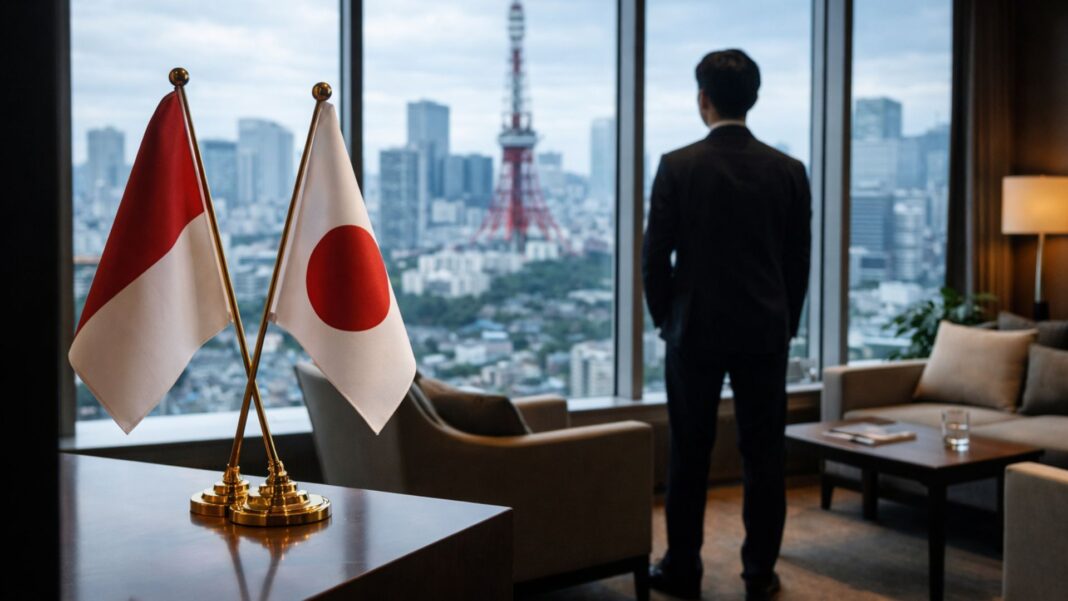

Indonesia and Japan formalized a Memorandum of Cooperation covering nuclear energy development and critical minerals supply chains on March 15, 2026, at the Indo-Pacific Energy Security Ministerial and Business Forum in Tokyo, adding a bilateral diplomatic framework to Indonesia’s decades-in-progress nuclear program and placing Japan as a preferred technology partner at a moment when the Hormuz disruption has accelerated conversations about long-term energy security across the Indo-Pacific.
Key Facts At A Glance
- The MoC was signed on March 15, 2026, by Indonesian Minister of Energy and Mineral Resources Bahlil Lahadalia and Japanese Minister of Economy, Trade and Industry Ryosei Akazawa at the IPEM forum in Tokyo
- The agreement covers two strategic areas: nuclear energy technology development and critical minerals supply chain cooperation
- The nuclear component focuses on technology transfer, human resource development, safety standards, regulatory alignment, and potential SMR collaboration
- Financing mechanisms referenced include the Japan Bank for International Cooperation and Nippon Export and Investment Insurance, subject to due diligence; the MoC creates no legally binding obligations
- Indonesia holds approximately 43 percent of the world’s nickel reserves along with major deposits of bauxite, tin, copper, and rare earth elements
- Japan’s JGC Corporation is currently supporting US-based NuScale Power in developing a 462 MW SMR complex in West Kalimantan province
- Indonesia targets its first 500 MW of nuclear power by 2033; the Nuclear Energy Program Implementation Organization has not yet been formally established
- Continued cooperation was also confirmed on LNG and coal supply chains and AZEC framework projects including the Sarulla Geothermal Power Plant and Legok Nangka Waste-to-Energy facility
The Signing And Its Context
Indonesia and Japan signed their Memorandum of Cooperation at a bilateral meeting on the sidelines of the Indo-Pacific Energy Security Ministerial and Business Forum in Tokyo on March 15, 2026. The forum brought together energy ministers and senior officials from across the Indo-Pacific at a moment when the US-Israeli war on Iran had closed the Strait of Hormuz and placed acute supply pressure on nearly every Asian economy. Indonesian Energy and Mineral Resources Minister Bahlil Lahadalia and Japanese Minister of Economy, Trade and Industry Ryosei Akazawa signed the agreement, which covers two strategic pillars: nuclear energy and critical minerals.
Akazawa framed the agreement explicitly in terms of the current crisis, stating that “amid the current global crisis, it is important for us to strengthen cooperation to maintain energy security.” Bahlil, in his remarks, described the partnership as an opportunity to build a more integrated and sustainable energy system, and expressed Indonesia’s openness to Japanese government and private sector involvement in managing the country’s strategic mineral endowments. The agreement has a five-year duration with an option to extend for a further five years. It does not create legally binding obligations.
The Nuclear Component
For Indonesia, the nuclear energy provisions of the MoC are the more consequential element in terms of long-term grid and generation planning. The country has harbored nuclear ambitions since the 1960s and has been navigating a crowded field of foreign technology vendors, including the United States, Russia, South Korea, and France, all of which have sought a role in Indonesia’s nuclear program.
Japan’s existing footprint in Indonesia’s nuclear program is concentrated around a project in West Kalimantan province, where Japan’s JGC Corporation is supporting Oregon-based NuScale Power in developing a proposed 462 MW small modular reactor complex utilizing NuScale’s VOYGR-6 technology. The technical and economic feasibility study for the West Kalimantan site was initiated under a grant from the US Trade and Development Agency and includes site selection, grid interconnection design, environmental and social impact assessment, and regulatory review. Evaluated sites in West Kalimantan include areas in Mempawah and Melawi, where geological surveys have identified uranium resources estimated at approximately 24,000 tons.
The March 15 MoC deepens Japan’s institutional involvement beyond the West Kalimantan project. It opens the door to collaboration at additional potential deployment sites, and explicitly addresses the financing dimension through references to the Japan Bank for International Cooperation and Nippon Export and Investment Insurance as potential export credit vehicles. Both financing instruments are described as applicable subject to the completion of necessary due diligence processes and in line with project progress.
Indonesia’s nuclear target calls for the first 500 MW of nuclear capacity to be operational by 2033, with a broader national roadmap from the National Energy Council targeting up to 7 GW by 2034. The country’s RUPTL 2025–2034 electricity plan officially integrates an initial 500 MW of nuclear capacity across two 250 MW units in the Sumatra and Kalimantan grids, targeting completion no later than 2034. However, a critical institutional prerequisite remains unfulfilled: the Nuclear Energy Program Implementation Organization, which is intended to be chaired by President Prabowo Subianto and will function as the coordinating body overseeing reactor planning and development, has not yet been formally established. Bahlil’s aide Senda Hurmuzan Kanam acknowledged at a separate conference that no technology selection decision has been made and that no procurement bid has been opened.
Hendry Cahyono, an economist at the State University of Surabaya, described the agreement as a tangible step forward while cautioning that the path to realization remains long. He noted that Indonesia’s position as a late mover carries a potential advantage: the country can adopt the latest generation of nuclear technology without repeating earlier safety failures, citing the Fukushima accident as a reference point from which Indonesia can learn. He also emphasized that the success of the cooperation would depend critically on whether technology transfer provisions are implemented in a manner that builds domestic Indonesian capability rather than leaving the country as a passive consumer of foreign technology.
The Critical Minerals Dimension
The second pillar of the MoC links Indonesia’s position as the world’s largest holder of nickel reserves to Japan’s demand for the critical mineral inputs required for batteries, electric vehicles, and low-carbon technology manufacturing. Indonesia holds approximately 43 percent of the world’s nickel reserves and is also among the largest producers of bauxite, tin, copper, and rare earth elements.
For Japan, the strategic interest in securing a stable and diversified supply of these materials has only grown more acute as global supply chains have come under pressure. The MoC formalizes cooperation aimed at strengthening global supply chain security for critical minerals and accelerating the development of clean energy technology under the Asia Zero Emission Community framework. Japan and Indonesia had, as of mid-2025, established 175 memoranda of understanding under the AZEC framework, though the gap between signed MoUs and commercially operational projects remains a documented challenge in the bilateral relationship.
AZEC Projects And Broader Energy Context
The March 15 agreement explicitly confirmed continued cooperation on LNG and coal supply chains in addition to the energy transition agenda, a reflection of the immediate supply pressures both countries face from the Hormuz disruption. Japan confirmed its continued commitment to several ongoing AZEC-framework projects in Indonesia, including the Sarulla Geothermal Power Plant in North Sumatra, which was developed with involvement from ITOCHU Corporation, Kyushu Electric Power, and INPEX and financed by the Japan Bank for International Cooperation, and the Legok Nangka Waste-to-Energy Power Plant in Bandung regency, West Java, which involves Sumitomo Corporation in partnership with PLN and the West Java provincial government.
These projects represent the first-tier commercial-ready category within the AZEC development framework’s three-tier classification system, alongside the Muara Laboh Unit 2 Geothermal Power Plant, which reached financial close in May 2025 at approximately USD 500 million, with commercial operations targeted for 2027.
The MoC was signed at a moment when both Indonesia and Japan are reassessing long-term energy security architecture. Japan holds 254 days of oil reserves, far exceeding Indonesia’s approximately 21–23 days. The disparity has been referenced in recent Indonesian energy commentary as a structural vulnerability that nuclear baseload power could, over the long term, partially address by reducing dependence on imported fossil fuels.
Publicly available details on specific technology selection criteria, NEPIO formation timelines, and the precise scope of JBIC and NEXI financing commitments under the MoC remain limited as of the publication date of this report.