

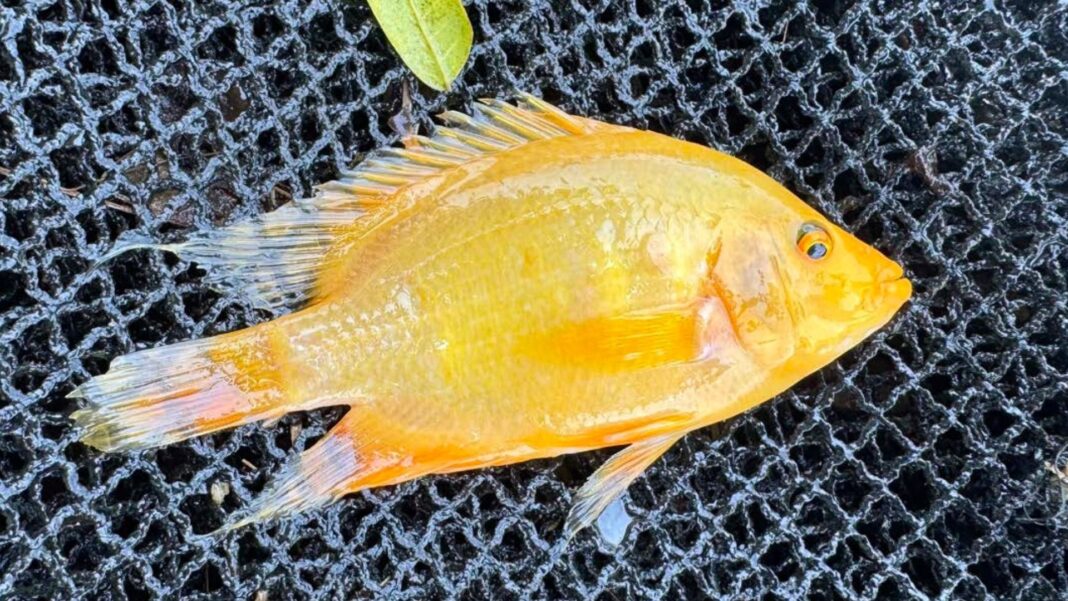

A hardy aquarium fish prized for its golden hue, the ornamental Flowerhorn cichlid (Amphilophus spp.) has become a problem for the residents of San Pablo City, Laguna: it is increasingly taking on an outsized role in both the natural ecosystem and local aquaculture operations in nearby Lake Sampaloc.
Researchers from the Ateneo de Manila University Department of Biology and the Ateneo Aquatic and Fisheries Resources Laboratory have documented the broad presence of Flowerhorn cichlids in the volcanic crater lake in San Pablo City, Laguna. The researchers say that this “fenced and feral” status is intensifying pressure on native biodiversity and posing potential risks to public health.
Originally introduced through the aquarium trade, Flowerhorns reportedly escaped into the lake during a major typhoon, and fish assemblage surveys as early as 2016 had already documented their establishment. Researchers Hannah Nicole C. Gasmen and Dr. Janice A. Ragaza discovered that the species “are no longer merely escaped ornamental fishes, but have become integrated into local aquaculture through intentional retention and sale, indicating that human activities may continue to reinforce their persistence and spread.”
Health Concerns, Environmental Impact
But this has a sharp impact on native species: known for territorial aggression, Flowerhorns tend to monopolize breeding grounds and feeding sites. Consequently, the native Ayungin (Leiopotherapon plumbeus), once a common local staple, is now rarely encountered and is listed as Vulnerable by the IUCN.
Flowerhorns also display remarkable adaptability to a wide range of environmental conditions. While the lake is affected by nutrient runoff, microplastics, and trace organic pollutants linked to untreated sewage, household runoff, and aquaculture practices, the species’ phenotypic plasticity enables it to thrive and dominate in these anthropogenically stressed waters.
Beyond charting the Flowerhorn’s spread, the researchers call attention to broader threats such as pollution, habitat degradation, declining native fish populations, and public health concerns. Notably, previous research has shown that Flowerhorns can host Paracapillaria philippinensis, a zoonotic parasite capable of causing serious illness in humans, such as intestinal capillariasis—an infection that can lead to abdominal pain, chronic diarrhea, and malnutrition.
“The species may serve as a possible reservoir of parasites, pathogens, and contaminants, providing a strong foundation for future ecological, parasitological, and aquaculture research aimed at developing evidence-based management strategies for invasive Flowerhorn populations,” Gasmen explains.
Possible Solutions
To help manage Flowerhorn populations, the study puts forward a possible circular economy model: harvesting invasive Flowerhorns and converting them into aquafeed, provided the biomass is screened for parasites, contaminants, and microbiological safety.
Gasmen also points to the Aquatic Species Invasiveness Screening Kit (AS-ISK) as a promising tool for assessing invasion risks of non-native freshwater fishes, as demonstrated in a 2024 study of Lake Naujan by aquatics researcher Allan S. Gilles Jr. Applying AS-ISK to Lake Sampaloc and other Philippine lakes could help identify high-risk species early and inform targeted management actions.
Lake Sampaloc illustrates that invasive species are not solely an ecological concern but are also shaped by social, economic, and public health realities. As communities adapt to changing aquatic environments, the lake’s future hinges on solutions that restore ecological balance while sustaining the livelihoods, cultures, and histories tied to its waters.
“Protecting and sustaining our aquatic ecosystems requires a collaborative approach among communities, research institutions, and policymakers,” Gasmen emphasizes.
Hannah Nicole C. Gasmen and Janice A. Ragaza published their article, Fenced and Feral: Farming and Spread of Flowerhorn (Amphilophus spp.) in Lake Sampaloc, Philippines, in the March 2026 issue of World Aquaculture.