

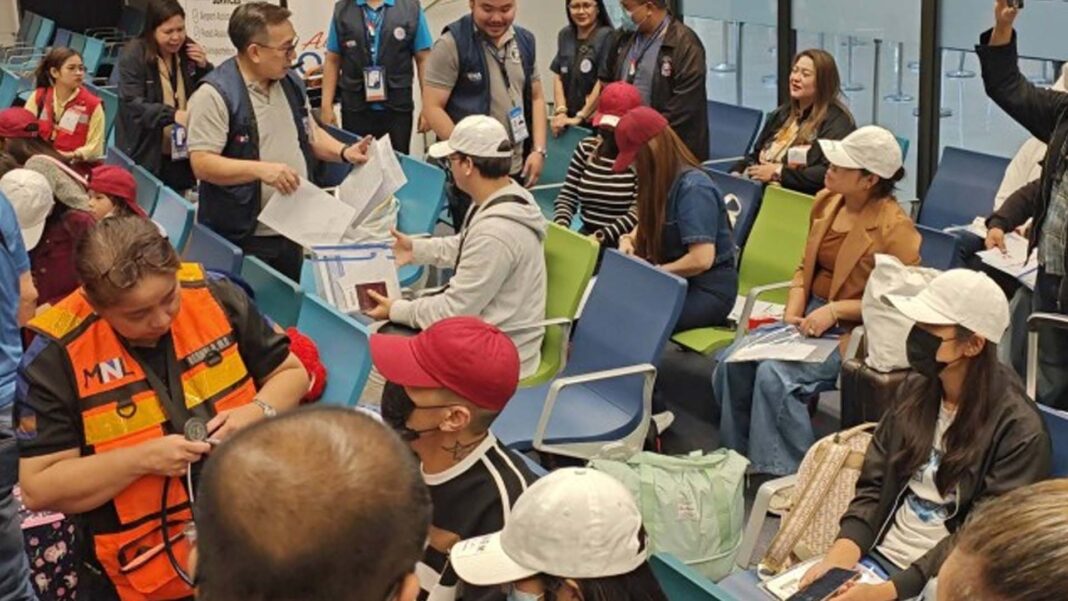

A total of 4,608 overseas Filipino workers (OFWs), as of Tuesday, have received various types of assistance from the Philippine government amid the escalating regional tension in the Middle East, Migrant Workers Secretary Hans Leo Cacdac said.
In his presentation at a joint hearing of the House Committees on Overseas Workers Affairs and Foreign Affairs on the impact of the United States/Israel and Iran conflict on OFWs on Wednesday, Cacdac said the DMW and the Overseas Workers Welfare Administration (OWWA) have been on the ground providing various forms of support, including temporary accommodation, financial aid, food and basic necessities and psychosocial services, both in in conflict-affected areas and transit hubs in Hong Kong, Singapore, Malaysia, Manchester, United Kingdom and Ethiopia.
“Thus far, 4,600 ang natulungan natin. It could be the case na yung 4,600 na yan ay one or two or three modes of assistance ang naibigay natin. Maaring nadala natin to temporary accommodation, maaring na-repatriate natin, maaring nabigyan ng pagkain (that the 4,600 were given one, two, or three modes of assistance. We may have provided them with temporary accommodation, we may have repatriated them, we may have given them food). So it need not be one form of assistance lang per person,” Cacdac said.
He said the DMW is also coordinating with the Department of Foreign Affairs to help Filipinos in areas without Migrant Workers Offices (MWOs), including OFWs who were traveling as tourists when the tensions escalated.
In host countries with designated shelters during emergencies like Bahrain, Israel and Qatar, Cacdac said Philippine officials are coordinating closely with these facilities to ensure the welfare of OFWs.
He said the Philippine government also provides backup support, including temporary accommodation, food, water, and financial assistance, particularly for workers whose employment has been disrupted.
Cacdac said at least 380 OFWs have so far requested repatriation from the region.
“We get the requests, and we’re braced to repatriate. Those who are ready at this stage would be 380,” he said.
Cacdac assured the government is preparing two chartered flights, as directed by President Ferdinand R. Marcos Jr., to assist those who wish to return home.
He explained that at this time, repatriation efforts remain challenging due to limited airspace in several countries in the region.
“The reality is, with the closure of the airspace, because we’re looking at Kuwait, Bahrain, Qatar, UAE, and Israel, the reality is four of those five countries, except for the UAE, ay hindi regular ang flights (have no regular flights),” he said.
For now, Cacdac said the DMW, OWWA and the DFA assist OFWs and cross them over land.
“All the border crossings are identified per each of the five countries, and we have teams that will bring them to the border and teams that will receive them on the other side. Naka-pre-position na po yung ating teams (Out teams have been pre-positioned in areas) that surround these countries,” he said.
For the OWWA side, Caunan said rapid response teams were deployed to critical areas in the Middle East as early as March 2, adding that the government has already released funds from the emergency repatriation fund.
Caunan said OWWA is expanding its hotline1348 operations, and the government’s e-report platform is currently being used to process requests for assistance and repatriation.
She said the ERF under the General Appropriations Act is at PHP1.2 billion, with nearly 20 percent utilized as operations continue. (PNA)