


Despite challenges in the agricultural sector, the Department of Agriculture (DA) has cited long-term gains as it advances reforms in infrastructure and the entire food value chain in the Philippines.
These milestones are part of the Marcos administration’s food security agenda to benefit both Filipino food producers and consumers, even amid external pressures including the Middle East conflict, global price spikes of oil and fertilizers, as well as the El Niño phenomenon.
In an interview ahead of the 5th State of the Nation Address (SONA) of President Ferdinand R. Marcos Jr., DA Secretary Francisco Tiu Laurel Jr. stressed significant gains with the government’s prioritization of the agricultural sector.
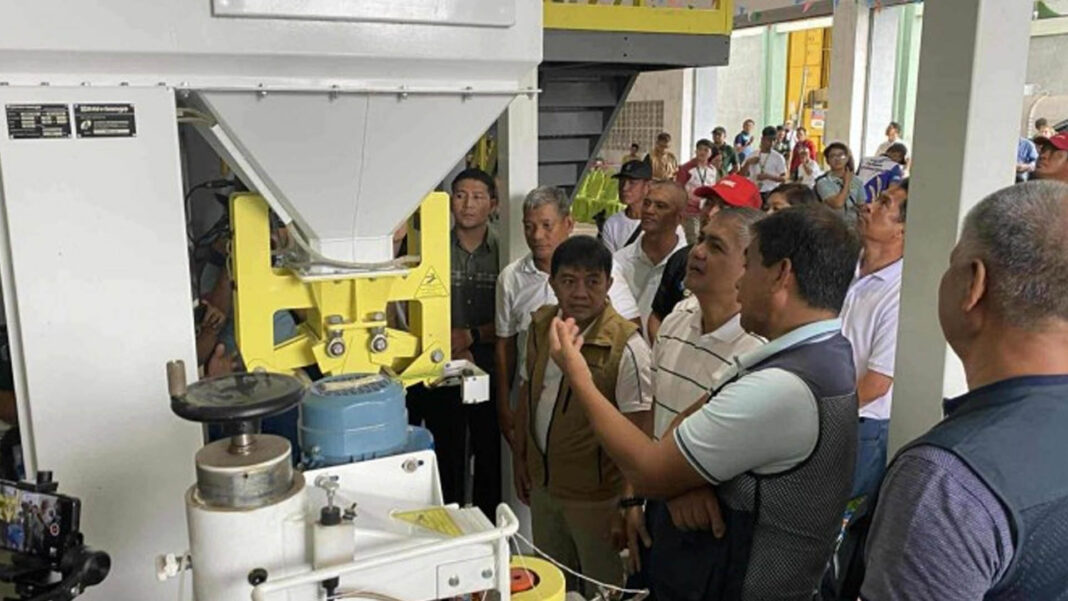
“We’ve built the most number of rice processing systems (RPS) in the history of our country in a short span of time,” he said on the sidelines of the Economic Journalists Association of the Philippines’ (EJAP) Food Security Forum on Thursday.
RPS units are considered significant in sustaining the competitiveness of Filipino palay (unhusked rice) farmers, as these help dry and mill rice to meet competitive quality standards.
This means Filipino farmers may be protected from unscrupulous rice traders who may take advantage of them through plunging farmgate prices for wet or fresh palay, especially during wet harvest season.
According to the Presidential Communications Office (PCO), government records showed that some 145 Rice Processing Systems (RPS) were turned over as of June.
These have benefited 145 beneficiaries nationwide since July 2022, under the Rice Competitiveness Enhancement Fund (RCEF) Mechanization program.
Besides RPS, Tiu Laurel mentioned other key achievements in major infrastructure projects which have “rarely trended online.”
“The biggest reforms, however, rarely become headlines. Mechanical dryers, modern rice mills, cold-chain facilities, mobile soil laboratories, greenhouses, seed storage, irrigation systems, stock farms, mega hatcheries– None will really trend online. All reduce waste, raise incomes and lower food prices,” he said.
To date, the Marcos administration has already distributed about PHP21 billion worth of agricultural machinery nationwide, according to the PCO.
These cover 15,126 pieces of machinery distributed to around 1.28 million farmer-beneficiaries, 7,715 farmers’ cooperatives and associations, and 507 local government units (LGUs).
“Then, we have a mega cold storage, and we’ve built up a lot of modular cold storages,” Tiu Laurel said.
Among these are the Mega Cold Storage Warehouse in Camarines Sur, Modular Cold Storage Facility in Bataan, and Onion Cold Storage Facility in Isabela, among others.
The construction, procurement, and pre-implementation activities for 67 modular cold storage units are still underway.
The DA chief attributed the infrastructure gains to boosted agricultural investment, with the increased funding.
“Today, it is roughly PHP215 billion– still not enough but finally moving in the right direction. Investment is where reform begins,” Tiu Laurel said.
This is higher than the PHP117 billion allocated when Marcos assumed office in 2022.
More affordable food
Besides long-term gains, the DA chief also mentioned short-term programs that helped cushion the impact of external pressures in food inflation.
“Rice prices eased. Food inflation slowed; still high, it is low already– until conflict in the Middle East pushed global oil prices higher,” Tiu Laurel said in a separate speech.
“Through calibrated rice importation, expanded Kadiwa stores, the maximum suggested retail price, stronger NFA buffer stocks, sustained production support, and the rollout of the PHP20-per-kilo rice program, agriculture helped create room for the central bank to lower interest rates at that time.”
Since its launch in May 2025, an estimated 12.1 million beneficiaries have enjoyed access to the affordable rice nationwide.
Among the beneficiaries are members of the Pantawid Pamilyang Pilipino program (4Ps), persons with disabilities, solo parents, minimum wage earners, public transport workers, indigents, and registered farmers and fisherfolk.
At least 121,271 metric tons of rice have been sold under the Benteng Bigas Meron Na (BBM Na) program, amounting to PHP2.4 billion in sales.
To date, the DA is continuously expanding the P20 rice program and will remain in place until 2028.
Besides cheaper rice, Tiu Laurel also mentioned price stability in onions and sugar, which have previously incurred historic price spikes in late 2022.
“The costs of vegetables are more stable, wala na tayong PHP600 na onion (we don’t have PHP600 per kilo onions anymore),” Tiu Laurel said.
To date, sugar prices are also at PHP80 per kilo, lower than the PHP140 per kilo in previous years.
Prices of livestock products are also stable as the government intensified its efforts against African swine fever (ASF), imposed a previous maximum suggested retail price (MSRP) for pork, and sustained continuous support to hog raisers.
The previous pork MSRP was pegged at PHP370 per kilo of liempo and PHP330 per kilo of kasim and pigue.
In 2025, the government also enacted the Animal Industry Development and Competitiveness Act (AIDCA), which is seen to boost animal health, as well as recover and combat ASF through repopulation and more stringent production policies.
Under the law, at least PHP20 billion in funds will be allocated for the hog industry per year.
On top of food affordability, Tiu Laurel also mentioned continuous growth in agriculture and fisheries, as well as a lower trade deficit with the boosted Philippine exports.
In 2025, the agrifishery sector grew by 2.6 percent, the fastest in eight years.
The agricultural trade deficit, meanwhile, narrowed by 34.7 percent in April, according to the Philippine Statistics Authority (PSA).
This is equivalent to USD600.09 million, lower than the USD919.64 million recorded in the same period last year.
“The gap is gradually narrowing as exports of higher-value products-durian, cacao, avocado, and traditional export winners such as coconut, banana, mango, and pineapple are accessing newer markets,” Tiu Laurel said.
The Philippines, likewise, logged a historic high in agricultural exports, reaching USD1.029 billion in April amid the DA’s intensified global market expansion campaign.
The value represents a 33.2-percent increase from the USD772.68 million in agricultural exports recorded in April 2025.
Among the cited top commodity groups are animal, vegetable, or microbial fats and oils and their cleavage products; prepared edible fats; and animal or vegetable waxes.
Moreover, Tiu Laurel said these agricultural gains shall be further strengthened with enhanced transparency, digitalization, and integration of artificial intelligence (AI) within the agri systems.
On Wednesday, the DA launched the country’s centralized agriculture data under the Agriculture-based Central Data Ecosystem (AbCDE) Project.
The project, implemented in partnership with the South Korean government, seeks to advance smart governance in the Philippines’ agricultural sector. (PNA)