

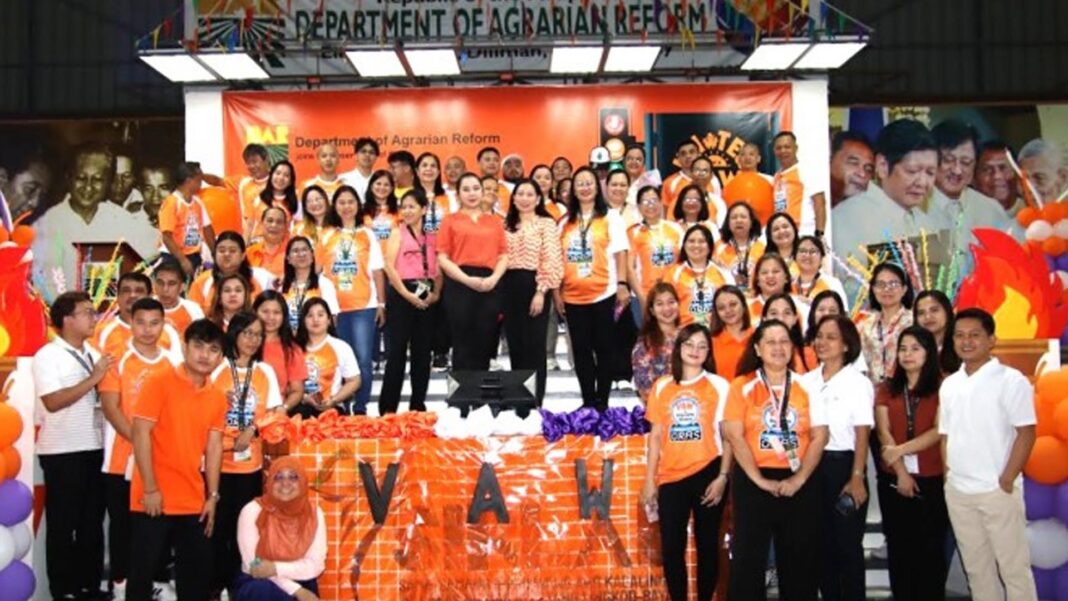

The Department of Agrarian Reform (DAR) has underscored the need for stronger protection systems for women and girls in the agrarian reform communities as the agency launched its 2025 18-Day Campaign to End Violence Against Women (VAW).
In a news release on Wednesday, the DAR called on its personnel, partners and the public to actively participate in the nationwide observance in line with Republic Act 10398 or the National Consciousness Day for the Elimination of Violence Against Women and Children.
“Ending violence against women begins with awareness, but it is sustained by collective action. At DAR, we stand united to create safer, more inclusive spaces where every woman can live with dignity and without fear,” DAR Assistant Secretary Vinci Beltran said.
Undersecretary Amihilda Sangcopan, chairperson of the DAR National Gender and Development Executive Committee, led the kickoff event on Tuesday in Quezon City, where employees pledged their commitment to end VAW and wore orange shirts as a symbol of solidarity and hope.
The 18-Day VAW campaign will run until Dec. 12 with the theme “United for a VAW-Free Philippines.”
The DAR said this year’s agency observance highlights the role of government institutions in preventing gender-based violence and ensuring that rural women can access justice and support services.
It said that women and girls in the agrarian reform sector still face heightened risks due to social, economic, and geographic vulnerabilities.
Among the events connected with the campaign are activities that aim to broaden awareness and encourage conversations on violence, gender inequality and community action.
Philippine Commission on Women Executive Director Nharleen Santos-Millar, in her message delivered by DAR Director Agnes Mendoza, emphasized that addressing gender inequality strengthens protection mechanisms and empowers women to claim their rights.
She also called for sustained, systematic action that safeguards the full and equal human rights of women and children.
“We need a long-term, systemic, and comprehensive approach that recognizes and protects women’s and children’s full and equal human rights,” she said. (PNA)